
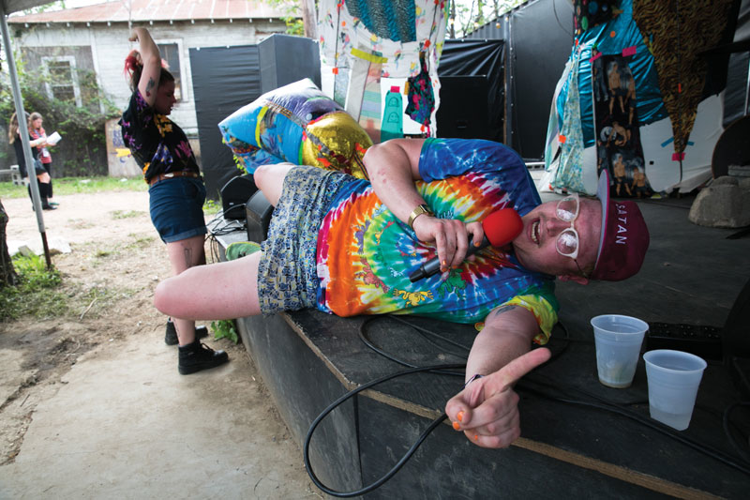
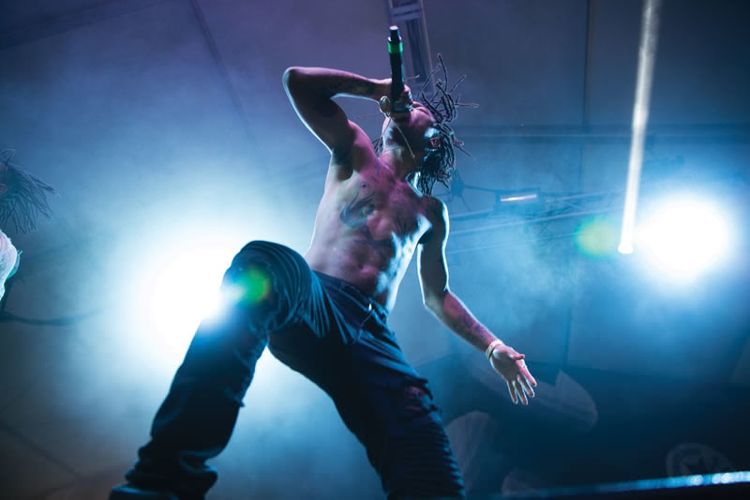
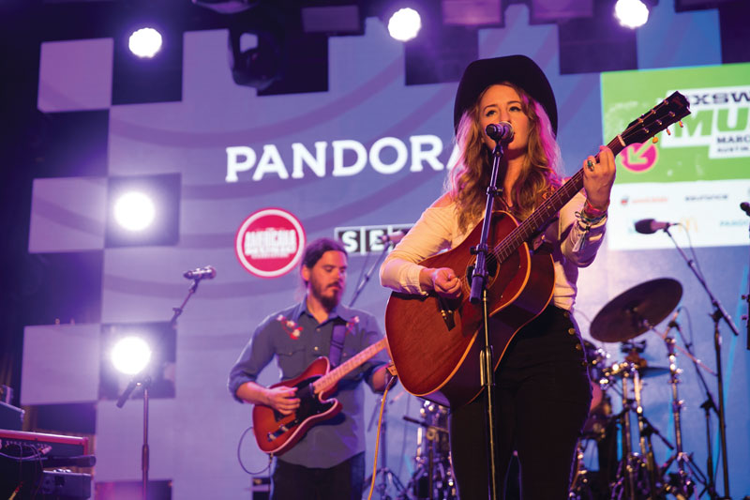
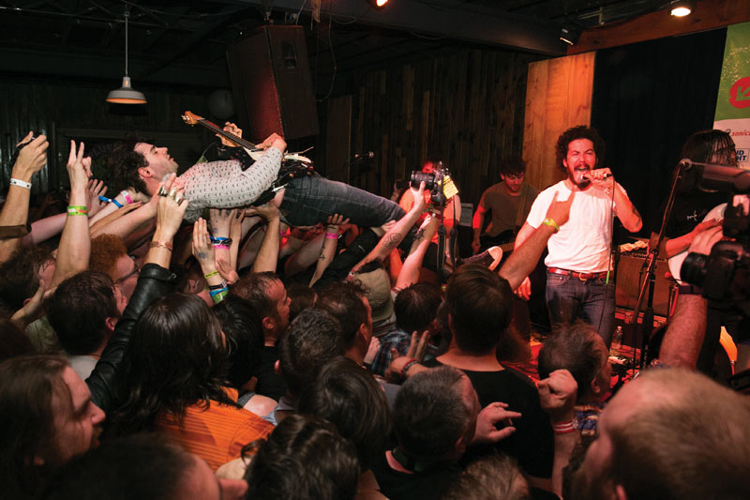

While it's 2016 and anything can happen, a band can probably never count on playing the big rooms with a name like PWR BTTM. "Our band is called PWR BTTM, so I'll let you tweet your own joke about that," the Brooklyn self-identifying queer-punk duo's sometimes-singer-guitarist, sometimes-singer-drummer Ben Hopkins joked between songs late Thursday afternoon, when I'd found myself squeezed sardine-like into a small overflowing bar called Cheer Up Charlie's in Austin, Texas, taking in the band's set.
It was my first day of my seventh year attending the annual SXSW interactive media and music festival and conference, the music portion of which, now in its 30th year, kicked off two days earlier on March 15. This was my first time seeing PWR BTTM, a band I had only a cursory knowledge of but was nonetheless curious about. I hadn't planned on seeing this performance. Despite my at-times-half-hearted efforts to schedule my musical intake down to the minute — as SXSW features thousands of bands playing turn-and-burn performances morning, noon and night at hundreds of venues of varying diviness — I'd stumbled upon this gig, a 20-something-hipster-teeming day party hosted by cool-kids-daily-read blog Brooklyn Vegan. I'm glad I did. Sporting glitter and face paint and mocking many of rock's formalities, PWR BTTM is a fun band — and like Don Caballero covering Blink-182, they're musically interesting to boot, even when singing tossed-off, sardonic pop ditties espousing the simple pleasures of taking showers and overindulging in carbohydrates. The songs are catchy, but when it comes to pure entertainment value, overshadowed by Hopkins and bandmate Liv Bruce's catty cable-comedy-ready stage banter.
"South-by is one long excuse to be a big bitch to people," Bruce observed, to knowing chuckles in the crowd. "A lot of people think SX is about music and art, but what it's really about is survival."
While Bruce was only joking, there's more than a little bit of truth in that line. Yes, in the arena of first-world problems SXSW offers no shortage of small plights for entitled types to grouse about — long one-in-one-out lines, too much traffic, lost Uber drivers, too little bandwidth, dying iPhone batteries, the horror. But two years ago at SXSW, on March 13, 2014, it was a life-or-death situation for a crowd of people queued up outside Cheer Up's next-door-neighboring club Mohawk, where a fleeing motorist plowed into a crowd, killing four and injuring dozens more.
The deadly crash — combined with criticisms over the festival losing its way, going from a small-town, music industry-centric trade show for discovering buzz-building up-and-coming artists, to an unwieldy onslaught of unofficial parties taking up real estate in a Times Square-like sensory overload of branding efforts pumped out by corporate sponsors paying top-dollar guarantees to superstars like Lady Gaga, Jay Z, Kanye West and Prince — led many to wonder about SXSW's ultimate survival.
"If you want to know how far the South by Southwest Music Festival has strayed from its anti-corporate, indie-rock roots, you need only consider this: One of the most popular shows on the final night of the festival was Justin Timberlake, playing a concert sponsored by Chevrolet to promote the newly revamped Myspace Web site," wrote The New York Times' James C. McKinley Jr.
Opening the floodgates to corporate sponsors, somewhat ironically, proved a bad branding exercise for SXSW itself. So last year, with help from the city of Austin — which, in the wake of the 2014 deaths, granted roughly 25 percent fewer event permits — the festival hit the reset button, scaling things back in an effort to rein the festival closer to its roots. The result was a South-by that was noticeably more chill, with fewer eyesores like the heroically mocked Doritos vending machine stage dotting the horizon.
This year, rapper Drake — who made a not-so-surprising surprise appearance at the Converse-sponsored, uber-exclusive, mega-hip Fader Fort — was the only big star (save for the Obamas) to descend on the festival. Hours before the gig, my colleague Lance Conzett made a wise decision. "Do I stand around waiting for Drake?" he wrote in his coverage, "Or do I see 15 other bands instead? With respect to Drizzy, I chose the quantity option."
At SXSW 2012, I saw indie-rock heroes Built to Spill, hall-of-famers Bruce Springsteen and the E Street Band, and dream-pop pioneers Jesus and Mary Chain perform within hours of each other, leading to one of the most pinch-self-inducing days of concert-going life. It was wonderful, and entirely not what SXSW is supposed to be about. I didn't discover a single new artist that day.
Like most music critics, I'm not above comparing artists to their influences as a shorthand, especially in a situation like SXSW, where I'm seeing a dozen or so bands a day. And it comes in handy when I leaf through, see "Flickerstick-esque" written next to a band name and remember why that band isn't worth writing about. But save for reality TV's finest, the comparison artists littering my notes would make a pretty impressive festival lineup: Nick Cave, DEVO, Yeah Yeah Yeahs, Sun Ra, The Cure, The Fall, Nirvana and so on. Though I saw a lot of great bands this year, I wouldn't go so far as saying I saw the next Nirvana, but I did see Demob Happy, a great British band that aspires to sound a helluva lot like Nirvana did on their sludgier days. Demob rocked in the middle of the crowd on the floor of Barracuda, where Nashville's favorite punk label Infinity Cat was hosting a showcase in conjunction with English label Fluffer.
Last year, I saw actual bona-fide shoegaze legends Swervedriver at SXSW. This year I saw a half-dozen bands that sound like Swervedriver. Among the best of that lot was L.A.'s Tracy Bryant, who held an attentive crowd at Hotel Vegas with a set of surfy '90s psych. On the same bill — an all-day, multi-stage rock blowout hosted by Burger Records — I was just as impressed by Israeli aggressive space-rock trio Vaadat Charigim. For my money, neither band held a candle to IAN, a Brooklyn-by-way-of-Boston trio who, clearly years younger than many, blew me away at Cheer Up Charlie's with a heroic approximation of the kind of mathy, emotive Midwestern indie rock I obsessed over in the '90s. IAN was a new discovery for me, and one I enjoyed way more than still-fun-as-hell peppy Seattle art punks Tacocat — the band I was there to see.
Late Friday afternoon, after taking in an excellent should've-been-better-attended set from eclectic Virginia alt-folkies Thao and the Get Down Stay Down — who justified a criminally long line-check with note-perfect renditions of standouts from their stellar new LP A Man Alive — I trekked out to Auditorium Shores, a massive outdoor expanse where SXSW hosts its annual free, no-badge-or-wristband-required shows. At Auditorium Shores, a triple-wide Nordstrom booth competed for attention with the Mazda T-Shirt Creation Station. Neither was a match for Hostess, which gave music fans an opportunity to ride the amazing mechanical Bucking #Twinkiebull. But while the spirit of SX-style corporate marketing was alive and well, the surprisingly sparse crowd was kind of dead. That surprised me, as I was there to catch Philadelphia rockers Beach Slang, one of the more buzzed-about bands of SXSW 2016. "This place is gigantic, thanks for filling some of it up for us," frontman James Alex bantered early on. Basically, Beach Slang is to The Replacements as Oasis is to The Beatles. Taking one on the the nose, they even cover the Mats' classic "Bastards of Young."
Unless the band is named Goo Goo Dolls, I'm mostly a sucker for a good Mats knockoff, so I dug the hell out of Beach Slang's set. But I couldn't help but wonder if it was the incoming lightning storm that drove crowds away from Auditorium Shores, or the fact that the night's headliner was somehow-still-a-thing Sabbath-aping Aussies Wolfmother. There's perhaps no better band to represent the embalming fluid that's filling the corpse of rock 'n' roll these days. In 2016, more so than in recent years, and perhaps more like at the festival's inception, SXSW still is, ultimately, about discovering new music. But how much new music really sounds all that new?
This was my train of thought Saturday afternoon as I found myself back at Cheer Up Charlie's watching a set from Detroit neo-post-punks Protomartyr, who sound like low-fi Ohio anthem-crafters Times New Viking as fronted by The Fall's Mark E. Smith. Sure, I couldn't believe that less than an hour earlier, Bill Murray stopped by the venue specifically to catch a set from Margo Price, and waiting in a slow-moving line, I just barely missed it. But I was also fatigued at the thought of spending the rest of the day seeing bands I'd have to describe with some variation of "garage this" or "punk that" — I was hankering for something different. It was then that a friend let me tag along with some folks I'd never met on a cross-town cab ride to see a band I'd never heard of, described to me as some kind of colorful 15-piece free-jazz ensemble. Local Austin Afrobeat psychedelic avant-funk collective Golden Dawn Arkestra wasn't free jazz, but with killer tunes, infectious grooves, synthesizers, vocoders, face paint, colorful capes and trippy choreography, the band (shockingly so fully realized in vision despite being so far under the radar) was far and away my most inspiring discovery of SXSW 2016 — a band I knew absolutely nothing about but saw on a whim.
Discovering Golden Dawn Arkestra was a very South-by experience for a music fan. So is it SXSW that's changed, or is it really the culture of music that's changed, with the festival trying to keep up?
In 2010, when I started attending the festival, and even in more recent years than that, Sixth Street was still the epicenter of the SXSW. These days, it seems few official events, and even fewer hip parties, go down on Austin's equivalent of Lower Broad. Yet Sixth is more crowded than ever, teeming shoulder to shoulder with spring breakers, Texas youth and hypervigilant cops who show little interest in the music event. I ended up braving the crowds en route to the one show I hit up on the main strip of Sixth, when on Thursday night I checked the nostalgia box and went to see '90s pop-punk gods NOFX play a pool hall, Buffalo Billiards. The show was a blast, but navigating the crowds at 3 a.m. on the way back was a nightmare.
Luckily, I was miles away on the east side of town, sandwiched in the middle of a beer-drenched pogoing crowd watching California freak-rockers Thee Oh Sees — at this point a flagship band for the festival — close out SXSW 2016 when a confrontation erupted and shots were fired on Sixth Street. With the festival's more desirable events having long moved to other areas of the city, I wasn't surprised to find that nobody I know was in the vicinity when the shooting happened. In fact, I was back in Nashville when I learned of it. Nobody was hurt, but it was another bit of bad press that will dog the festival moving forward.
EMAIL MUSIC@NASHVILLESCENE.COM



