
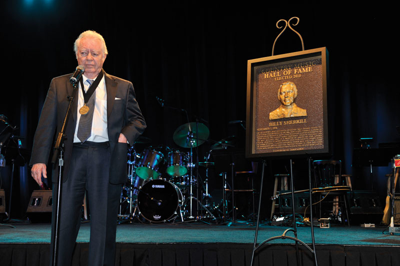


Billy Sherrill being elected to The Country Music Hall of Fame in 2010.
text-autospace:none"> Billy Sherrill, who died Tuesday, Aug. 4, in Nashville at age 78, was one of the greatest producers in country music history, and he put his stamp on everything he did while making records that were unabashedly commercial. On the recordings he created with such superb singers as Tammy Wynette, George Jones and Charlie Rich, Sherrill turned country into a sophisticated form in much the same way as Phil Spector did with rock 'n' roll. Originally an R&B fan, Sherrill applied timeless musical values to country at a time when it was searching for ways to reach a wider audience. Some listeners and critics perceived his use of strings and background singers as a dilution of country’s message, but Sherrill’s marriage of emotionalism and sophistication would become part of the music’s vocabulary.
He was born Billy Norris Sherrill on Nov. 5, 1936, in Phil Campbell, Ala. His father was an evangelist, and Sherrill played piano in church. He soon switched to saxophone and the more lucrative field of rock ’n’ roll, as he told writer Dan Daley in 2002. “My dad was being paid in cabbages and pigs, milk and fruit,” Sherrill said. “There wasn't a whole lot of money in church music, but there was some in rock 'n' roll.” He met fellow Alabama-bred R&B enthusiast Rick Hall, and they formed a rock ’n’ roll quintet The Fairlanes.
The First Lady of Country Music
1968 Charts:
#1 (3 Weeks) Us C/W
#19 Us Hot 100
#11 Us A/C
#1 Can C/W
#15 Can Top Singles
#9 Australian Go-Set
1975 Charts:
#1 Uk Top Singles
#1 Irish Singles
#1 Dutch Top 40
#31 New Zealand Singles
Sherrill and Hall would write songs for Homer and Jethro and Brenda Lee before forming the Florence Alabama Music Enterprises publishing company, better known as FAME. The two men parted ways in 1960.
Sherrill came to Nashville in 1962. He was playing in a band in Alabama when he received a $4,000 royalty check for a song he had written, “Your Sweet Love.” He and a couple of friends started a demo studio in downtown Nashville, and Sun Records founder Sam Phillips bought it. Sherrill began working for Epic Records in 1963.
At Epic, Sherrill cut Tammy Wynette’s 1966 track, “Apartment #9,” and went on to co-write her epochal 1968 hit “Stand by Your Man.” He produced Rich’s 1970 The Fabulous Charlie Rich and Boss Man LPs before helming the singer’s 1973 “Behind Closed Doors” and “The Most Beautiful Girl.”
country video
Sherrill’s perfectionist tendencies helped make such George Jones recordings as “We Can Make It” and the Bobby Braddock-penned “Nothing Ever Hurt Me (Half as Bad as Losing You)” both commercial and idiosyncratic. One of country’s finest songwriters, Braddock remembers Sherrill as a brilliant, elusive figure.
“He was kind of reclusive,” Braddock tells the Scene. “Not everybody gained admission to that inner sanctum, and I was very fortunate to be one of those who was. I couldn’t even begin to say the huge impact he had on my life as a songwriter.”
written by Bobby Braddock
Nashville-born soul singer Freddie North sang demos at sessions Sherrill engineered in the ’60s, and North cut the first version of Jerry Williams Jr. and Gary “U.S.” Bonds’ “She’s All I Got” in 1971, before Sherrill recorded the song with Johnny Paycheck. North was working at Nashboro Records as the record was about to be released. “I still couldn’t tell you how Billy had heard it,” North says. “He called me at the office and he said, ‘Freddie, listen, I understand you’re gonna have a release pretty soon on that record, and I’m going to give you three weeks head start, and then I’m covering that record.’ ”
In the ’70s, Sherrill worked with Wynette, Jones, Jody Miller and Tanya Tucker. He oversaw Jones’ 1980 recording of Braddock and Curly Putman’s “He Stopped Loving Her Today,” widely considered one of country’s greatest singles.
Sherrill produced Elvis Costello’s 1981 country endeavor Almost Blue, and left Epic four years later. His reputation as an enigmatic maverick increased after his retirement. Sherrill was known as a sharp wit, and he rarely attended industry events. He was inducted into the Country Music Hall of Fame in 2010 and received BMI’s prestigious Icon Award the same year.
The new deluxe album ‘Look Now’ out now, order here: https://ElvisCostello.lnk.to/LookNow
Explore more music from Elvis Costello: https://lnk.to/wWTFS
Music video by Elvis Costello & The Attractions performing Good Year For The Roses. (C) 1981 Elvis Costello
Sherrill’s use of strings and background vocals came out of his desire to create interesting music. Talking to writer Barry Mazor in 2010 about his use of a saxophone on a 1984 George Jones and Brenda Lee song, “Hallelujah I Love You So,” Sherrill said the experimentation was justified.
“I got a call from George Jones and he said, 'Well, you have just killed me. . . . You put that damned sax on the record; my people don't like saxophones.' And I said, 'But I do!' And it was a pretty good hit, so he came around, too."
Sherrill died after a short illness. He leaves behind his wife, Charlene, a daughter, Catherine Lale, and two grandchildren. Funeral arrangements are pending at press time.



