
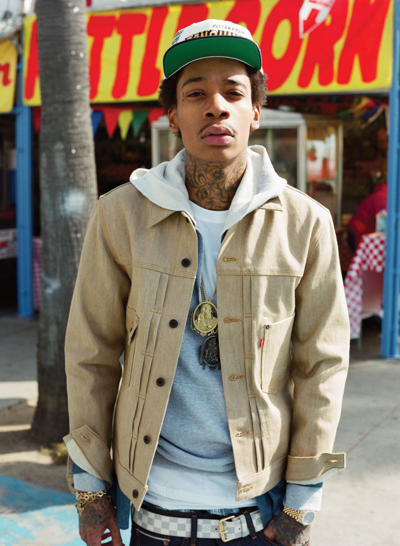
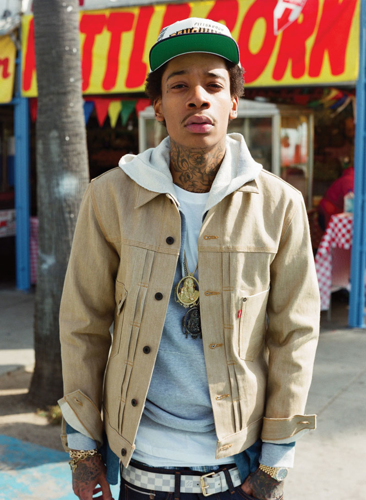
Earlier this year, I saw the Pittsburgh rapper Wiz Khalifa perform for more than 5,000 people on a surprisingly cold April night in downtown Raleigh, N.C. Khalifa had never performed in Raleigh, but thanks to a groundswell of collegiate support and his then-new rise to the radio, the sell-out crowd met the unabashed stoner rapper with unbridled enthusiasm.
But Khalifa didn't overcompensate: There was no major light show, no huge dance troupe and no emphasis on magnificent production. Khalifa just stood center-stage most of the night, rapping, singing, dancing and telling jokes. His idea of a grand gesture was taking his shirt off to reveal his tattoo-canvassed body or, occasionally, thrusting his hips toward the crowd. Aside from the size of his stage and the sound of his songs, he seemed mostly like someone you'd say hello to at the supermarket.
Indeed, outside of the hip-hop cognoscenti, Khalifa is best known for a pair of songs (found back to back on his major label debut, the excellent and adventurous Rolling Papers) that deal with topics you've probably often considered — sports, sex, money and friends in bad situations. The first of those songs, "Black and Yellow," is an anthem about ambition and acquisition — "Everything I do, I do it big," he chants, stretching that all-important final word for a full second. The song has also become a de facto anthem for the Pittsburgh Steelers, the rough-and-tumble team of Khalifa's hometown. He released the single in September, just as football season started, and issued the video — featuring the rapper at home in Pittsburgh, wearing a Super Bowl-emblazoned ring — during a mid-season Steelers bye week, as if to keep his city's eye on the prize. A few months later, he performed the song ahead of the AFC Championship, where his Steelers bested the New York Jets to head to the Super Bowl. "I took that hometown pride," he said, "and put it in a song."
As with "Black and Yellow," the Norwegian duo Stargate produced the next track on Rolling Papers, "Roll Up," a slab of swooping synthesizers and drums custom-made for handclaps. Like "Black and Yellow," it's a hit, driven not just by the sound but by the sentiment. Where "Black and Yellow" equates hometown pride and the quest for victory with getting rich and living big, "Roll Up" is about a special relationship between two people that serves a restorative purpose when everything else in life is going poorly. She's part of a controlling relationship filled with drama and fights, even on her anniversary. He's the bad boy, the escape who excuses the affair as her liberation. With a hook that sounds more like a nursery rhyme for adults, Khalifa memorably sings, "Whenever you need me, whenever you want me, you know you can call me / I'll be there shortly."
Earlier this year, Khalifa — a military brat who lived abroad before returning to Pittsburgh — told Matt Diehl at Interview Magazine that rapping was his way of fitting in as a teenager. He didn't expect it to be a career, let alone something that's steadily making him a superstar. "I just try to keep that connection to normalcy. I never want to lose that," Khalifa told Diehl. "People connect with me just as a cool, around-the-way type of guy. I never want to confuse people or go over their heads."
In Steelers parlance, then, touchdown.
Email music@nashvillescene.com.



