
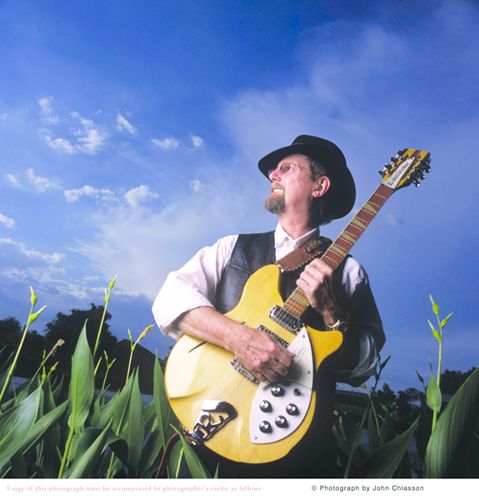
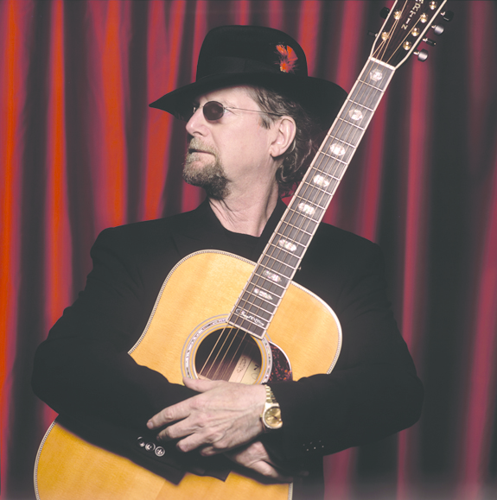

Though he helped provide a new direction for rock in the mid-'60s, singer and songwriter Roger McGuinn has always considered himself first and foremost a folk musician. His brilliant 12-string Rickenbacker guitar style — a mix of rippling chordal flurries and the innovative atonality normally associated with avant-garde jazz musicians — coupled with soaring leads and extensive vocal range, proved key ingredients in The Byrds' revolutionary sound.
McGuinn credits Miles Davis with helping elevate his band's fortunes. "I never met Miles, but one of the people in his management group knew our producer," McGuinn says. "His daughter had heard about us, and then Miles encouraged the people at Columbia to take a chance on us. He told them that was the music young people were listening to, rather than what was on their label. They signed us and gave us a one-song deal. Then they sat on the single for months."
The tune McGuinn and comrades David Crosby, Chris Hillman, Gene Clark and Michael Clarke cut was a cover of Bob Dylan's "Mr. Tambourine Man," rearranged from 2/4 to 4/4 time, with McGuinn's upfront vocal propelled by teeming harmonies and the unusual blend of 12-string guitars and ace support from the studio group known as The Wrecking Crew. Of course, in spite of Columbia's dilatory tactics, the song eventually became a massive hit.
During a nine-year stretch, McGuinn and various Byrds' cohorts created a number of memorable and influential albums and singles, blending the storytelling flair of folk and country with the expressiveness of rock and blues. They had another No. 1 hit with a magical version of Pete Seeger's "Turn! Turn! Turn!," while creating their own signature numbers like "Eight Miles High" and "So You Want to Be a Rock 'n' Roll Star."
But perhaps their most imaginative release, despite its meager commercial success, was Sweetheart of the Rodeo, a 1968 LP cut in Nashville It was their first full country project, and among other things it introduced Gram Parsons to a wider audience. The Byrds were also one of the first rock groups to appear at the Grand Ole Opry, an occasion McGuinn says wasn't quite as bad as some claim.
"There were indeed some folks attending The Byrds' appearance at the Grand Ole Opry who didn't seem to appreciate how sincere we were in doing country music," McGuinn says. "You have to remember, it was during the Vietnam War and we were perceived as hippies. But backstage was different. Skeeter Davis took us under her wing, and she was very kind."
"We had a great time in Nashville recording Sweetheart of the Rodeo," McGuinn says. "I've made many lifelong friends there and I consider it to be right up there with Los Angeles as one of the great music centers in the country, probably the best place anywhere for songwriters."
But since leaving the band in 1973, Roger McGuinn's career has been an intriguing blend of vintage sensibility and contemporary business acumen. Despite being a traditional folk champion, McGuinn has also been a proponent of utilizing advances in recording and engineering technology. The Byrds were among the first bands to use a Moog synthesizer, and McGuinn began downloading folk songs on the Internet in 1995.
"The problem has never been with technology in terms of music," McGuinn says. "It's the abuse of technology that's the problem. The same thing holds true with downloading. The music industry should have been in the forefront of downloading, embracing the technology and developing a system where people could do it and the artists could still benefit. Instead, they wasted years trying to sue people, and now the whole business model has been pretty much overturned."
Moreover, McGuinn says, technological advances have benefited artists in other ways. "So many opportunities have been opened up for music and musicians today that weren't around in the '60s," he says. "If I were advising anyone about a career in music today, I'd tell them to get a laptop and ProTools, a couple of good books about music theory, arranging and structure, and go to work. You don't need to go in debt to a big label to get your music out to an audience. ... I've released three recordings on my own label, and I've made more money with those than anything that I ever did on Columbia or Capitol."
From touring with Bob Dylan in the Rolling Thunder Revue during the mid-'70s to teaming with Chris Hillman and Gene Clark, opening for Tom Petty, making the acclaimed 1991 release Back From Rio and his ongoing Folk Den releases in the 21st century, Roger McGuinn has constantly celebrated his roots, yet kept looking forward. The Byrds were inducted into the Rock and Roll Hall of Fame in 1991.
"I really set out all those years ago to be a traditional folk musician," McGuinn says. "That's really what I love. But at the same time I've always thought you could still do different and unusual things working in that field. That's the area I want to emphasize now, and what I plan to keep doing for as long as I can."
Email music@nashvillescene.com.



