
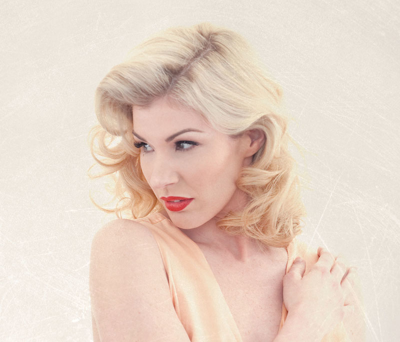
Consider for a moment just how friggin' many country careers have been launched by reality show singing competitions: Carrie Underwood, Chris Young, Scotty McCreery, Lauren Alaina, RaeLynn, Danielle Bradbery, Cassadee Pope, Craig Wayne Boyd, The Swon Brothers. ... And that's a radically abbreviated list. Then there's off-and-on Nashville resident Emily West, who saw season nine of America's Got Talent as an opportunity to leave her mainstream country past in the dust and completely rebrand herself as something of a cabaret singer. Odd move, right?
Well, it worked perfectly for West, a charismatic interpretive singer and beguiling show-biz cut-up who speaks of authenticity in exalted terms, even as she embraces a performing tradition of grand theatricality — of Judy Garland, Bette Midler, Barbra Streisand, even Cyndi Lauper. West didn't win the TV competition outright, but she did win over a host of new fans unfamiliar with the period of her career when she was cast as a next-generation Faith Hill.
They and the listeners who've stuck with West since her first subtly torchy overtures toward country stardom are finally getting a full-length album from her, the lushly orchestrated All For You, parts of it written with local songsmith k.s. Rhoads and all but the philharmonic overdubs recorded here with producer Dustin Ransom.
You've said that going on a reality TV singing competition actually allowed you to be more yourself musically. That's not most people's view of reality show competitions. Why was it that way for you? It was kind of like my only chance I had left. I really believed that. ... Of course, I'm not gonna sing anything that I don't believe in. I think they have a really great collection of producers and people working on the show that were really excited about what I did naturally. With that, I got what I wanted, which was a completely different sound from where I was coming from, country music.
When I was in country music, everyone was kind of saying, "You're not country. You're not a country artist. You should be on Broadway," or "You should go do the New York circuit." ... I just love a good story with a beautiful melody. I have a problem with being boxed in. ... Going on the show, it was a really great opportunity for me just to be completely different and to take a step into something completely new, and that was kind of like being this Jessica Rabbit something, where I got to sing in a really beautiful diamond dress and lift my hands in the air at Radio City Music Hall.
Why was Jessica Rabbit, a cartoon pinup, a point of reference for you? I think a lot of it was I'm really shy as an artist. ... I kind of had to invent a character. I'm not saying that it's not who I am. When I get onstage, I see myself becoming more of a woman than I am in real life, because I sing about heartache. ... When I say Jessica Rabbit, it's more just I morph into this one-woman show singer that sings about tragedy and love and codependency. So I use Jessica Rabbit because, as I'm singing a Tom Waits song, I'm wearing a Jessica Rabbit dress.
There's a YouTube video out there of you covering Patsy Cline's "Walkin' After Midnight" at age 8, which suggests you had torch-y leanings from the start. Absolutely. You know, Patsy, she wasn't really a country singer either; she was a pop singer. We consider her country, but she was a classic torch singer and she sang about every type of sadness imaginable. I cut my teeth on Patsy Cline. I moved to Nashville when I was 18, and I sang so much like Patsy that I had to, like, stop and figure out who I was, find my sweet spot.
There's quite a distance between the cabaret-ish thing you've moved into and what was happening in contemporary country when you were releasing singles in the latter half of the Aughts. I was probably the most depressed facing that country dream, that neon rainbow. I had a song that I released [in 2014] called "Made for the Radio," and I was so depressed at the time, because I was trying so hard to be somebody that I wasn't, trying to be this country star on the radio. No one was buying it, because to be honest, it wasn't authentically who I was. I was trying to sing like Carrie Underwood, or trying to sing songs I wasn't resonating with. I got really depressed, because that was my dream for so long, and then it wasn't working. Then I just stopped trying, and I just started writing songs from my heart and interpreting songs from my heart. That's when people started listening. I feel that boys and business and music are the same thing: If you start chasing 'em, no one wants anything to do with you.
Email music@nashvillescene.com



