
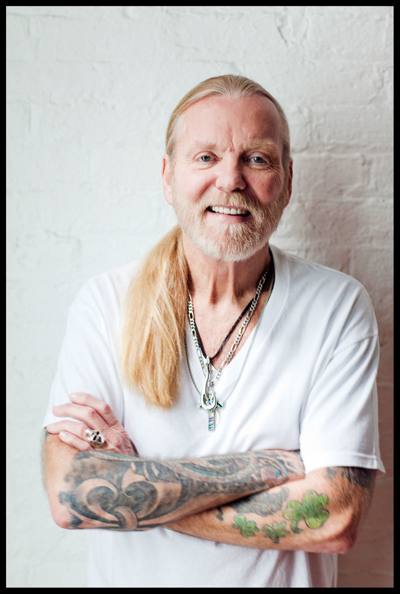


In this week's dead-tree edition of the Scene, I preview
Gregg Allman's upcoming Ryman showson Jan. 13 and 14. The Ryman dates will be a homecoming of sorts — he was born in Nashville at Saint Thomas Hospital, and spent his early years here. Allman spoke with the Scene by phone recently, and reminisced about his early days here, including a particularly memorable trip to Centennial Park that involved a jungle gym, some new cowboy boots, lost teeth and lots of blood. He also discussed his and Duane’s formative musical years, his Grammy nomination, his 2012 memoir My Cross to Bear and The Allman Brothers’ farewell show.
I was watching your Grammy-nominated performance of "Statesboro Blues" with Taj Mahal, and I AB'ed it with the 1971 At the Fillmore East version. Your voice pretty much sounds the same today as it sounded in 1971. That's partially because your voice is in good shape these days, but it's also partially that in 1971 you sounded like a 50-year-old bluesman, even though you were 23 years old. In fact, what blows me away about At the Fillmore East isn't just what a great album it is, but that you guys were in your early 20s. Why do you think that was? How did you all have that kind of musical maturity at such an early age?
I suppose it's because we studied that kind of music. We grew up with it, we lived it. That's the only kind of music we knew, or that we wanted to play.
Maybe there was something unique about the late 1960s and early ’70s that caused musicians to grow so quickly, like The Stones, The Beatles, Jimi Hendrix, Bob Dylan, Van Morrison and you guys. You all were in your early 20s, but sounded like fully formed musicians.
Fully formed? (Laughs)
It sounded like it. You had evolved and found your style at a very early age.
That we did.
Do you think there was something special about that era?
There could have been, but that's basically what they were playing back then. We used to go to these different nightclubs in Daytona Beach. One was after-hours, one was right under the pier. It was called the Surf Bar. There was a band there, all black dudes. And at the other club, called The Paradise Inn, it was the same thing. I learned to play from mostly black people, and at that time, that's what they played. And it was known as rhythm and blues. And to me it will always be rhythm and blues. And what's rhythm and blues now ain't nothing like it. What's rock ain't nothing like it used to be.
You know, we're all old-school. (Laughs)
What led to the decision to do a final Allman Brothers show, and to officially put the band to rest as it were?
I initiated it. At the 40th year [anniversary] that we did in ’07, I even thought about it then. I mean, 40 years is … wow. Ain't many bands that last that long. I figured it was enough. It's time to go onto something else. Finally everybody agreed with me, and we did it.
I heard some of the final Beacon Theater show on SiriusXM in my car. I didn't know that's what it was at first. I just turned it on. It had the urgency and the power of the early years, the Fillmore years. It sounded absolutely phenomenal. Was it a special moment? Was it an emotionally trying night, knowing it was the final one?
No, it wasn't trying at all. Actually, we were all just laughing and smiling. The first three rows (of fans) were tearing up. (Laughs.) We all just had a real good time at it. I guess it was the last six shows, so everybody was at their best.
You lived in Nashville for your early years. Do you still have a lot of memories of Nashville?
Oh, yeah. I sure do. I remember I went to Centennial Park once. I don't think I was even in school yet. I had these new cowboy boots, and I had to wear them, right? And my mama told me, "No, you gotta put on your sneakers." Because we'd go to the park and play on that big huge jungle gym, slides, all different kinds of stuff.
I fell from that big maze of bars — they called it a jungle gym back then. I fell from the top. And it knocked my baby teeth, my two front ones, it knocked 'em up into my gums. I had to have surgery to have them taken out. I went without two front teeth for about two years. (Laughs.) Finally, they had me an appointment where they were going to split the gum so the teeth would come through. And that morning, I got up to get ready to go and sure enough there was little tiny spot of white on my gums, and they went, alright! Teeth!
I remember vividly, because my grandma was with me, and remember her sitting there laughing. There was blood everywhere.
Did you get blood on your new boots too?
I'm sure I did. (Laughs.)
As far as being someone who's survived while a lot of people close to you haven't, is that a strange situation? Has there ever been any sense of guilt? Why me? Why am i the one still here? Or do you just take it in stride?
At first it kind of was. After Oakley went, we were all saying, "Why us?" It got real disheartening, but we got together and talked, and I said, "If we don't keep playing, we're all going to fall by the wayside." It was just something to hold onto, and everybody agreed. As hard as it may have been, we ventured on.
You talk a lot in your book about your whole experience at the Rock and Roll Hall of Fame induction — how you were still drinking really heavy and don't feel like you were even there for it. Does that make moments like your Grammy nomination more special?
Oh yeah. That goes for a lot of things, you know? For so long there I was just kind of half asleep. Actually, if it hadn't of been for the induction into the Hall of Fame, I don't know when I would have stopped. That was the final thing. I woke up the next day, and someone played me a tape of it, and I just went, "Wait a minute. Hold on, boy. It's time to stop this bullshit. Way past time." I'm thankful to God it happened.
Was writing the book a cathartic experience? Did you find it to be healing at all?
Well, it wasn't a book in the beginning. It was my journal. But yes, it really was. I had this guy who used to come to my house every Thursday who started taping it. I had written this by hand, and written a lot of it that I'd kept in my journal. I kept a journal because I figured if I ever got to be in a place where I couldn't play or sing anymore, an old dude sitting in a rocking chair on a front porch, I figured if I kept a journal, I could pick it up and go through a few pages and kind of relive it again.
My manager was at my house one day, and I had a duffel bag full of tapes. He said, "What's that?" I said, "My life." (Laughs.) He said, "Oh, really? Do you mind if I listen to some of it?" And i said, "No, go ahead."
He listened to, like, eight different tapes, and he said, "Man, you need to make a book out of this." I said, "Aw, c'mon. Are you kidding? I don't know where to start writing a book."
And he said, "Well, you've already started." Then he got Alan Light, and Alan Light helped me put it together. It was a good experience. It really was.
Going back to the loss of Duane and Berry, at that point, could have ever conceived that the band would go on for another 40 years after that?
Are you pretty excited about being nominated for the Grammy with Taj Mahal?
I really am. I just found out about yesterday. I said, "Wait a minute. Grammy?" I'd forgotten about the record. And I thought, what am I nominated for? My wife to be told me, "It's from the All My Friends gig." I was really elated because that was a real good concert. That was a magic night.
When you play in Nashville does it feel like a homecoming?
It does.
You've played the Ryman a few times, haven't you. Are you a fan of the Ryman?
I am. That place sounds good. I guess it's something about those church pews in there. Makes for good acoustics.
Who's in your touring band?
Pete Levin on piano, Scott Sharrard on guitar, Ron Johnson on bass, I'm playing hammond and guitar, Steve Potts from Memphis on drums, Marc Quinones on percussion, and three horn players: Marc Franklin on trumpet; Jay Collins plays baritone, tenor, soprano and flute; and Art Edmaiston, who used to play with Bobby "Blue" Bland, on tenor. Nine pieces counting me, and boy, they smoke.



