
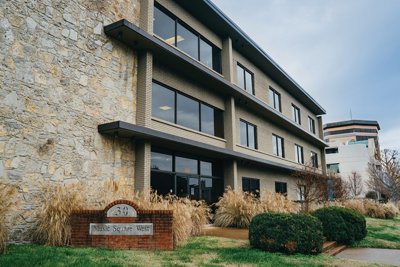

30 Music Square West
Thirty Music Square West — the building housing RCA Studio A — took a big step yesterday in its journey from
potential condo redevelopment atrocity to treasured Music Row landmark. The Tennessee State Review Board voted to endorse an application to place the building on the National Register of Historic Places. The application now awaits federal approval from the National Park Service, which could come come as early as this summer.
The 48-page nomination application was prepared by Carroll Van West at the MTSU Center for Historic Preservation and contains detailed information about the building’s structure, location, architecture and most fascinating (for die-hard music history nerds like myself), a 21-page narrative history of the building's first 25 of its now 50-year history, from its construction in 1965 until 1990.
Read on after the jump for some fun musical facts from the report, or pour through the whole damn thing right here.
- Chet Atkins’ vision of the studio was at least partly driven by a music industry perception that country music was a second-rate genre that only merited second-rate recording facilities. Atkins envisioned a studio that would match other major RCA facilities across the world, including recently built studios in Hollywood, Calif. and Rome, Italy.
- How Atkins partnered with his industry “rivals,” Owen and Harold Bradley, to build the new studio and office building that would make a statement about Nashville’s arrival as a major recording center on par with any in the world.
- The studio portion of the building was designed by RCA Victor general plant engineer, Alan Stevens, in collaboration with John E. Volkmann of RCA Laboratories. Volkmann had just recently designed the RCA Italiana studio in Rome, Italy and the sound system at the Kennedy Center in Washington, D.C.
- There’s no definite record of the first session held in Studio A, but the likely suspects include Waylon Jennings, Perry Como and Eddy Arnold and the Browns.
- In addition to the building housing RCA Victor’s Nashville offices, it provided modern rental office space for independent publishers and record labels. The first non-RCA tenants included “Cowboy Jack” Clement’s publishing and production company, Jack Music Co. and the performing rights organization ASCAP.
- The construction of the office building and studio were instrumental in establishing the perception that the music industry was a “legitimate” and important part of Nashville’s economy, eventually leading to the city government’s redevelopment of the Music Row area in the early 1970s.



