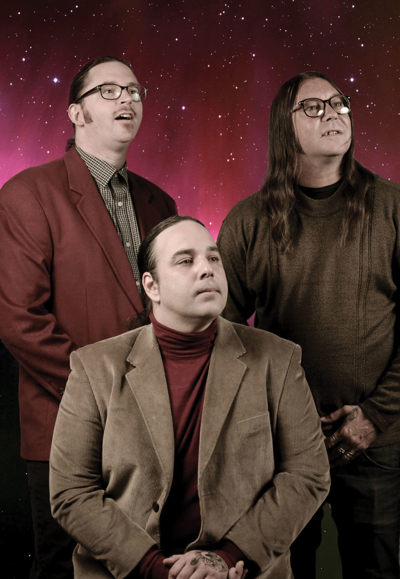


While the hope-inspiring domino effect of marijuana legalization made the mean green available to even more lucky Americans in some states on Election Day, President Trump’s recent cabinet picks have left many fans of the wacky tobacky wondering if they’ll ever be next. With such a potential buzzkill of a term just getting underway, pioneering stoner-doom trio Sleep is poised for a comeback that offers a silver lining for those of us still fighting for our right to party.
The band’s dedication to cannabis is so staunch, prominent and unprecedented, they’ve made it impossible to so much as casually reference them without exhaling imaginary clouds of thick, skunky smoke. Since reuniting in 2009 after an 11-year hiatus, the band has released just one song — 2014’s 10-minute slow-burner “The Clarity.” That said, after issuing 2003’s Dopesmoker — hands-down the most iconic and exemplary stoner-metal album to date — Sleep didn’t really need to give fans any new music to remain relevant. This year, the band is finally including Nashville among its tour stops — that’s more than enough reason to pack a bowl and ruminate on the wonders of stoner rock and Sleep’s essential role in furthering the genre.
Rivaled only by reggae as a genre so inextricably connected to combustible herbage, stoner rock has emerged over the past 25 years as one of the most popular subgenres in metal’s increasingly splintered spectrum. Though Black Sabbath wasn’t by any means the first band to sing the praises of the “Sweet Leaf,” they were the first to do so with such appropriately potent results, combining deep, earth-shaking guitar grooves with lethargic tempos executed with a lumbering swagger. Sabbath simultaneously invented metal and stoner rock in one fell swoop.
Metal as we know it had fully blossomed within just a few years, but it was a couple decades before Sabbath’s slow-and-low aesthetic manifested itself within the stoner-metal and rock communities that surfaced in the early ’90s. Though spurred on through the ’80s by sludgy purveyors like Saint Vitus, Pentagram and some experiments from later-era Black Flag, the formula was perfected by Sleep with 1992’s Holy Mountain — a Sabbath-worshipping slab of intense psychedelia, rumbling fuzz and fantastical images that crafted the recipe with which all guitar-wielding, amplifier-obsessed metalheads would simmer their sound for a quarter-century to come.
The band spent four years and a $75,000 record label advance writing, rehearsing and recording what was intended to be Sleep’s major label debut for London/Decca Records. But it should come as no surprise that when they handed London the 63-minute, one-song masterpiece Dopesmoker, the label — whose roster in the ’90s included Salt-N-Pepa, Chumbawamba and Ace of Base — was less than pleased. London deemed the product unmarketable, and with the band refusing to compromise on length and structure in any way, Sleep was forced into a three-year hiatus and eventually broke up. London Records split the album into four unflattering segments, attempted a more palatable mix and released it as the album Jerusalem, while guitarist Matt Pike started sludgy metal act High on Fire and drummer Chris Hakius and bassist/singer Al Cisneros regrouped in 2003 to form experimental doom outfit Om.
As if its runtime and title weren’t already squarely on the nose, Dopesmoker’s lyrics chronicle a caravan of priests belonging to an ancient race called the “Weedians” on a pilgrimage across the desert to fulfill a ganja-centric covenant. Meanwhile, the song’s herculean riffs grind, rumble and throb with the kind of momentum 99.9 percent of other albums simply don’t have the time to build. The vocals plod in a malevolent, half-chanted incantation, while solos stretch for minutes on end, strapping the listener in for a journey that’s potentially the closest one can get to a doper mindset without actually smoking the stuff.
Since reuniting, Sleep has popped up for festival appearances and short tours here and there to perform both Holy Mountain and Dopesmoker in their entirety. At the tail end of 2016, the band posted photos from inside a recording studio on their official Instagram account, indicating they were recording new material. With the fate of the country’s weed revolution in limbo, is it foolish to think an even more formidable record might be in the works, poised to liberate the God-fearing, dope-smoking, tax-paying, freedom-loving people of this nation? Maybe Sleep does owe us another record. There are many things this country needs right now, and one of them is another Dopesmoker.
Email music@nashvillescene.com