
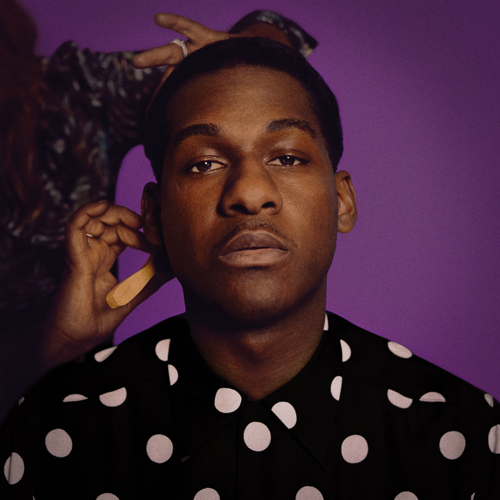
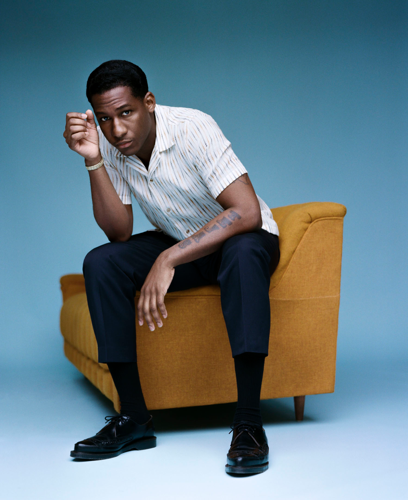


You might perceive a through-line in soul music by comparing contemporary soul singer Leon Bridges’ “River,” a track from his 2015 debut album Coming Home, with Al Green’s 1974 track “Take Me to the River.” Bridges’ tune is high-grade Americana that’s reassuring during its four minutes, while Green and Teenie Hodges’ song is great American music that admits to doubt and hints at an insanity that Bridges never comes within shouting distance of. “River” even lacks a sense of place: Al Green has a specific river in mind, but Bridges simply says, “Take me to your river,” as if we have our own personal rivers we visit in moments of need.
If a cynic needed confirmation that contemporary soul music exists mostly for listeners who look to Americana radio and NPR for sustenance, Bridges, who has become a star, provided some evidence for that view on Coming Home. The Texas-born singer and songwriter has released a new full-length, Good Thing, that modernizes his retro sound in ways that suggest cynics are usually half-right at best.
Bridges cut Good Thing with a brace of producers who updated the 29-year-old singer’s style. Coming Home put Bridges into a ’60s mode, while Good Thing brings him into the world of post-’80s soul. The production duties were shared by Ricky Reed, the duo King Garbage, Nate Mercereau, and Niles City Sound, the Fort Worth studio headed by former White Denim members Austin Jenkins and Joshua Block.
Some reviewers of Coming Home compared Bridges to Otis Redding, but the record reworked ’60s soul in a nonspecific manner. Unsurprisingly, a portion of Bridges’ white audience perceives him as a savior of soul, and Good Thing debuted at No. 1 on Billboard’s Americana and R&B charts upon its release earlier this year. For a young, green African-American singer who hadn’t made his bones on the road or in the studio, the needs of his audience could be oppressive.
“As far as having to meet expectations, that’s more so from the white community,” Bridges tells the Scene. He’s in New York preparing to appear on the television show Good Morning America, and he sounds down to earth. “They were kind of holding me to a standard. From the beginning I saw, ‘He’s not Otis Redding enough,’ or whatever.”
Bridges, in fact, ran afoul of racial and musical politics earlier this year. Booked to play RodeoHouston in March, Bridges was derided on social media as an inappropriate choice for the event. Bridges, his critics maintained, was a favorite of white audiences and somebody black audiences were largely unfamiliar with, and therefore unsuited to play RodeoHouston’s Black Heritage Day at NRG Stadium. He ultimately did perform at the event to a relatively small crowd. Reviewing the show in Paper City Magazine, Annie Gallay wrote: “There’s something yearning in Bridges’ music, something that works much better at a smaller scope. The giant Rodeo stage almost swallowed him whole.”
Bridges refutes the notion that he’s unpopular with black audiences.
“Honestly, in my community, the black community, we can be, across the board, trendy,” he says. “You know, if I’m not making music that’s popular, some people in the black community, they don’t want to hear me out, but that’s not black people as a whole.”
Still, as Gallay writes, there is something yearning about Bridges’ music. He tells me he admires the late Alabama-born singer Arthur Alexander, whose music explores the intersection of rural aspiration and show-business dreams. I hear echoes of Alexander’s innocence and anxiety in some of Bridges’ vocals, and like Alexander, Bridges is a gifted songwriter.
Good Thing combines the elegant and the gawky. “If It Feels Good (Then It Must Be)” evokes one of ’80s singer Fonzi Thornton’s collaborations with Chic. It’s a great track, but the lyrics are as banal as the clunkiness of the title would suggest: “See yourself like I do / Oh, tonight looks good on you.”
Bridges’ new music doesn’t lack meaningful idiosyncrasy, but it feels anodyne compared to Al Green’s or Chic’s. Bridges has a vocal sound, but he hasn’t developed a style, and this may be one of the keys to his success with Americana-centric listeners.
If that sounds cynical, so be it. I think Bridges has the stuff to become an innovator in a conservative genre. When I ask him about his favorite old-school soul artists, he mentions South Carolina singer Roy C., auteur of the greasy ’70s cult classics Sex and Soul and More Sex & More Soul. That’s hip, and maybe Bridges can figure out how to take his audience down to the river on his own terms.



