

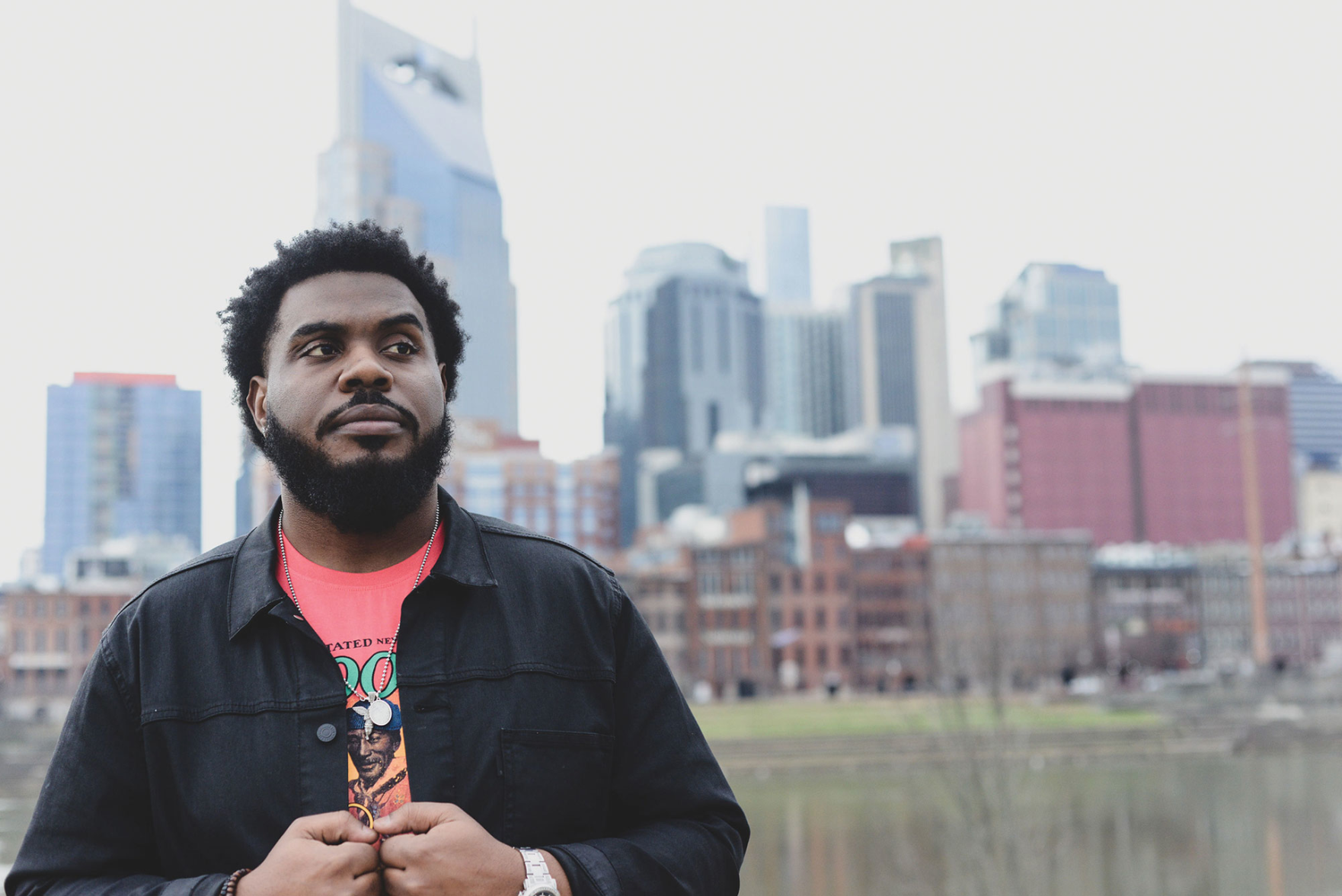
On his 28th birthday in October 2018, Quez Cantrell made a choice that would change the course of his life. He was a lifelong hip-hop fan with myriad connections to Nashville’s booming hip-hop scene, and he decided it was finally time to try his hand at making music. He began writing songs in short order, and found that he had a lot of stories to tell.
“I was going to sit down and see what I could come up with, and give it a year before I even let anyone know I was working on anything,” Cantrell tells the Scene via phone.
In January 2020, he released 9, a six-song project that establishes him as a preternaturally gifted MC. The record showcases Cantrell’s natural prowess at powerful storytelling and a deep, authoritative delivery that adds a meaningful heft to the yarns he spins.
Sports figure heavily in Cantrell’s lyrics. They are his way of “putting the candy in the medicine,” as he says, so that he can riff on weightier topics like systemic racism and gentrification. He also made a lot of his musical connections, including his long-standing friendship with top-shelf Music City rapper Petty, through playing sports as a youngster.
“We met when we played football and baseball on the same team,” Cantrell says. “We grew up playing together. So our relationship is deeper than rap. Rap is just something we both love to do, so it makes sense to do it together.”
Cantrell studied computer science at Austin Peay State University. His studies led him to developing websites for Petty and other local MCs, and those early connections have been integral in developing his career. “I’ve been able to grow a network and relationships with people musically, just by being helpful to the culture,” he says.
Cantrell wrote 9’s six tracks between October 2018 and February 2019, using borrowed beats while he made plans to work with producers on original tracks. He wrote “Max Contract$” to the beat of Brian Brown’s “Stoop Kid” before enlisting Chino to produce the track you hear on the final project. When it was time to share his demos with loved ones and collaborators, he was surprised by the encouragement he received.
“I’m [almost] 30 years old,” he says, laughing. “To go to someone and say, ‘I’m making music’ — even the people closest to you might look at you like, ‘Huh?’ “
The centerpiece of 9 is its title track, which pays homage to late Titans quarterback Steve McNair. The magic of “9” is how Cantrell takes a snapshot of present-day Nashville (and all its problems) while drawing a line back to McNair’s historic career and the aftershocks of his untimely death. After lamenting the loss of several locations of the restaurant Mrs. Winner’s (“They took Mrs. Winner’s from the culture / And we been struggling with defeat”), Cantrell compares the opening of the pizza parlor Slim & Husky’s on historic Buchanan Street to a cousin coming home. The story revolves around the tools you use to form your identity.
“At least for me personally, [McNair] is the first black male figure someone can tie to the city of Nashville globally,” he says. “I wanted to find one symbol for all blackness in Nashville. … That’s to lead [listeners] to the water — then they realize I’m trying to be more informative. I sat down and wrote from a place of frustration, living here my whole life and seeing the collective struggle of blackness. I felt like that was a necessary song. I wanted this project to feel like a ride through Nashville from the black perspective.”
Cantrell has an uncanny knack for turning the timely into timeless. On “The Black Today,” which also features local vocalist Dee Grand, he laments the assassination of hip-hop artist and activist Nipsey Hussle, who was gunned down in front of his South Los Angeles store Marathon Clothing in March 2019. “It hurt being black today,” raps Cantrell as the somber track begins, gentle keys and an understated beat rolling out around him.
“It was a really touching moment for me and everybody around me, because we hold him in a very high light,” says Cantrell. “He gave me a lot of context to my story through his story. That situation ended up presenting that song.”
The song has other echoes that don’t die down. A few days before this interview, the story of Ahmaud Arbery, an unarmed black man who was shot and killed by two white men while he was out for a jog in Brunswick, Ga., became national news. When asked if that horrific story makes “The Black Today” resonate in a different way for him, Cantrell looks closer to home.
“In the second verse I say, ‘How many of our brothers do we have to pick up off the pavement / Before we realize this shit don’t make sense,’ ” he says. “I had a cousin murdered in June, and my brother was murdered in July. I had to live the reality of that song. … I feel like that’s a song we’ll still relate to 10 years from now. When I wrote it I felt it would always be relatable, because it talks about collective black struggle as a whole.”



Post a comment as anonymous
Report
Watch this discussion.
(0) comments
Welcome to the discussion.
Log In
Welcome to the discussion.
Keep it clean. Please avoid obscene, vulgar, lewd, racist or otherwise abusive language. Comments featuring hate speech or threatening or violent content will not be tolerated.
PLEASE TURN OFF YOUR CAPS LOCK.
Be truthful. Don't knowingly lie or mislead.
Be proactive. Use the “report” link on any comment that violates our comment policy.
Share with us. We'd love to hear your feedback.