
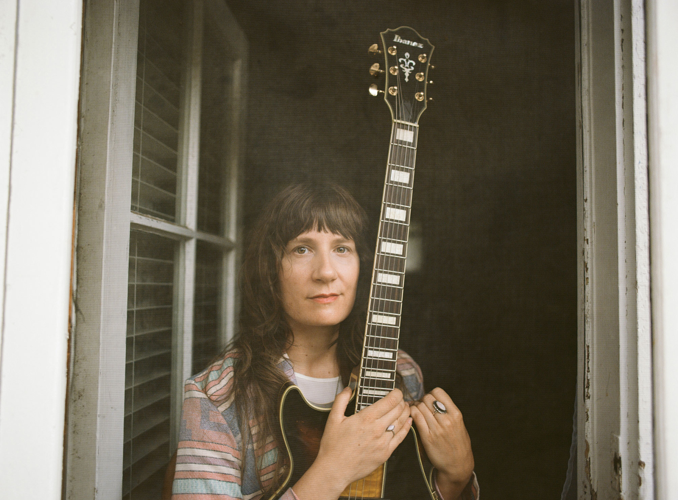
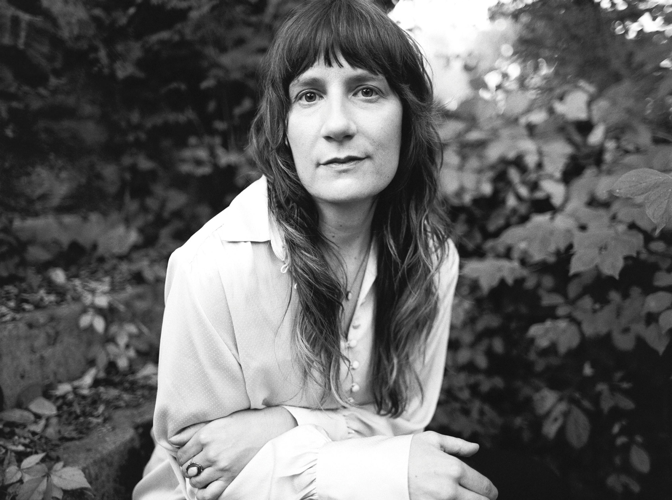


The first thing to say about Nashville singer-songwriter Lauryn Peacock’s new full-length Theology is that it manages to live up to its title by not sounding overtly theological. In her latest songs, Peacock adds a sense of moral gravity to the texture of everyday life, but she delivers her insights into the nature of religious belief by making her music as engaging — and, at times, as indecisive — as the lives of the struggling human beings she writes about. Theology is a record about religion, but it’s not a drag. It’s high-level pop that might make you rethink your own spirituality, and her substantial melodic and harmonic gifts help the medicine go down as sweetly as it can.
Theology is the first album Peacock has released since 2015’s Euphonia, and in a sense it’s her take on Nashville-style folk rock. She cut most of Euphonia in Nashville, with some parts recorded in Philadelphia, where she lived before moving to town in 2013. Produced by Peacock and Andrija Tokic at his Music City studio The Bomb Shelter, Theology builds upon the strengths of Peacock’s previous work, which fuses folk, classical music and jazz. Her latest music keeps the complexity that characterizes Euphonia and her 2011 debut full-length Keep It Simple Let the Sun Come Out, and Tokic adds organ and layers of electric guitars to Peacock’s carefully written songs.
Theology fits into the rich tradition of Nashville singer-songwriterdom, but Peacock’s ear for idiosyncratic structure and her clear, vibratoless voice also link her to innovative experimenters like Joni Mitchell and Brian Eno. Euphonia amounted to a brilliant distillation of the usages of pop art song, in part due to the production skills of Danielson Famile leader Daniel Smith, with whom Peacock worked in Philadelphia. For Peacock, the shift in production style augments her music without altering it.
“Daniel’s very quirky,” Peacock says of Smith. She’s at home in Nashville, where she’s busy working on an MFA in poetry from New York University. “He’s actually credited with kind of messing up the Christian rock scene and opening it up to alternative musics. [His method] is not like Andrija’s more murky, mostly-to-tape, mix-it-in-the-board approach.”
Peacock was born in North Barrington, Ill., and she settled in Philadelphia in 2008 after living in locales as varied as Chicago and Santa Rosa, Calif. She split her time in Philadelphia between earning a master’s degree in literature from the University of Pennsylvania and performing in the city’s indie-folk scene.
“It was everybody running into each other on the street constantly,” she says about her Philadelphia days. “It was a lot of the folk scene, like the people who camp out and sometimes win the lottery of musicians to play, like, the Philly Folk Festival.”
You can clearly hear the folk elements throughout Theology, but Tokic’s production nudges Peacock into an area that’s adjacent to rock ’n’ roll and Americana. The album’s opening song “Camus Blues” amounts to a modernized Sun Records-style tune about French novelist and essayist Albert Camus. On the track, Megan Coleman’s drums gallop along as if in emulation of the style of the late Sun Records session drummer W.S. “Fluke” Holland. Meanwhile, Peacock’s lyric lays out one of the record’s themes: “The morality of attention / Is a sign of invention.”

Peacock’s studio band on Theology, which includes Coleman along with Deslondes guitarist John James Tourville, Raconteurs bassist Jack Lawrence and background vocalist Molly Parden, complements Peacock’s songs perfectly, casting them in a manner that sounds less baroque than Smith’s approach on Euphonia. The five-minute track “Ephrem’s Request” begins with an acoustic guitar figure before spiralling into a minor-key folk song featuring seething electric guitars. Meanwhile, “You Choose You” sports pizzicato strings and a chord progression that recalls prog pioneers Procol Harum circa their 1969 album A Salty Dog.
As “You Choose You” demonstrates, Peacock, who plays keyboards and guitars on the album, creates newfangled prog-folk on Theology — you can envision her covering the classic A Salty Dog track “Pilgrim’s Progress,” right down to Matthew Fisher’s Bach-like organ part. Still, Peacock gets her message across in “Cameron,” one of the simplest, folkiest songs on the album. As she tells me, it’s based on director Desiree Akhavan’s 2018 film The Miseducation of Cameron Post, itself adapted from Emily M. Danforth’s 2012 novel of the same name.
“In the movie, Cameron Post is forced to go into, pretty much, gay conversion therapy camp — Christian gay conversion therapy camp,” Peacock says. “The spiritual and emotional damage of that space is made very apparent throughout the movie. It speaks, also, about any system or religious practice, or mindset, that doesn’t respect the whole of a person.”
As it’s heard on Theology, “Cameron” doesn’t make its underlying situation completely explicit, though Peacock sings it with pained sympathy. The slight ambiguity works in the song’s favor — the problem of self-definition is universal. Theology never makes the answers appear to be easy, and Peacock’s music communicates the combination of ecstasy and unease that religion was designed to address.



Post a comment as anonymous
Report
Watch this discussion.
(0) comments
Welcome to the discussion.
Log In
Welcome to the discussion.
Keep it clean. Please avoid obscene, vulgar, lewd, racist or otherwise abusive language. Comments featuring hate speech or threatening or violent content will not be tolerated.
PLEASE TURN OFF YOUR CAPS LOCK.
Be truthful. Don't knowingly lie or mislead.
Be proactive. Use the “report” link on any comment that violates our comment policy.
Share with us. We'd love to hear your feedback.