
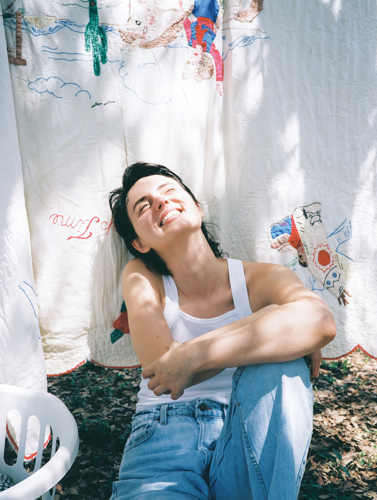
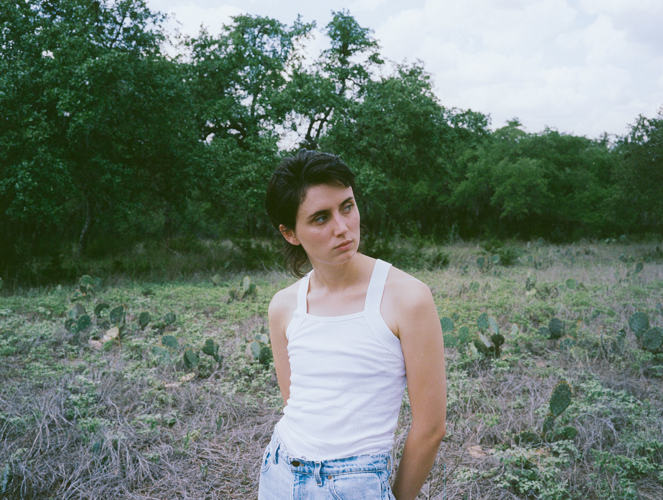


“Someone called me a songbird once,” Katy Kirby tells the Scene by phone. “That made me want to smash every acoustic guitar.”
Ahead of the release of her first LP Cool Dry Place Friday via Keeled Scales Records, the Texas-born Kirby is reflecting on her time as a Belmont student and rookie songwriter during the peak of the folk revival of the mid-2010s. It was a scene she was on board with at first.
“Big Mandolin got us all,” she jokes. “But with respect to The Lumineers — all the stomping and the clapping — I got tired of writing from that place. I knew that if I sang in my pretty girl voice, with my acoustic guitar in hand, I’d be trying to do something I’m not.”
Rock music in general came a bit later for Kirby than most. Her hometown — Spicewood, Texas — sits 30 miles from Austin and is home to Willie Nelson’s 500-acre Luck Ranch. “We’d see his bus driving by sometimes,” she says. But for Kirby and her deeply religious family, the rock venues of Sixth Street may as well have been in another galaxy. Kirby was homeschooled from kindergarten through ninth grade — a cocoon-like upbringing she calls “a bit lonely, to be honest” — and for the remainder of high school, attended a private Christian academy in a neighboring town.
At the school, she played in a worship band, where she met and befriended Joelton Mayfield — now a Nashville-based alt-country songsmith himself. Kirby is speaking to the Scene from Alabama, where she’s co-producing Mayfield’s follow-up to his 2019 EP I Hope You Make It. Mostly, though, Kirby’s high school experience motivated her to leave home. “My parents observe the faith in a way that is pure and noble and good, but I hadn’t realized at the time how right-wing the school was,” she remembers. “I kind of wish I’d caused more trouble. There was some wild shit that was said out loud.”
The absence of a classic-rock record or CD collection in the house left Kirby to discover secular music essentially on her own. She points to free iTunes singles as a critical jumping-off point — like the title track from Bay Area indie band Rogue Wave’s 2007 album Asleep at Heaven’s Gate, which inspired her first original song. It wasn’t much, she says with a laugh. “I ripped off the chord progression, and wrote new words.” But it instilled in Kirby the desire to pursue songwriting — which led her to Nashville and Belmont, and eventually to making Cool Dry Place.

Of the nine tracks on the album, Kirby has been playing “Secret Language,” a tender ballad that subtly references Leonard Cohen’s “Hallelujah,” the longest. But “Juniper,” an ode to motherhood — not her own mom specifically, she clarifies — “felt the most like a catalyst” for the rest of the record. “I wrote it in early 2016, and [always] heard it as a rock song. It was the first thing I’d written that sounded like something I wanted to listen to.”
Coming later was the loose, limber first single “Traffic!,” which features a digitally treated chorus in the style of Daft Punk’s “One More Time.” It’s a happy accident that throws the listener for a loop initially, but ends up making the song. Her voice depleted from her day job at a call center, Kirby was struggling to sing the part as intended, so producers Alberto Sewald and Logan Chung temporarily employed the pitch-correction filter “to distract from how bad I sounded,” she explains. “We ended up liking it so much we kept it.”
The rest of Cool Dry Place is just as self-assured. Vivacious pop songs like “Peppermint” highlight Kirby’s silvery voice and easy way with melody. The aforementioned “Secret Language” and album-closing “Fireman” are more laid-back, but get their hooks in the listener just as effortlessly. The slow-burning title track — at five minutes, the longest on the record — rocks with abandon, going out with a cacophonous multi-guitar-solo pile-on.
The concise 29-minute set defies easy categorization, suggesting the gaps in Kirby’s knowledge are more creative assets than blindspots. Sonically, with its clean, resonant guitars and indie-folk overtones, it maintains a refreshingly upbeat vibe — even when the subject matter is a downer.
“There’s a bummer of a lyric in almost every song,” Kirby says. “Some darkness, some violence, some thrashing around like goldfish in a garbage bag. But I think my melody-focused CCM background wired me in a different way. It would be very hard for me to write a song that could alienate people, or be too weird to be approachable. That approachability is hard-wired in there. I don’t worry about making things friendly — if it sounds good to me, I trust it.”



Post a comment as anonymous
Report
Watch this discussion.
(0) comments
Welcome to the discussion.
Log In
Welcome to the discussion.
Keep it clean. Please avoid obscene, vulgar, lewd, racist or otherwise abusive language. Comments featuring hate speech or threatening or violent content will not be tolerated.
PLEASE TURN OFF YOUR CAPS LOCK.
Be truthful. Don't knowingly lie or mislead.
Be proactive. Use the “report” link on any comment that violates our comment policy.
Share with us. We'd love to hear your feedback.