
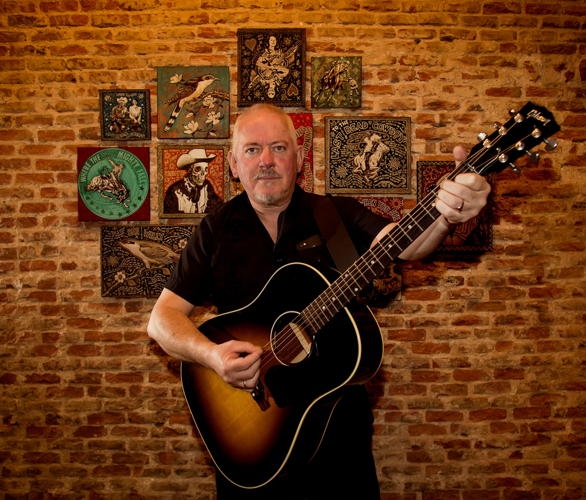
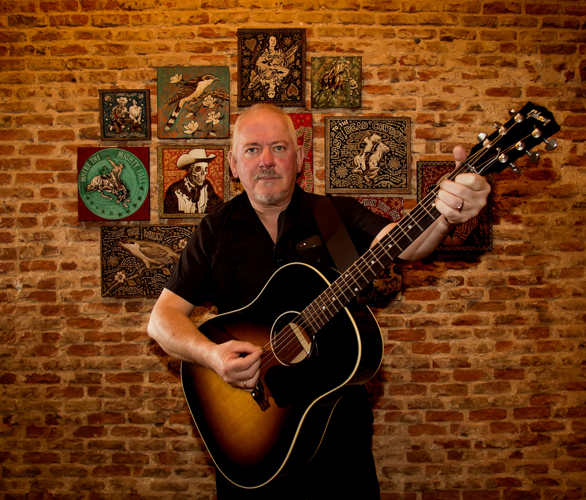

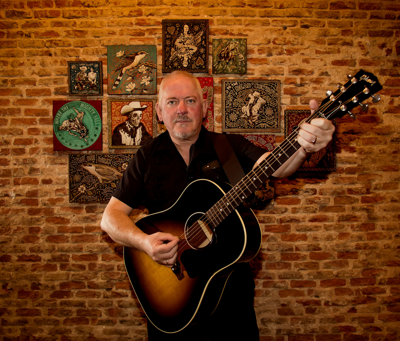

Jon Langford with some of his paintings
Speaking with Jon Langford and Paul Burch is, in some ways, a matter of deciding which rabbit hole you want to go down. Langford is a co-founder of The Mekons, a band that’s been blending punk, early rock ’n’ roll, country and more into their politically and socially conscious music since the late 1970s. The Welsh-born polymath’s myriad other projects include the alt-country outfit Waco Brothers, launched in 1994 in his adopted hometown of Chicago, and he’s a well-regarded painter whose work has appeared at the Country Music Hall of Fame. Burch, Langford’s friend and occasional collaborator over the past two decades, is a longtime Nashvillian. Along with Greg Garing, BR549 and others, Burch began an organic revival of trad-schooled country on Lower Broadway in the 1990s, and the stylistically nimble, historically astute, never-pretentious music he’s been making since is full of layers that reward examining in greater detail.
The Scene caught up with both musicians on separate phone calls discussing their show set for Nov. 2 at Julia Martin Gallery in Wedgewood-Houston. Burch plays first with his band of ringers, The WPA Ballclub, and he’ll sit in on drums with Langford afterward. The event celebrates Bacon Grease & the Lost Song, an exhibit on display through Nov. 30 that touches on country music and the warping of cultural history. In addition to work by Langford, there are paintings by much-loved multimedia artist Wayne White and ceramic pieces by Ashley Atterberry. Langford traces his interest in painting images of country musicians to a visit to Nashville in 1988, when he and a friend watched Johnny Cash play on the Grand Ole Opry and stopped at Tootsie’s for a nightcap. Langford found himself fascinated with the promotional photos lining the honky-tonk’s walls.
“It was these hopeful young country-Western singers — some I recognized, some I didn’t have the faintest idea who they were — all smiling out at this kind of fulcrum moment of, ‘Here we are, we’re giving it our best shot,’ ” says Langford. “And then we were looking at them — 30, 40 years later, all covered in nicotine and snot. It was these hopeful people forgotten. It was quite powerful for me, and I wanted to make images that kind of summed that feeling I had up. … I felt like they were being erased. It’s more like a kind of Stalinist thing than the natural progress of events.”
The Langford paintings and prints you’ll see in Bacon Grease feature Connie Smith, Charley Pride and others as they appeared in those photos. But the images are faded, scuffed and scarred as if they’ve been shoved unceremoniously into dark corners, perhaps not even noticed by people who bump into them. Public interest in and celebration of these figures has increased in recent years, but it’s still instructive to remember how they came to be forgotten.
“My paintings may be vaguely autobiographical on many levels,” Langford says. “ ‘Well, let’s do a painting of Hank Williams signing his contract.’ It’s not necessarily just about Hank Williams signing his contract. It’s about experiences I’ve had, and some sort of commonality that all musicians have had to deal with — and that’s been the world I’ve dealt with. It’s about how we are all manipulated by corporate capitalism, and also how we relate to notions of creativity and commerce.”

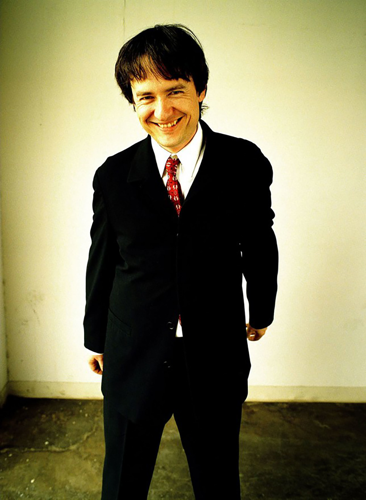
Paul Burch
A respect for the past without being restricted by it is just one of many sociopolitical and artistic concerns that inform Langford’s vast catalog. It’s what drew him to Burch’s work when he first heard it in the late ’90s. What’s kept him coming back to work with Burch as often as they can get together is the latter’s work ethic and the ease with which they can get on the same page. The feeling is mutual.
“There’s just a lot of energy, and he uses it wisely,” Burch says. “He gets right into it, and he’s ready to work, which I like. … I don’t know if ‘intimacy’ is the right word, but it does require a kind of letting down your guard, probably in the same way that people who work in theater do. Like, if you’re going to act a scene, you have to go right at it. You can’t kind of sniff each other out, you have to show what you got. That’s one of the things I look forward to — he’s fearless.”
Saturday’s gig is an all-too-rare opportunity to watch that partnership in action. Burch and Langford have only one album-length collaboration together so far: 2012’s Great Chicago Fire, a characteristically raucous, joyful and insightful LP credited to Waco Brothers and Paul Burch. Burch has a new record with The WPA Ballclub set for a March release — he’s hesitant to give out much more detail, other than the fact that it was recorded using his time-honored live-in-studio method, and that there are special guests. Langford, meanwhile, is set to release a new collaboration with Toronto’s Burlington Welsh Male Chorus next year. Unlike his previous work with the group, the pieces on the album were written with the chorus in mind. Despite the increasing frequency of requests to appear in documentaries, Langford has no plans to shift his focus backward.
“I’ve always enjoyed history,” says Langford. “I’m getting to the point now where it’s like, ‘No, I don’t really want to be part of history.’ ”



Post a comment as anonymous
Report
Watch this discussion.
(0) comments
Welcome to the discussion.
Log In
Welcome to the discussion.
Keep it clean. Please avoid obscene, vulgar, lewd, racist or otherwise abusive language. Comments featuring hate speech or threatening or violent content will not be tolerated.
PLEASE TURN OFF YOUR CAPS LOCK.
Be truthful. Don't knowingly lie or mislead.
Be proactive. Use the “report” link on any comment that violates our comment policy.
Share with us. We'd love to hear your feedback.