
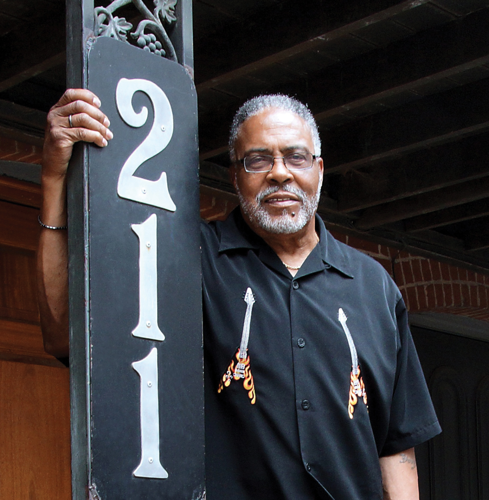


James “Nick” Nixon never considered himself a great performer, though he was a gifted, highly engaging vocalist and musician. He was always the type who would praise others, cite their accomplishments and downplay his own, even though his five-decade-plus career was among the finest and most important in the Nashville blues and R&B scene. Nixon, who died Feb. 28 at 76, could rattle off with ease the names of legends with whom he’d worked, most notably Jimi Hendrix, Billy Cox, The Fairfield Four (he produced 1989’s Revival, one of the group’s finest efforts), and seminal rock ’n’ roll guitarist Scotty Moore.
But Nixon deemed his long association with such area luminaries as his cousin Marion James and his work as a mainstay of the Jefferson Street Jazz and Blues Festival equally valuable, and he was a walking encyclopedia when it came to remembering the heyday of Jefferson Street’s musical scene. He could instantly recall a laundry list of past clubs, talk about which greats played where on what nights (many of whom he backed or worked with at various times), and recall without bitterness — most of the time — how busy and exciting those days were.
Nixon’s earliest vocal training came in two vastly different environments: gospel via the church, and one-on-one tutoring from an opera singer. He would often chuckle when talking about the differences between the exacting precision operatic singing demanded and the lyric embellishments and emphasis required of a great blues or R&B vocalist. Nixon consistently demonstrated his flair for R&B during his years as a lead singer for such groups as King James and the Sceptres, a rare integrated ensemble in an era when Nashville as a whole was still extremely segregated. He also led the group Past, Present and Future (anyone who still has copies of their 1974 Chess single “Behind Closed Doors” backed with “Boogie Bones” has a vastly underrated nugget of soulful funk) and the band NTS Limited, and he had a long tenure in the New Imperials.
As a solo artist, Nixon also made gospel recordings — 1997’s Me, Myself and the Lord is one of his best. But it was on his blues LPs where Nick Nixon put his singular vocal flair to its best use. His striking performance on “Rising Sun Blues” was featured on the soundtrack for Mario Van Peebles’ film Redemption Road (in which Nixon also appeared). Nixon’s 2002 release No End to the Blues and 2010’s Live in Europe were two other strong efforts, and he gained a new generation of fans with his recent work with fellow blues stalwart Andy Talamantez in the Andy T-Nick Nixon band.
“I started booking Nick Nixon years ago when I was managing a club downtown,” recalls singer Markey Blue. “A year later I found myself singing backup around Nashville with his cousin Marion James and with Nick. When the Andy T-Nick Nixon Band started, the two of us found ourselves traveling all over the country and the world singing the blues. Nick never met a stranger, everyone was a cousin. [He made] family wherever we went. … We all went to the Nick Nixon ‘school of the blues,’ as he used to call it. [I have] many years and great stories singing the blues with Nick I’ll cherish always.”
The Andy T-Nick Nixon band evolved after the two met at a Nashville Blues Society Sunday night jam, where Talamantez was leading the house band. “The first time I heard Nick sing next to me onstage I got goosebumps,” Talamantez later said. “Nick sings like I’d like to be able to sing.” The band issued three albums between 2013 and 2015: Drink Drank Drunk, Livin’ It Up and Numbers Man. Nixon is featured on six of the 13 songs on the 2017 release Double Strike, which is credited to The Andy T Band — sadly, health problems forced Nixon to leave the group before it was issued.
Recalling the blues’ heritage and sharing the history of Jefferson Street with younger generations were the primary reasons that teaching became almost as important as performing to Nick Nixon. He spent 35 years as a music instructor with Metro Parks, and his dedication to spreading the word about the vitality and relevance of the blues to contemporary audiences helped earn him a Keeping the Blues Alive Award from The Blues Foundation in 2000.
I had heard and read about Nick Nixon for many years before relocating from Memphis to Nashville in 1996. Not long after I arrived here, I asked Nixon why he chose to stay in a city more widely known for country music rather than moving to Chicago or even Memphis. He looked at me as though I were an alien. But then his expression softened.
“There has been so much great music made here by black musicians: blues, R&B, soul, gospel, even some jazz and yes, some country,” he said. “My hope is that one day everyone will know about this legacy and history in Nashville that is so great. I played a role in it, and I’m proud of it, but it’s even more important that the generations behind me honor and remember it. It shouldn’t be forgotten or overlooked.”
Thanks to the recorded gems he left behind and the impact he had on all those who crossed his path — musically or otherwise — James “Nick” Nixon has certainly done his part to achieve that goal.



