
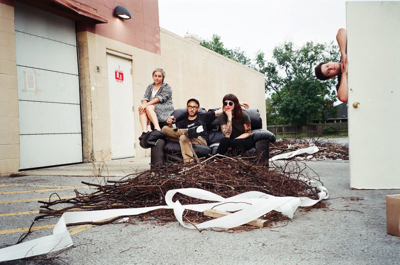


Idle Bloom
The dream of the ’90s is alive in Idle Bloom’s East Nashville rehearsal space. Once you descend a narrow staircase — hitting your head on a low-hanging ledge despite several warnings not to — you reach a basement that feels like a fort made by the kids in Stranger Things. If, that is, the kids in Stranger Things grew into teens in a punk rock band.
Old bedsheets and pieces of foam hang on the walls as soundproofing. A huge poster featuring Kurt Cobain is made shrine-like by a gaudy gold frame. A shelf holds various odds and ends, including guitar pedals, vintage-looking mannequin heads from frontwoman Olivia Scibelli’s cosmetology classes, and a Caboodle, one of the highly coveted candy-colored makeup organizers of yesteryear. Several strings of Christmas lights are wrapped around the beams of the low unfinished ceiling, casting a glow over old amps and various instruments.
“This is our favorite song to play live,” says bassist Katie Banyay before the band kicks into “Hive,” the first single from their debut full-length, Little Deaths. Like many of the songs on Little Deaths, “Hive” addresses the emotions that accompany loss, in this case betrayal. Scibelli sings, “Caught in a lie, watch what you say now / Freeing me up, lightening my heavy load,” while she and the band blast through a hook-filled pop song laced with fuzzy and soaring guitar riffs and harmonies that recall early Get Up Kids but deliver much more bite than that Kansas City band could ever muster.
Scibelli, Banyay, guitarist Gavin Schriver and drummer Weston Sparks are locked together like well-seasoned veterans. Even though Little Deaths is their debut, Idle Bloom has been around, and their name ought to be familiar to anyone paying even the slightest bit of attention to Nashville’s rock scene. They’ve shared the stage with Tacocat, La Luz, Turbo Fruits and Those Darlins since playing their first show on St. Patrick’s Day 2014, and we at the Scene declared them Nashville’s Best Band in last year’s Best of Nashville issue, thanks largely to their high-energy live performances.
Little Deaths, out Friday via local label Fraternity as Vanity, has been in the works for years — and finished since early 2016 — but it’s been only a few months since the Idle Bloom we know today found stability.
“The EP was supposed to be the record, but it didn’t work out that way,” says Scibelli. “It was ambitious to do a full-length, and the timing ended up being bad. We just couldn’t get it the way we wanted it, so we had to make a choice.”
“I think that was a good thing, though,” Banyay adds. “We ended up being able to take a step back, re-listen to songs and rework the ones that we had recorded and didn’t put on the EP. Some of the songs that are on the record are, at this point, almost three years old.”
Once the album was done, the band also paused to make a lineup change last summer. “Singing was really important to me,” Scibelli says of replacing former guitarist Callan Dwan with Schriver. “I love when [Banyay, Schriver and I] sing together. And I love harmonies. I freaking love harmonies.”
Those hiccups played into the vibe of Little Deaths, which Scibelli says is very much about “change through rebirth.” But easing the weight of those heavy vibes is another common theme — a love of both ’90s music and pop music.
Opening track “Seeker” sounds like a psychedelic ode to The Breeders, while “Goner” waves the Sleater-Kinney flag. “Lost Cause” starts with a heavy, fuzzy guitar riff that, were that poster in Idle Bloom’s rehearsal space to come to life, might just make Cobain smile. There are nods to the chilling harmonies of Luscious Jackson and the shimmering guitar work of Dinosaur Jr. — the band smiles and nods as I list comparisons that sound like a 1994 college-rock radio playlist.
“Olivia and I recently were trying to figure out, like, what it is,” says Banyay. “People always say the ’90s. It’s not like we’re intentionally doing it, but I think that’s a point ... where rock music, mainstream-wise, kind of peaked.” She also cites Sonic Youth and The Lemonheads as influences. “After that, [rock] turned into …”
“Nickelback,” Schriver says with a laugh.
The band argues that there’s more than familiar grunge pop beneath the surface of their work.
“Weston’s drumming is so unique — it’s not just straight-ahead rock drumming,” Scibelli says. “It’s playful at times and has really great rhythms and different shining moments.”
Sparks doesn’t deny it. “I’ve always said I think the first influence, musically, that still sticks with me is early-’90s U.K. breakbeats and shit. Like, early techno from England. I don’t listen to that music at all now. I think rhythmically it imprinted something.”
“We like music, and we write songs a lot together,” Scibelli adds. “Maybe that’s why the record seems all over the place, ’cause each song is like a weird little adventure. We’re always like, ‘What can we do with this?’ ”
“We’re all definitely music nerds,” says Schriver. “I think that’s one of the most bonding things between all four of us — we’re all total geeks.”



