
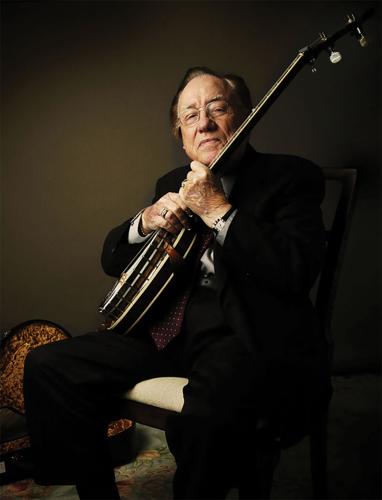


Earl Scruggs
Popular music in North America entered a revolutionary stage in the 1940s, and a handful of recordings from the decade document the shift into music that was more virtuosic than what had come before. When you listen to jazz saxophonist Charlie Parker fly into space on his solo on a 1942 track with pianist Jay McShann’s band, “I’m Forever Blowing Bubbles,” technology connects you to a moment when music fundamentally changes. In the world of bluegrass music, you could date a similar change to a 1946 recording of Bill Monroe’s Blue Grass Boys at the Ryman in Nashville that features the altogether radical banjo playing of Earl Scruggs on a version of a well-known Appalachian tune, “Little Maggie.” Scruggs turns “Little Maggie” into an expression of a fast, tough world, and his banjo technique carves its melody into fragments.
In every way, Scruggs was a revolutionary musician. On Jan. 6 at the Ryman, a group of bluegrass greats who have been inspired by his career and music gather to mark Scruggs’ 100th birthday. It’s a fitting tribute to a groundbreaking musician whose work ties together tradition and relentless innovation.

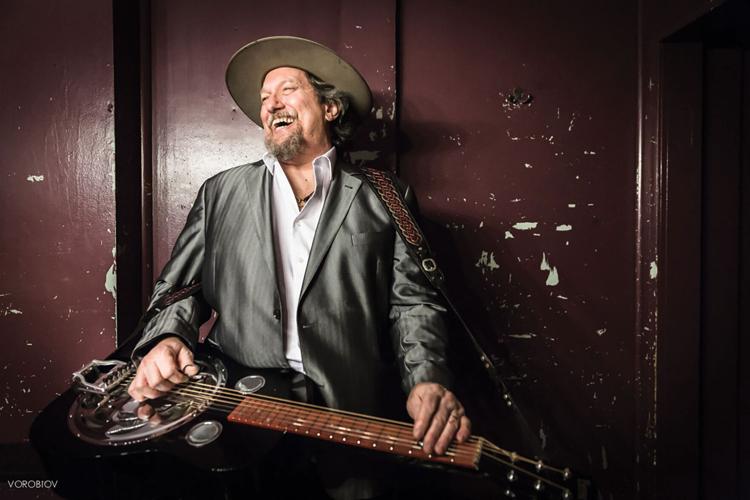
Jerry Douglas
Indeed, the musicians who will take the Ryman stage to celebrate Scruggs’ career largely work in an area he created. The show’s musical director, dobro master Jerry Douglas, has carried the torch of progressive bluegrass throughout his career. With players on the high level of banjoist Béla Fleck, mandolin aces Sierra Hull and Sam Bush and The Del McCoury band — and a host of other amazing instrumentalists and singers — carrying on his aesthetic, the music Scruggs helped codify continues to change with the times.
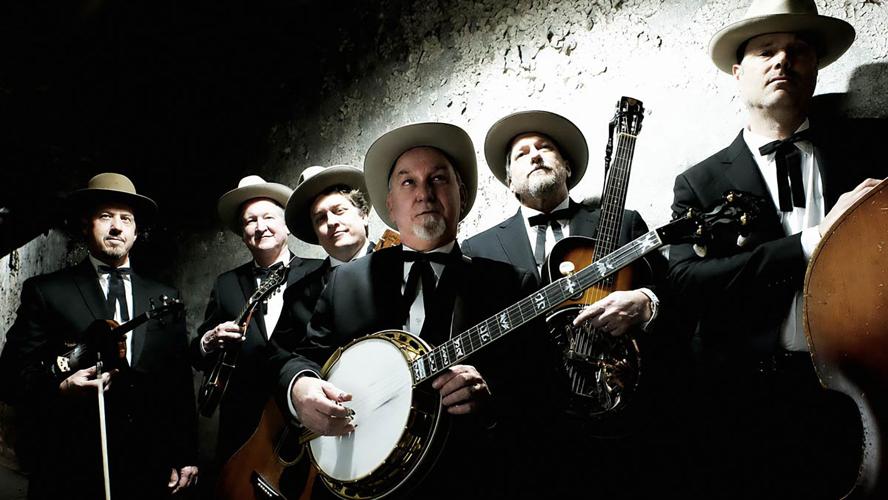
Douglas will also be performing with The Earls of Leicester, whose moniker puns on the name of what might be the best-known traditional bluegrass group, Flatt and Scruggs. For many listeners, singer and guitarist Lester Flatt’s music with Scruggs defined bluegrass in the 1950s and ’60s in the same way as did the ’40s recordings by the singer and mandolin player who is usually credited with the invention of the genre, Bill Monroe. Flatt and Scruggs became as much a part of ’60s culture as any pop or rock group via their signature tune, “Foggy Mountain Breakdown,” and 1962’s “The Ballad of Jed Clampett,” the theme they performed for the television show The Beverly Hillbillies.

The Earls of Leicester
For banjoist Charlie Cushman, who has played with The Earls of Leicester for a decade, growing up in Clarksville, Tenn., in the 1960s and ’70s afforded him the chance to immerse himself in the world of bluegrass, from the first recordings by Monroe to banjoist Don Reno’s 1956 “Remington Ride,” a record that influenced Cushman. In addition to his duties with The Earls of Leicester, he’s a much-recorded studio musician, and he owns a banjo repair business in Cottontown, Tenn., Cushman Banjo Set-Up and Repair. He’s been a professional musician for a half-century, and his take on bluegrass history comes from way inside the genre.
“[Earl] brought the banjo from being a background instrument to a lead voice,” Cushman tells the Scene from his home. He’s referring to Scruggs’ stint in Monroe’s band, which lasted from 1945 until 1948. “In other words, playing melodies. Bill Monroe, I think he was the vehicle to put this [music] on a 50,000-watt station, WSM, at the Opry. Pre-Earl Scruggs, he had the Blue Grass Boys’ name, from Kentucky, but the music at that time was not really that much different from any other string band until Earl Scruggs stepped in.”
As Cushman says, it was the technique Scruggs mastered — using three fingers to play both melodies and arpeggiated variants on them — that opened up new rhythmic and harmonic possibilities that pointed the way to the future of the music. Scruggs grew up in Cleveland County, N.C., in the southwestern part of the state, where he was born on Jan. 6, 1924. He died in 2012 at age 88. Scruggs later said the three-finger technique was common in that part of North Carolina, but he invented a style of bedrock utility that was fast and sometimes sardonic — the unmistakable signature of a searching, modernist sensibility.
Scruggs’ playing on 1949’s “Foggy Mountain Breakdown” and 1952’s “Pike County Breakdown” sounds aggressive and fresh today, just like a Charlie Parker solo from the same time. In later years, Scruggs famously split with Flatt and kept his eyes to the future by playing with rock and folk musicians like The Byrds, whose country-bluegrass-rock fusion owed a debt to the work of Flatt and Scruggs.
For Cushman, as for innumerable other bluegrass players, what Scruggs accomplished stands as a benchmark for their profession.
“He was a tidal wave of a musician. Once he stepped up to the microphone in 1945 with Bill Monroe, everyone started thinking of this string-type music in a more organized, sophisticated delivery. Whereas before, it sounded like front-porch pickin’.”




Post a comment as anonymous
Report
Watch this discussion.
(0) comments
Welcome to the discussion.
Log In
Welcome to the discussion.
Keep it clean. Please avoid obscene, vulgar, lewd, racist or otherwise abusive language. Comments featuring hate speech or threatening or violent content will not be tolerated.
PLEASE TURN OFF YOUR CAPS LOCK.
Be truthful. Don't knowingly lie or mislead.
Be proactive. Use the “report” link on any comment that violates our comment policy.
Share with us. We'd love to hear your feedback.