
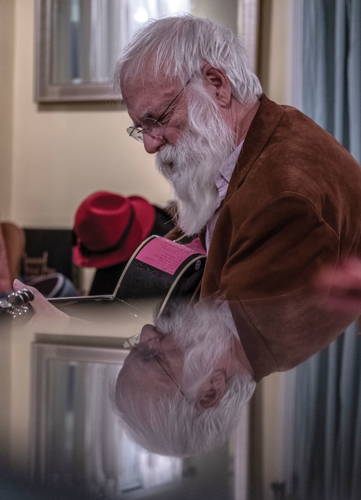

David Olney rehearsing before the 30A Songwriters Festival earlier this month
David Olney, one of Music City’s most prolific singer-songwriters, died of an apparent heart attack while performing in the Florida panhandle on Jan. 18. He was 71.
Singer-songwriter Amy Rigby was onstage with Olney for the acoustic in-the-round set at the 30A Songwriters Festival. According to a Facebook post from Rigby, Olney paused midway through a song, “apologized, and shut his eyes. He was very still, sitting upright with his guitar on.” Witnesses reported that Olney remained on his stool holding his guitar, but despite assistance from a doctor in the audience, he never regained consciousness. His wife Regine Olney was also in the room. “I just want the picture to be as graceful and dignified as it was,” Rigby wrote.
News of Olney’s passing electrified social media, spreading initially through the tight-knit network of Nashville’s songwriters and performers. But international media, including CNN, The New York Times, The Washington Post, The Guardian, the BBC and NPR’s Morning Edition soon reported on the uncanny circumstances of his death, his voluminous body of work, and the sense of loss being expressed by fans and musicians in and beyond Music City. Among those from further afield is Virginia songwriter Scott Miller, who was also onstage when Olney died.
“[His passing] was as easy and gentle as he was,” Miller posted to Facebook.
Those aren’t just kind words spoken out of respect. Olney regularly welcomed conversation with fans before and after performances. He had the same ease when he was approached while sipping coffee at Bongo Java, near his home in Hillsboro Village. He was humble, despite having carved out a reputation as a songwriting giant over nearly five decades in Nashville. Olney arguably did little to draw attention to himself other than distribute a free songwriting series on YouTube titled You Never Know, in which he would talk about upcoming shows, discuss songwriting and perform original songs. Despite his modest demeanor, Olney was highly regarded by his peers.
“He was a songwriter’s songwriter,” Grammy-winning singer-songwriter Jim Lauderdale tells the Scene. “Low-key in person [and] unassuming, he delivered such a fantastic body of songs and performances. He was a fine man and will be missed dearly. He left a mark that he can be proud of.”
After arriving in Nashville in 1973, Olney formed The X-Rays, a hard-rocking, high-energy band that championed musicianship and literary songwriting. The X-Rays appeared on Austin City Limits in 1982 before disbanding three years later. Olney continued to earn his reputation for fiery live performances even later in his career. In all, he released more than 20 solo studio and live albums. His songs have been recorded by Emmylou Harris, Linda Ronstadt, Del McCoury, Slaid Cleaves and The Wailin’ Jennys, among many others.
Like his late friends Guy Clark and Townes Van Zandt, Olney is widely considered a founding father of Americana music. Van Zandt famously listed Olney alongside Mozart, Bob Dylan and Lightnin’ Hopkins among his “favorite music writers.”
“Dave Olney is one of the best songwriters I’ve ever heard,” Van Zandt wrote in the liner notes to Olney’s 1991 LP Roses. “And that’s true. I mean that from my heart.”
Through his songs, Olney brought to life characters that elevated the genres of alternative country, roots music, Americana and folk. In “Deeper Well,” arguably Olney’s best-known song, he masterfully wrestles with the tension between want, need and longing. And in the song “Roses,” Olney edges toward high art in telling of a battle between an aged oak tree and the rain, lightning and wind that threaten to destroy it.
“David was touched by genius,” Grammy-nominated singer-songwriter Mary Gauthier tells the Scene. “He was the master of perspective, of finding a brilliant way into a song.”
Gauthier identifies “1917” as a vital entry in Olney’s catalog. “I cannot pick a favorite Olney song,” she says, “but I do come back to it over and over.” In “1917,” Olney memorably narrates from a French prostitute’s perspective, telling the story of an American G.I. on a three-day leave from the WWI battlefront. In “Titanic,” a crowd favorite at his live performances, he tells the story of the ill-fated luxury cruise liner from the viewpoint of the iceberg. Likewise, in “Brays,” he tells the story of Palm Sunday from the perspective of the donkey who carried Jesus into Jerusalem.
This winter, Olney had planned to release an 11-song album titled Whispers and Sighs that he recorded with Nashville-based singer-songwriter Anana Kaye. According to Olney’s longtime manager Mary Sack, he and Kaye had planned to tour behind the record, and there would have been “a theatrical, visual component” to the performance. Sack also indicates that there’s a sizable cache of unreleased audio and video recordings and “other creative output” that could possibly be released at a later date.
“Dave Olney was only the best,” says revered singer-songwriter John Prine. “Whenever Dave had a new bunch of songs, all the songwriters I know would gobble them up because Olney always had original ideas and fully formed songs. He was just beautiful. One time Dave asked me to play [John Barrymore’s] bartender in a song, and I am proud as punch to be on that record.”
Olney wrote several original songs for the Nashville Shakespeare Festival’s 2014 adaptation of As You Like It, which he performed during the play; he acted in it as well. In 2016, he composed music that he also performed in the troupe’s production of The Comedy of Errors.
“He was an artist,” Gauthier says. “People who know songs — people who do this troubadour work every day — we knew he was brilliant, the real thing, a genuine original whose songs will live forever.”
Born David Charles Olney in Providence, R.I., he briefly studied English at the University of North Carolina before relocating to Nashville. Olney is survived by his wife of 30 years, Regine Olney; Redding, his son; Lillian, his daughter; his brother Peter; and sister Debby Atwell.



Post a comment as anonymous
Report
Watch this discussion.
(0) comments
Welcome to the discussion.
Log In
Welcome to the discussion.
Keep it clean. Please avoid obscene, vulgar, lewd, racist or otherwise abusive language. Comments featuring hate speech or threatening or violent content will not be tolerated.
PLEASE TURN OFF YOUR CAPS LOCK.
Be truthful. Don't knowingly lie or mislead.
Be proactive. Use the “report” link on any comment that violates our comment policy.
Share with us. We'd love to hear your feedback.