

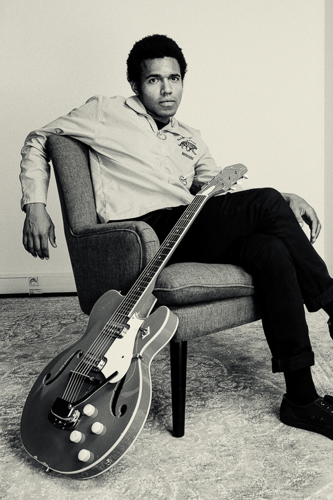


Sometimes the only way to get through is to get out. Such was the case for Benjamin Booker, who found both personal refuge and artistic inspiration when he left his home base of New Orleans to spend a month by himself in Mexico City. Booker took that trip after releasing and touring to support his self-titled debut album, a frenetic fever of bluesy garage rock released in 2014 that earned him the attention of national publications and plenty of fans hungry for the raw, unbridled energy of his live shows. The Mexico detour gave the 28-year-old Virginia Beach-born songwriter and musician the space to take a breather from the demands of touring life and to plot what would become his sophomore LP Witness, which was released in June.
Booker spoke with the Scene before leaving San Francisco — where he’d just played a couple of shows — to head to his current home in Los Angeles. In conversation, Booker is just as dynamic as he is in performance, excitedly zigzagging from one topic to the next.
“New Orleans was pretty rough at the time,” he says of his decision to leave and spend time in Mexico. “I burned a lot of bridges in that town. I was having a rough time there. I got shot at a couple weeks before I went to Mexico City. I needed to leave. So I went down there, and it was the perfect place to escape.”
While Booker didn’t intend for his stint in Mexico to be a professional one, he ended up writing the bulk of Witness during his time there. The album is a marked departure from Benjamin Booker, stretching the garage-punk of his debut into expansive, often soulful rock. As a whole, Witness feels like an album by an artist who’s finally had time to catch his breath.
“I rented an apartment [in Mexico City] for a month and ended up writing in that time,” he explains. “It was nice, because I brought a guitar with me, but I didn’t plan at all on coming back with an album.”
Unencumbered by time constraints, Booker was able to explore ideas and textures that had been on his mind while out on the road. He distilled musical influences like Sly and the Family Stone and Neil Young, while writing through troubling events that had nagged at his consciousness, like the 2012 killing of Trayvon Martin by George Zimmerman. Those considerations are never more evident than they are on the album’s title track, a gritty modern gospel anthem with pointed lyrics like, “We thought that we saw that he had a gun,” which features vocals from Mavis Staples, whom Booker describes as one of his “favorite singers of all time.”
The song serves as a thesis statement for the album as a whole, on which Booker’s songwriting looks inward in ways it hadn’t before. That move to the more personal came, in part, from an encounter with a passage in Don DeLillo’s 1985 novel White Noise that spoke to Booker on such a deep level that he has it memorized: “What we are reluctant to touch often seems the very fabric of our salvation.”
“That [line] was the beginning of writing the whole album, seeing that and realizing that the things I need to write about are the things I’m uncomfortable with,” Booker says. Elsewhere on Witness, he embraces other uncomfortable topics. Opening track “Right On You” looks at reluctance to come to terms with mortality, and it’s laid over a driving beat and dark, spacey effects, as Booker sings, “I’ll be fine / I’ll stop at 25 / They say kids these days will live forever.” The ethereal blues of “Believe” documents the difficult quest for individual spirituality, while the quietly percussive “Truth Is Heavy” grapples with interpersonal relationships, as he sings, “My problem isn’t all my baggage / But how I let it get to me / Having trouble trying to accept the fact / That someone could love me.”
“I was in a different space.” Booker says of writing Witness. “Usually when I’m writing stuff, it’s pretty closely tied to what’s happening at that point in my life. At this point, there was more space in my life. You can hear that on the album.”
Now, several months after the release of Witness, Booker says he can feel himself and his band settling into performing the songs. He seems pleased with how they open up a fuller picture of his personality.
“I think you just try to do the best that you can to understand, and speak to that,” Booker says.
Email music@nashvillescene.com



Post a comment as anonymous
Report
Watch this discussion.
(0) comments
Welcome to the discussion.
Log In
Welcome to the discussion.
Keep it clean. Please avoid obscene, vulgar, lewd, racist or otherwise abusive language. Comments featuring hate speech or threatening or violent content will not be tolerated.
PLEASE TURN OFF YOUR CAPS LOCK.
Be truthful. Don't knowingly lie or mislead.
Be proactive. Use the “report” link on any comment that violates our comment policy.
Share with us. We'd love to hear your feedback.