
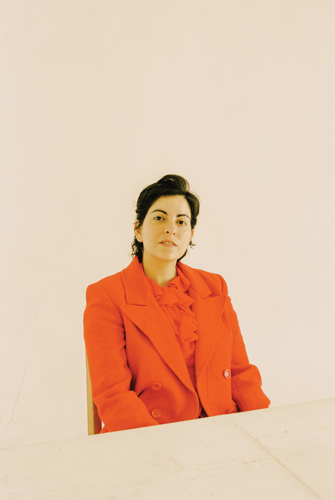
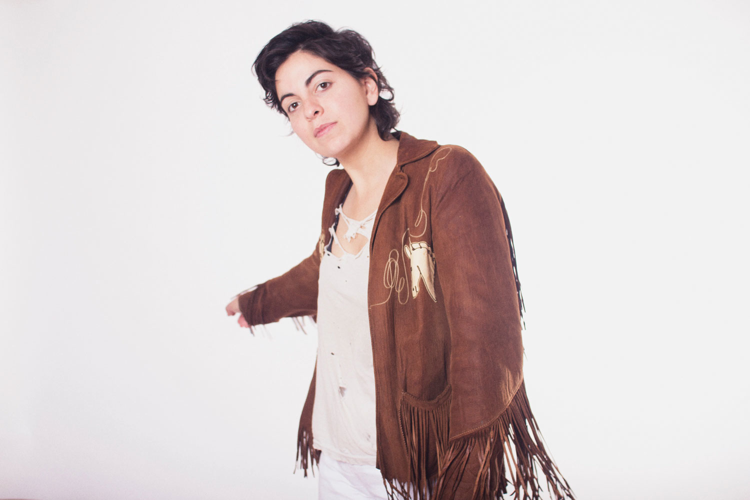


Becca Mancari
"We labored many hours together to come up with the smallest details,” says Nashville singer-songwriter Becca Mancari about the process of recording her richly textured debut full-length Good Woman. Mancari and Music City producer Kyle Ryan make the details count throughout the record, a set of pop-folk songs that are divided between introspective and extroverted. Mancari and her band had perfected the album’s nine songs on the road before they entered the recording studio.
“We’d already written our parts,” Mancari tells the Scene as we sit outside an East Nashville coffee shop. “I don’t ever wanna do a thing where I go to the production and am by myself, and then go to the producer and say, ‘Now, make me nine songs.’ That’s not my philosophy.”
Mancari has developed her democratic philosophies of music and life through years of traveling. She was born on Nov. 12, 1986, in Staten Island, N.Y., and moved at age 3 to Newport, Pa. Her father, a fundamentalist Independent Bible Church pastor, relocated the family to West Palm Beach, Fla., when she was 16. Mancari became an adaptable traveler whose ability to absorb the atmospheres of new places has informed her songwriting. Making her way around the world in her early 20s, Mancari survived what she describes as a harrowing sojourn with her father in Zimbabwe. But it was her 2005 journey to Lynchburg, Va., that proved especially important.
Mancari moved to Lynchburg to attend college, but quickly turned her attention to songwriting and performing. She also became immersed in the city’s community of train-hoppers and transient musicians. As she found her way inside a group of outsiders whose code of solidarity she respected, she began to assess her own feelings of exclusion.
“I felt outside my whole life because of who I am,” she says. “I’m a queer musician.”
Mancari praises her parents for their faith in her musical abilities — they bought her what she says was “a really good guitar” when she was 14 — but her identification as queer strained her relationship with them. “My folks loved that I played music, and they did support me in that,” she says. “They definitely believed the music aspect [of my life], but they couldn’t get past some other things.”

Yet another move brought Mancari to Nashville in 2012. She got an opportunity to perform a special Record Store Day 2016 show with pioneering gay country-rocker and LGBT rights advocate Patrick Haggerty, whom Mancari describes as a key influence. “Patrick is one of my greatest heroes, because he’s alive and well, and he fucking believes in it,” she says.
Ryan, who has worked as guitarist and bandleader for country-pop performers Kacey Musgraves and Mindy Smith, met Mancari after the show with Haggerty. As she says, Ryan had been attending her performances for months. He advised Mancari to avoid standard Nashville country-rock and concentrate on creating innovative sonics that would complement her songwriting. Their intricately layered work on Good Woman strikes a balance between folk-rock and indie pop.
Mancari and Ryan’s aesthetic on Good Woman subtly shifts the focus from her spare, vexed lyrics to music that’s engaging and slightly eccentric. Still, Mancari writes about her lust for a woman whose allure makes her “hot like the stones on the Tennessee ground” in “Summertime Mama,” and mourns the absence of a former lover in “Arizona Fire.” Good Woman is a superb record about the distance between desire and reality, and Mancari creates lyrics that express her personal experiences while remaining true to universal emotions.
The album reveals Mancari as a miniaturist who favors oblique narratives. Ryan’s production employs numerous guitar licks, pedal-steel flourishes and subtle keyboard touches, and Mancari delivers her minimalist poetry with élan. The record’s “Waiting So Long” is a tapestry of guitars that shimmer and dissolve in intricate patterns. Against that backdrop, Mancari essentially repeats the song’s title for nearly three minutes, punctuated by a charged question that comes out playful: “Why you living in the dark?”
“Kyle is a master at putting the finishing rug in the room,” Mancari says. “He know’s what’s missing. I write in a way that’s pretty direct, and I think it’s really cool to focus on sounds. So it’s not, to me, about a genre at all. It’s about what we’ve created together.”
Mancari’s new music is pure pop Americana for now people, and she seems pleased when I tell her that I hear Good Woman as catchy pop. Her work has affinities to the post-pop music of, say, Texas-born singer Kevin Morby, who bends The Germs’ snarling and grating 1979 song “Caught in My Eye” into a superb folk-pop meditation on his recent collection City Music. Much like Alabama Shakes vocalist Brittany Howard and Nashville singer-songwriter Jesse Lafser, who perform with Mancari in the trio Bermuda Triangle, she seems equipped for crossover success.
I ask her if she has ambitions to write Nashville-style country-pop hits, and she gives me an answer suitable for a traveling musician.
“If I were to write this really great, catchy country song, sure,” she says. “I’ll put that money down and buy me a house.”
Email music@nashvillescene.com



