
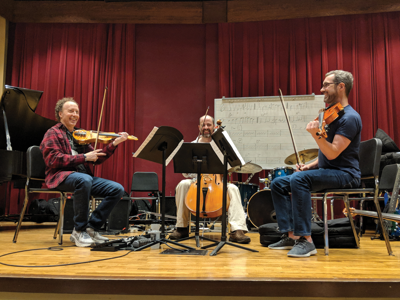


Whenever composer and Alias Chamber Ensemble violist Christopher Farrell writes a new piece, he always wonders the same thing.
“I wonder whether anyone is going to want to hear what I wrote more than once,” Farrell tells the Scene. “My entire aesthetic is based on the idea that I want to write music that people will actually listen to and enjoy again and again.”
Farrell’s latest piece, a multi-movement work for electric violin and string quartet, gets its first performance courtesy of the Alias Chamber Ensemble July 12 at Ingram Hall. Alias’ program will also feature new music by cellist and composer Matt Walker and electric violin phenom Tracy Silverman. And fortunately for Farrell, his new piece Tennessee Roads is all but guaranteed repeat performances, since it’s being included on Alias’ forthcoming album. The ensemble’s three previous recordings were each devoted to the music of prominent American composers. For its fourth record, which will be self-released in January, Alias opted to do things differently.
“We wanted this album to be closer to home, so we decided the recording should focus on the music of Tennessee-based composers,” says Zeneba Bowers, a violinist and founding member of Alias. “We also decided this should be a concept album that celebrates the people, places and music of our home state.”
For that reason, Alias’ program comes across as a kind of sonic postcard of the Volunteer State. Farrell’s piece commemorates three iconic roads associated with Tennessee’s Grand Divisions: the Newfound Gap Road that traverses the Great Smoky Mountains in East Tennessee; the Natchez Trace that stretches westward to Natchez, Miss., from Middle Tennessee; and the portion of the Great River Road that traces the edge of West Tennessee. More than just paying tribute to the highways, it captures the essence of the land through which they pass.
Much of the work’s success in conveying this ambience is due to the versatility of Silverman’s six-string electric violin. Silverman’s instrument encompasses the full range of a string quartet, from the translucent top notes of the violin to the dark-chocolate bottom notes of the cello. Add to that the electric violin’s capacity to produce loops and drones, and you end up with a veritable string orchestra’s worth of sound.
“Basically, the range of the electric violin allowed Chris to write Tennessee Roads as if he had a sixth musician instead of just five,” says Silverman.
The first movement, “Newfound Gap,” opens with an extended drone from the electric violin, suggesting the thick blanket of morning fog covering the Smokies. Members of the string quartet weave in sounds reminiscent of bird songs. Then, two musical ideas come together in “Natchez Trace,” the work’s middle movement. The first is a fiddle tune, appropriate given the fact that the Trace’s 440-mile path ends at Nashville. It’s followed by a deeply felt hymn-like melody, and Farrell explains that Silverman’s amplifier allows his part to soar above the other players. In West Tennessee, the Great River Road follows the course of the Mississippi River, and in the final movement “Great River Road,” Farrell calls on the electric violin to play a four-bar loop to imply the river’s meandering flow. “The loop evokes the idea that the river is constant, while the rest of the music suggests that the river is also always changing,” Farrell says.
Walker, Alias’ cellist and another of its founding members, has been the group’s most prolific composer, having written nearly a dozen pieces for the ensemble over the past 16 years. Like most of his compositions, his new piece Quartet Out of Time is deeply rooted in jazz, blues, gospel and folk music.
“Chris and Tracy found inspiration for their music in the geography and topography of Tennessee,” Walker says. “My piece differs from theirs since my inspiration is drawn from Tennessee’s musical culture.”
Walker derived his work’s name from 20th-century French composer Olivier Messiaen’s Quartet for the End of Time. He also borrowed that famous piece’s unusual instrumentation of B-flat clarinet, violin, cello and piano. But the similarities between the two works end there. As Walker’s title suggests, his piece engages in a lot of rhythmic and metrical sleight of hand.
Silverman has written two works for the program. His first comes as a surprise since it’s scored for the acoustic instruments of a traditional piano trio. There’s no rocked-out reverb in The Harpeth River, though there is a considerable amount of sonic imagery that calls to mind the fog, birds, bugs and other critters often found along the riverbank.
His second piece, The Cumberland, is a string trio scored for electric violin, viola and cello, and it features one of his signature techniques, called “ghosting.” In classical music, a group of 16th notes will all get the same emphasis, but Silverman emphasizes some notes over others, creating an effect like strumming a guitar.
“In my music, not all 16th notes are created equal,” he says.



