

The Spin shuffled toward What Stage for the grand finale of Bonnaroo 2016 with modest expectations. Having spent the previous four days essentially living in the lot with the flower children, buskers and dealers, we were left with the actual Dead & Company show. And when the posthumous incarnation of The Grateful Dead — formed following the Fare Thee Well 50th anniversary-slash-retirement shows last summer, with John Mayer, Oteil Burbridge and Jeff Chimenti alongside original members Bob Weir, Billy Kreutzmann and Mickey Hart — pulled into Bridgestone Arena last fall, what happened onstage was the least compelling thing.
But inasmuch as loving the Dead is like having a favorite sports team, questions about how one of our favorite institutions is faring these days led us to stick around. Had John Mayer come any closer to finding the key that will let him escape the blues-splooge box? Even if the true Dead died with Jerry Garcia, can this new band honor the legacy by making the songs you know so well feel fresh, holding you on the edge of your seat — or patch of dusty grass — as you wait to see where the threads will lead? In a word, can they jam?

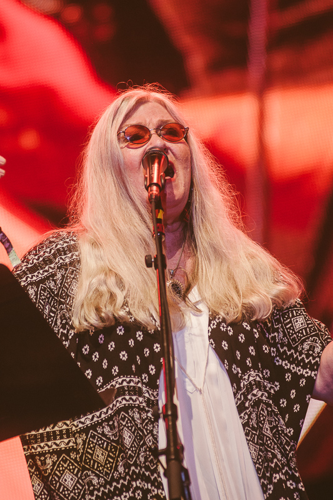
Donna Jean Godchaux
As the sun sank behind the treeline, the band eased into opening number “Truckin’,” a little slow and clunky but an improvement on the last time. As they tuned up for “Bertha,” Donna Jean Godchaux materialized from backstage. The Muscle Shoals-born singer, who, along with her late husband Keith was integral to the Dead throughout their ‘70s heyday and known to perform with Weir’s RatDog and other Dead-related offshoots, was not involved in Fare Thee Well. Her vocal contributions aside, her debut appearance with Dead & Company, giving the band grandmotherly hugs, was like Queen Elizabeth II rising from her throne to give her blessing.
Despite Godchaux's presence, the first set clanked and sputtered a bit as the band made its way through “Bird Song” and the obligatory sing-along “Tennessee Jed.” Mayer was more restrained than when we saw him last, but still tended towards overshooting, even if by inches rather than feet. It still felt like everyone was working at getting on the same page during “Shakedown Street,” but we went into the intermission on a high note, as “Casey Jones” morphed into an uptempo gospel-tinged stomp by the end.
The second set, the traditional time for extended improvisation, was where the most was on the line. Typically, the Sunday night headliner has the poorest attendance of the weekend (which, as if it wasn't already obvious, festival organizers admitted was down this year), as sunburnt, dirt-caked ‘Roovians make a beeline for the interstate, but Dead & Company appeared to pull a bigger crowd than either LCD Soundsystem or Pearl Jam. Symbolically, this brought the festival full-circle to its earth-biscuit roots for its 15th anniversary. Practically, it meant there were a lot of jam fans who could either walk away utterly thrilled or thoroughly disappointed. Nobody looked disappointed as we cruised through the crowd to people-watch. Their may be more glow sticks adorning their bodies, but otherwise it looked like a Classic Dead crowd — everybody was dancing.
The second set kicked off with “Help on the Way” into “Slipknot!”, tunes from the Dead’s mid-’70s jazz explorations and a secret weapon for D&C, as they fall right in the middle of the Venn diagram of the new members’ strengths: Mayer’s technical precision, Burbridge’s organic bass groove and Chimenti’s light touch on the keys.

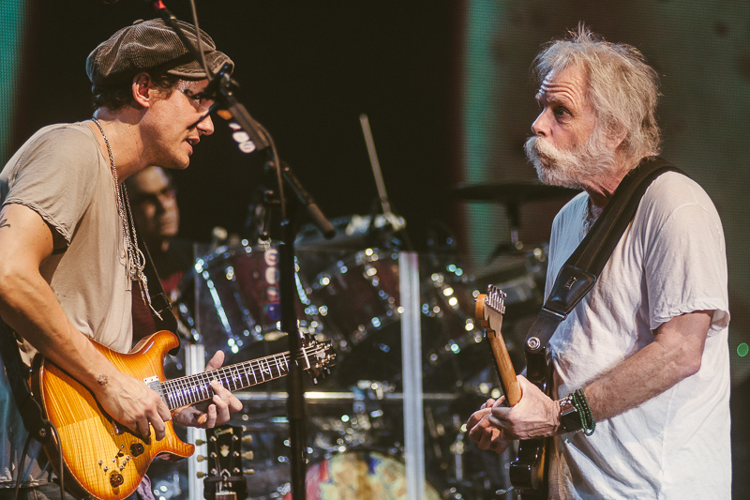
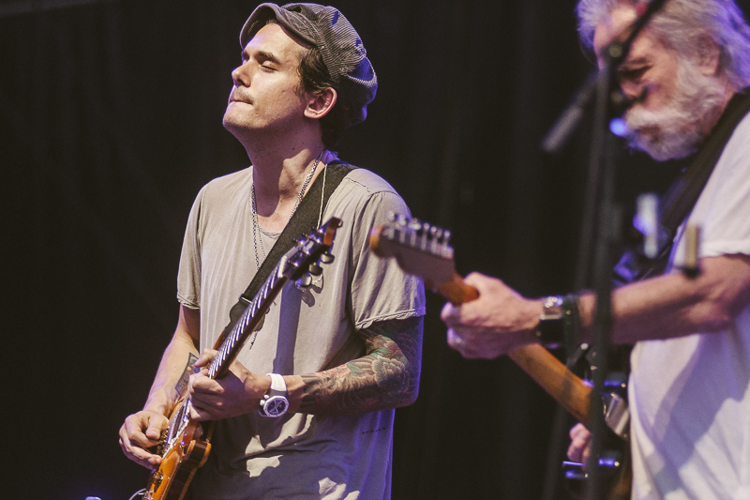
John Mayer with Dead & Company at Bonnaroo 2016
Then, the familiar contours of “Slipknot!” dissolved into unfamiliar territory, and we braced ourselves for a wearying barrage of scales from Mayer. Instead, he started sliding in riffs behind Weir. Pinwheel-eyed mad scientist Hart and stoic timekeeper Kreutzmann locked into elliptical orbit. Burbridge and Chimenti worked together to bring in a little Cuban flavor. We had an honest-to-God jam on our hands, and it was damn good — wobbly in all the right places, unpredictable.
Eventually, it coalesced into “Scarlet Begonias,” followed by its familiar partner “Fire on the Mountain.” A segue into an epic “Terrapin Station” led to a shining moment for Mayer, which had nothing to do with his guitar. Taking the lead vocal, he let his identity disappear into the story, singing without any of the put-on breathiness that usually leads us to change the station when we hear one of his songs. “His job is to shed light but not to master,” as the lyric says, and Mayer finally found his way to it.
“Drums” and “Space” saw Hart and Kreutzmann sneaking a little EDM onto the fest’s main stage, where it had mostly been kept to the perimeter this year. A mellow “Wharf Rat” became a majestic hymn, with the band backing a solemn Weir to the hilt. Then the boogie came back to a boil as the playful melody from “Franklin’s Tower” wound its way up through the jam, bringing the second set to an endorphin-rushing close. The band barely had time to leave the stage before rotating back to encore with “Touch of Grey,” their wry ode to beating the odds and their one and only chart-topping hit.

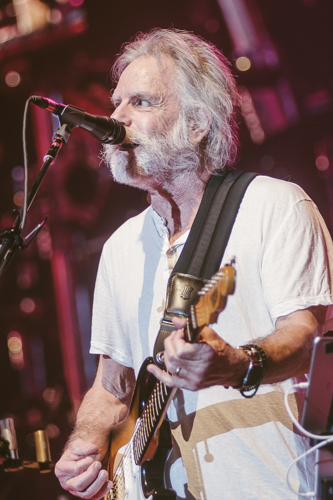
After everyone took a bow, Weir picked up the mic one more time, addressing the mass shooting at a gay nightclub in Orlando in the early hours of the morning.
“Last week,” he said, “a distinguished representative of the state of Georgia went on the floor of the House of Representatives and quoted Bible verses saying that gay people deserved death. After the shooting, the Lieutenant Governor of Texas tweeted, 'Well, they're gonna reap what they sow.' I want to ask you a question. Is that mindset any different than the Taliban or Isis?”
“No!” roared the crowd, in their loudest unified response of the night.
“It's the same hatred,” Weir continued, his voice firm with clear-eyed contempt. “They pull it out of different books, but it's the same fucking thing. Register to vote and get those assholes outta there.”
Time can steal a lot from a rock star. With nostalgia for rock's glory days at an all-time high, there’s not much incentive to make a statement about anything, even if your fans are likely to share your sentiment.
But as much as anything Dead & Company could do as a band, seeing Weir use his platform to make a strong, clear statement from the heart and the electric response to it was a inspiring reminder of the power music has to unite people who may not have much else in common. That’s a precious thing, worth all the sweat and dirt in Manchester.



