
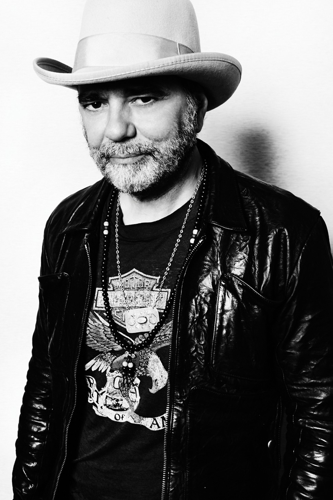


Daniel Lanois is best known for his groundbreaking production work with a wide variety of acts including U2, Bob Dylan, Emmylou Harris, Willie Nelson, Neil Young, Peter Gabriel and Brian Eno. But he's a great musician in his own right, and just released Flesh and Blood, an album of mostly instrumental music that's pretty splendid.
Lanois performs tonight at City Winery. Accompanying him will be two of the musicians who played on the new album — Jim Wilson on bass and Brian Blade, one of the greatest drummers on the planet — not to mention a slew of fascinating electronic gewgaws and doodads.
The Scene spoke with Lanois for a preview piece in advance of the show. Among the topics discussed: the creative process behind Flesh and Blood, studio wizardry versus human performance, U2's new album and the mercurial Bob Dylan.
I've had discussions with a songwriter friend of mine about instrumental music. He would say that instrumental music is great for creating ambiance, but that words are the preeminent tool for expressing the human experience. To me, there's a whole world that can't be expressed in words, that instrumental music can more effectively express. Listening to your new album Flesh and Machine, I get the impression you feel the same way.
I like to think of instrumental music as embracing the universal language. Reaching people and touching hearts, there are a lot of ways to do it. I listen to Tinariwen, from Mali, and I don't know what they're singing about, but I like hearing them, and I'm touched by their voices. I made an effort on this record for voices to live amongst the instruments. That track "Sioux Lookout" has moments in it that I swear it sounds like a whole village chanting from over the hill. Those are voices. They may not be specific to a lyric. They don't speak a lyric language, but they are a communication, and they will draw an emotion from people. Or I hope they will! [Laughs.]
Now on the Leonard Cohen scale, I'm not going to disagree with your friend! So he's absolutely right in that regard. When you talk to him next, ask him how feels about a universal language. Get him to call me!
Like some of my favorite instrumental records — for instance the Latin Playboys' stuff — Flesh and Machine almost sounds like a soundtrack to an imaginary film. Do you strive for a cinematic experience, musically speaking?
It's been said that my music is cinematic. It's part of a process for me. Images do come into my head. I thought that "Sioux Lookout" was a contemporary native chant. "Iceland" had a little something in it, that … I've never been to Iceland, but I imagine that's what it's like. So I named it that because it painted that kind of picture for me.
So the title "Iceland" was conceived after you recorded it. It wasn't like you were thinking about Iceland while you were composing it.
Exactly. It was a very raw piano and drum performance initially. And then I started applying my sound processing to the piano, and I overdubbed dulcimer, and it started feeling almost like a little folk song. But not something that belonged to America. It's what I imagine Icelandic folk music might be, and I named it that.
Sometimes it's good to pick up on a term or a tonality that drives the direction of the sonics from there on. There's a very sweet film that Jim McKay made to run in tandem with that. It's his daughter dancing in the woods. My friend Adam Vollick added all the color, and had sort of an icicle look applied to it.
Are the voices on the records yours? Other people's?
My voice is on "Opera." I sampled my own voice and then created seven different pitches that I put on my multitrack, and played the console like a keyboard. My friend Rocco DeLuca sings on the opening track, "Rocco." His voice is also in the background of "Sioux Lookout" and I think in one or two other spots. The initial track is probably the truest representation of his voice without weirding it out too much. [Laughs.] There are other tracks, like "Sioux Lookout," where I manipulated his voice. He's the guest singer on this record, a dear friend. I produced part of his new album. We're neighborhood Silver Lake friends.
Do you like the Silver Lake area?
I've had a studio here for a long time, about 14 years. I didn't know it was meant to be cool. I just found a house where I thought, "Yeah, I could put a studio in here." Then it blew up and I looked like a financial genius.
Are Jim Wilson and Brian Blade in the band coming to Nashville?
Yes, exactly. Brian Blade and Jim Wilson will be in the tour coming up. We start in Toronto and we're going to make our way to New York, L.A., San Francisco.
Is it a challenge to re-create the sounds on that record in a live setting, or do you even try to do that?
I'm bringing, what I'm calling a studio to the stage. I've built these multitracks, kind of condensed my multitracks down to eight tracks. And I've convinced Brian Blade to play to metronomic time for these shows, which is a big breakthrough.
So he'll be playing to a click track?
Well, we don't use the term "click track" around here, because I don't want to lose my friend. I said, "Brian, I've got this really nice tabla box thing that I'd like you to be loyal to." I used those words, "loyal to." [Laughs.] But he's got the heart of a lion, and he can roll with me on a good few things.
That's it, I'm taking these multitracks to the stage. I've got all my echoes timed. I do some kind of Jamaican dub type echoes. I sample on the run, so every night is fabulously different.
Are most of the tracks on Flesh and Machine composed in a more traditional way and then recorded, or are they more the results of experimenting in the studio, or both?
I think "Sioux Lookout" is an example of something that was very sculpted in the studio. It was a Brian Blade beat that I liked a lot, and I just kept building on top of that. I turned his bass drum into the bass part — I have this little computer program that allows me to feed in an acoustically recorded drum. it was essentially a jazz kit recording from Brian. But the bass drum was isolated enough that I was able to send it to this little device, and it spit more of a Roland 808 kind of sound back at me. But dynamically responsive. And then I was able to take that new isolated 808-type sound and put it through my P.A. at deafening volume through a fuzz wah pedal. And now the bass drum had that buh-wong, bong-bong buh-wong sound. So I vari-sped my recorder so that note was now the root note of the song. And I printed that. Once I got that, and it sounded striking to me, I put it back into the computer, and we created seven other pitches of that note. And then I played the console like a keyboard and I built this line that is perfectly in synch with Brian's bass drum because that's where it came from. So it's an interesting marriage of a very acoustically played instrument with this technology applied to it. That gives you a little bit of an example of the blood, sweat and tears and the labor I put into this. [Laughs.]
Other things were composed, like the "Iceland" tune. And some of them are just wild creations in the studio.
In your live performances is there any improvisation, or is it mostly rehearsed?
There's a lot of improvisation. I still have my steel guitar with me, so there's a moment in the set where I do this ramp-up to this tune of mine called "Sonho Dourado," but there's about a four-minute ramp-up that's just improvised. I just do that with Brian. He loves all that because he's a specialist with improv. He's amazing. We have so many years under the belt together that we largely operate by telepathy.
I think a lot of people see a dichotomy between a natural, organic approach versus an electronic-studio-wizardry kind of approach. But you seem to be one of the few producers who bridges that gap: using technology to create something that also sounds organic. Is that something you're striving to do?
Well, that's very well put. The record is called Flesh and Machine and it stands for that tightrope I've walked all my life. I have to deal with technology and I've got to deal with people. And isn't it great when the two add up to something special that draws an emotion from listeners? I have a responsibility here to embrace technology and embrace hand-played instruments. Authenticity, in the end, is what we want to get to. I'm quite proud of those moments, if I'm lucky enough to get that place where things still sound organic but there's obviously technology in there somewhere. I think it's very representative of where we're at culturally. I don't want to just make things we already heard in the ’70s. I respect the past, I respect everything that I've operated by philosophically, but I have a responsibility to the future.
This little track called "Two Bushes" I think represents that very well. That was a deconstruction. Those sounds were only meant to be hidden sonic details in the background of the song, but I took away the song, and made those details foreground. And it's quite beautiful, because it sounds like an orchestra, but you don't know what the instruments are. I'm quite proud of that. That's how I see the future.
Speaking of responsibiity to the future, as a producer, it seems like you challenge artists to venture beyond their comfort zones and reimagine themselves in a different way. Is that something you consciously try to do?
Well when I'm working with people, I obviously respect everything they've done. And they are generally artists who have made masterpieces in my absence. And I know they don't want to make that same record they did before. They want to make a masterpiece. And it's my responsibility to respect the past but present them with the possibility of a new direction. And we do that largely by devotion. You just show that you really care for someone, and want the best for them, then they're going to trust that whatever you pull out of them is not some premeditated blueprint plan. But it's something that belongs to this new vision. I like to invent that stuff on a daily basis. I may come in with a few sounds and a few suggestions from my experiments, but I wouldn't ram anything down anybody's throat. I think when I work with people, they feel like a really care about them.
My favorite albums you produced are the ones by people who are typically thought of as roots music types: Emmylou Harris, Willie Nelson, Bob Dylan. As someone who came from more of an ambient and electronic background, what drew you to artists so fundamentally roots artists?
I'm a Canadian kid from a small town, and to have an opportunity to work with some of the treasures of America, I just rose to the occasion, and respected the implication. I thought, I've got to do something with these people that will allow them to flourish in a different manner. I wanted to make a great record with Willie Nelson. I didn't want to make a bad Willie Nelson record.
I love Teatro, by the way. That intro with Willie's guitar playing, "Ou Es-Tu Mon Amour?," is just absolutely mind-blowing.
Well that's a fine example there. I rode on the bus with Willie to the studio, eight hours. I asked, "Willie, what was it like when you got started? What were you all about?" And he says, "Well I love Django Reinhardt. So I learned to play all those Django parts, learned all those odd little chords." And he says, "We were primarily a dance band back in the day. We played on the weekend, and people danced."
So I decided I would set up the recording studio as an old dance hall. So that's what I did. I had a nice little crew to work with at the time. So when Willie turned up in the studio — it was an old Mexican theater in Oxnard [Calif.], El Teatro — he walked in and said, "Wow, this is just how I remember it when I was a kid." I was able to rekindle that fire he had when he was getting started.
So he was all excited about that. Man, we knocked that record out in four days. The secret being that I played all the bass. That way I didn't have to put up with bass players playing the wrong notes.
You could hit the wrong notes instead!
[Laughs.]
My favorite song on Wrecking Ball is "Deeper Well," which you wrote with Emmylou and David Olney.
Boy, we did a lot of versions of that. We tried it fast, we tried it slow. But in the end it's essentially a Bo Diddley beat: Dum da-dum da-dum, da-dum-dum. It's not anything that Emmy had done prior to that. She really embraced it and she sang it in that low range. She has such a beautiful wide range. I wanted people to hear the more guttural part of her range.
Time Out of my Mind was a revelation for me. It's my favorite post-1976 Dylan record. As dark as some of the music was, I feel Dylan came out of a fog in that record, and seemed reinvigorated and relevant again. But I've read in interviews that there was some conflict and frustration, and he wasn't totally happy with it, which I find amazing, because I think it's some of his best work. Do you think artists sometimes have a problem if the music doesn't fit their preconceived notion of themselves?
Well you're always going to have some discomfort in the studio, because that's part of the process of making new discoveries. On Time Out of Mind we had 11 people in the studio, so I felt I was a conductor more than a record maker. But I played guitar on that record, and I felt connected with the band, and I worked very hard on the arrangements, so in the end, no matter what anybody was feeling, everybody understood they were all part of the same band.
But it was a little uncomfortable at first because the drummer that we initially had, whose name I'm not going to mention, didn't work out. He had to be sent home, and I brought in Brian Blade and Jim Keltner. Tony Garnier is a great bass player, works with Bob. I felt once I got the rhythm section intact, everything else could coast on top.
We did have a couple of moments. But in the end it won the Grammy Award, the Best Album of the Year. All is forgiven, all is forgotten, and let's celebrate life and the future. [Laughs.]
It seems to me that what you're trying with both your own music and production work is to create work that is transcendent or hypnotic, that takes the listener to a different place. Music that's mind-altering. Is that how you see your approach?
Well I think that's the job of art, to alter. You can't just be an observer or a passerby. I don't think that's good enough. So if you can shake people up a little bit, and cause them to look at the man in the mirror in a different fashion — that's what I want to feel when I come out of a film. I want to feel some kind of power to modify my life. Not just to be entertained. That's my idea of a masterpiece, if you can take a listener on a journey, or maybe their values shift a little bit, because they hear a lyric line from Bob Dylan that causes them to have a change of heart about something, or pursue a thought, pursue an idea. If I can pull that off, with a great artist, with Emmylou: [singing] "Waterfall, nothing can go wrong, my sweet waterfall." So, "Baby, I love you so much, nothing could go wrong in my life, as long as I'm in your presence." It's a beautiful thing to say, and maybe someone didn't think they had that power in them until they heard that line. That's just a small example of the responsibility that I feel I have with my work.
That was a Hendrix song originally, "May This Be Love."
Exactly. And I thought, there's something about Jimi's version that had a little country guitar playing, so I brought it to Emmy's attention. She said "I love Jim Hendrix." It was a sweet place to go to. She lived in the Village [when Hendrix was there], so it was kind of a nice homecoming of sorts.
Have you heard U2's new album, and what do you think of it?
I heard the new U2 album a year and a half ago. Bono came to my house and he said, "Would you listen to the record with me?" And I did. And it sounded fantastic to me then. It was full of energy and live and invention. I haven't heard the latest rendition, believe it or not. I'm letting a little of the campaign dust settle.
When you listen to an album like that, by someone you've worked with, is there a tendency to think about what you would have done differently?
Well, not really. I don't think, "Gee, I could have done better." I don't have those kind of thoughts. I listened to the new record thinking, "Did they work any of the stuff that we threw out before into the new record?" [Laughs.]
What are you working on right now?
I'm just getting my road rig ready for the tours. I'm in the studio preparing these multitracks I'm going to take to the stage, and twist Brian Blade's arm so he plays along with them. And that's it. We're just get on the bus and spread the gospel.



