
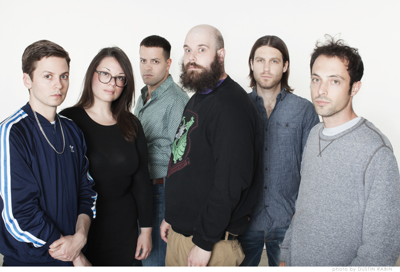

Fucked Up is a band that you experience more than you hear, and the totality of that experience defies description. But here goes nonetheless: a three-guitar Canadian hardcore powerhouse with a pounding rhythm section and a bald-headed, Grizzly Adams-bearded frontman who charges through the crowd shirtless, smiling maniacally, bear-hugging fans and rolling on the floor while shouting introspective lyrics in a voice like a professional wrestler atop pop-punk chord progressions and heavy-metal guitarmonies. Take into account their NSFW band name and you might expect an experience along the lines of getting spit on and kicked with a steel-toe boot in the mosh pit. But Fucked Up shows, like the band's music, are as catchy, fun and uplifting as they are aggressive and abrasive.
In a YouTube trailer for the band's latest LP, Glass Boys, Sean Yeaton, bassist for Brooklyn post-punk revivalists Parquet Courts, describes Fucked Up thusly: "When you're spinning the record on your turntable, there's sort of a spirit that comes out of the grooves. But seeing them live is like this whole other experience — you almost feel like you're in the presence of, like, a cult leader or something like that."
Close, but still no cigar.
"That's an amazing thing to have to deal with — to be in a position where you have to deal with people's preconceived notions about what your band is gonna be," boundlessly ebullient singer Damian Abraham tells the Scene via phone from Toronto. He's driving around with his wife and kid — not exactly what you'd expect for a punk star. He also hosts a TV show, The Wedge, on Canada's MuchMusic Network, which is quite a feat considering the fact that his band name can't be uttered on television. In 2009, Fucked Up's sophomore effort, The Chemistry of Common Life, rather shockingly won Canada's prestigious Polaris Music Prize. The praise continued with their follow-up, the even more critically acclaimed indie breakout double concept album David Comes to Life — which, among other rock-star-like experiences, landed Abraham on the cover of SPIN and the band on football stadium and festival tours with the likes of Foo Fighters and Metallica.
"There would be times when I'd watch the end of [Metallica's] set and I'd be listening to [hardcore band] Integrity on my headphones being like, 'Imagine seeing Integrity playing a venue this big. That would be incredible!' "
"There's no way I ever expected that stuff to happen with [Fucked Up]," Abraham says. "This band was not designed to be that band. That's why it's amazing having to deal with people's preconceived notions."
Par for the course, Glass Boys, which came out last month via Matador Records, might come as a shock to the system for fans only familiar with David's big, open sprawl. The album is a sludgier, hard-hitting, terse 10 tracks that deal with mental health struggles and reconciling adulthood realities with youthful punk ideals. Two songs in particular — the drum-heavy fist-pumper "Paper the House" and the shout-along anthem "The Art of Patrons" — deal with Abraham's reluctant ingratiation into contemporary Canadian rock royalty.
"Glass Boys comes as a direct result of realizing I was now part of this Canadian music industry that I despised so much growing up," Abraham says. "How would my 23-year-old self in Fucked Up judge the 33-year-old version of myself in Fucked Up?
"It's definitely a denser kind of record," he continues. "I think the flourishes are played down. I think [guitarist] Mike [Haliechuk] gave it more of a dirge than the sparkling kind of guitars last time. David Comes to Life was almost like a fairy tale from our perspective in a way — writing this rock opera, sort of fantastical made-up village that it takes place in — so it has the dramatic flairs that didn't necessarily need to be there this time around, when it's more of a self-reflexive, internal-judgmental kind of record."
Suffice to say, the indie-celebrity status that came along with the happy-accident success of Chemistry and David didn't quell Abraham's lifelong struggle with depression and anxiety ("All the issues are definitely still there, right?"), but it did help him come to terms with it, albeit begrudgingly.
"I've gained a perspective on the anxiety in the wake of realizing that I wouldn't be able to do this without this anxiety," he muses. "This anxiety is what let me write these songs, which led me to want to be in a punk band to begin with probably."
Email Music@nashvillescene.com.



