

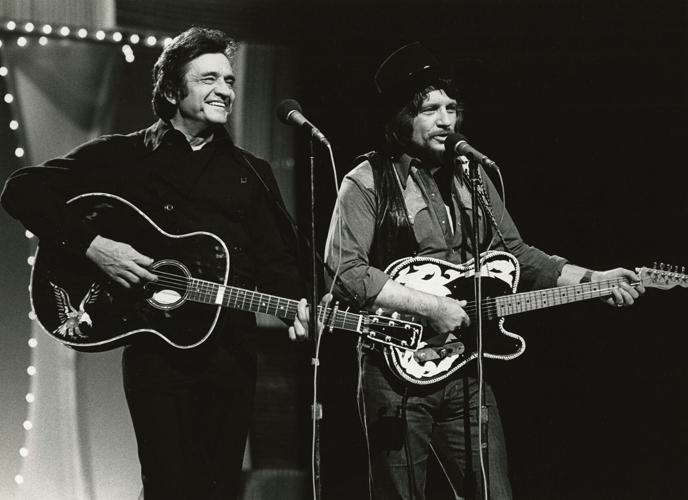
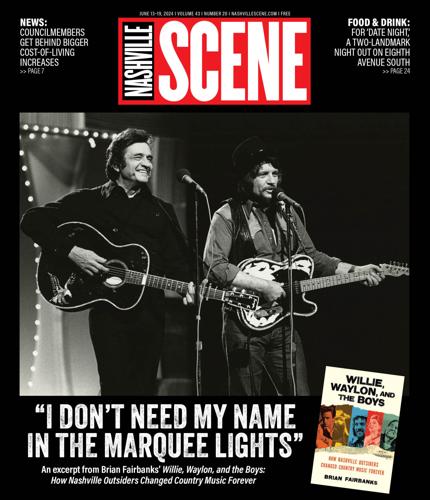


Johnny Cash and Waylon Jennings perform together during a 1980 TV special taping.
“I hope your damned bus freezes up again,” Buddy Holly told Waylon Jennings. “Well, I hope your ol’ plane crashes,” Jennings joked back.
This playful exchange took place between famed 22-year-old rock ’n’ roller Holly and his 21-year-old bass player Jennings shortly before what became known as the Day the Music Died: Feb. 3, 1959, when Holly, Ritchie Valens, J.P. “The Big Bopper” Richardson and pilot Roger Peterson were killed in a plane crash outside Clear Lake, Iowa.
Jennings originally had a spot on the single-engine Beechcraft Bonanza taking Holly and company to the next stop on their Winter Dance Party tour. But the Bopper had come down with flu-like symptoms, and thus the Texas-born Jennings gave up his seat, relegated once more to the cold and miserable conditions on the Winter Dance Party tour bus, chugging its way across the Midwest.
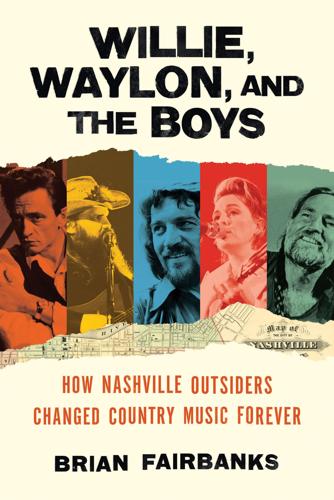
That fateful moment was one that would haunt Jennings for the rest of his life — and it’s a central thread in Willie, Waylon, and the Boys: How Nashville Outsiders Changed Country Music Forever, the brand-new book from New Orleans author Brian Fairbanks.

Brian Fairbanks
“Originally, I had the idea to do a book about Waylon Jennings,” Fairbanks tells the Scene. “You know, how does somebody go from basically making this morbid joke that becomes real and kills his best friend, and continue to make music for the rest of his life? What does that do to the person’s psyche? What does it do to their music?”
Ultimately, Fairbanks decided to broaden his pitch to include Jennings’ fellow members of country supergroup The Highwaymen — Johnny Cash, Willie Nelson and Kris Kristofferson — as well as modern-day country artists inspired by The Highwaymen’s legacy, like Jason Isbell and the all-women country supergroup The Highwomen.
Willie, Waylon, and the Boys, Fairbanks’ sophomore book, might seem like a major departure from his first. Wizards: David Duke, America’s Wildest Election, and the Rise of the Far Right, the author’s 2022 debut, was released by Nashville’s own Vanderbilt University Press and follows the bipartisan coalition that came together to defeat former Ku Klux Klan leader David Duke’s early-1990s bid for the Louisiana governorship. Structurally, Fairbanks tells the Scene, the two books have a lot more in common than you might think.

“This scenario is the same as Wizards, [which is] about the various Republicans, Democrats, candidates and random voters who came together to defeat David Duke, literally forming a coalition of the most ragtag, random group of people across the political spectrum,” he says. “And then [the book jumps] ahead several decades to Trump and Duke, but just tying it all together and showing how history repeats itself. … I find that fascinating. Despite whatever we do, and whatever warnings or things we change, American history does repeat.”
Willie, Waylon, and the Boys is bursting with fascinating stories from the annals of country music history — including the time several decades back when Willie Nelson got into a shootout with his own son-in-law. (That tale, the inspiration for Nelson’s song “Shotgun Willie,” is among Fairbanks’ favorites.) We at the Scene could’ve pulled just about any chapter from the book and made it this week’s cover story. But perhaps none is more fitting than the book’s fifth chapter, “Are You Sure Hank Done It This Way?,” which centers largely on Jennings’ dark days in the shadow of the Day the Music Died — including the singer’s brief and harrowing time sharing a Madison apartment with Johnny Cash.
Below, find the first two sections from Chapter 5 of Willie, Waylon, and the Boys. —D. PATRICK RODGERS, EDITOR-IN-CHIEF
Chapter Five: Are You Sure Hank Done It This Way?
“You lose all identity when you put a bunch of labels on something.
It’s a great compliment when they drop the labels off of you.” —Waylon Jennings
Honky-tonk patron: “Who the hell do you think you are? You’re just a kid. You don’t know nothin’.”
Waylon: “Sir, I may be younger than you, but I’ve been awake a long, long time.”
“They’re not doing enough for Waylon. They just don’t know what to do with him!” —A fan
The headliner at the Native American reservation bar couldn’t get up onstage. He sat hunched over near the stairs, head hung and dampened hair dangling over his forehead, angrily waving off the chanting.
“He resembled a biker chieftain,” wrote journalist Chet Flippo, “shiny black leather pants and vest, black needle-toed boots; beard, mustache and long dusty brown hair slicked straight back over his ears and flowing across the collar of his yellow shirt. His face—all angles—looked hard but his eyes were almost vulnerably gentle. They were always moving, questioning, evaluating, measuring.” Other critics were not as impressed: “The long, greasy hair could use a shampoo,” one wrote. But most fans cared only about his voice, all “honey and molasses on a biscuit, topped off with a pack of Marlboro Reds.”
The crowd alternated between aggressively cheering or heckling the singer for being a “bum,” saying they had paid their four dollars and they’d damn well better get it. But Waylon Jennings, thirty-five, didn’t believe in canceling shows. THIS IS NO DRESS REHEARSAL read a sticker he slapped on his road case. WE ARE PROFESSIONALS, AND THIS IS THE BIG TIME. Nonetheless, “the Chief” told the Waylors, his band, he was “sick and battered,” and they, not knowing what else to do, snickered nervously.
Jessi Colter, his wife and fourth within a single decade, met him stage right and, peering up into his face to kiss him, found it had developed a yellowish hue. She hesitated, then laughed at herself, thinking it was just a trick of the light hitting the golden fabrics of Waylon’s button-down. But Jennings couldn’t stand up straight, almost as if he’d thrown his back out playing honky-tonk songs on guitar. Something else was bothering him. Along Route 491 in Colorado that afternoon, he stopped near the New Mexico state line to meet the priest who booked him on the Southern Ute Reservation. The priest warned him of a hepatitis outbreak on the rez, so Waylon stuck to what he thought were safe bets: milk and pie.

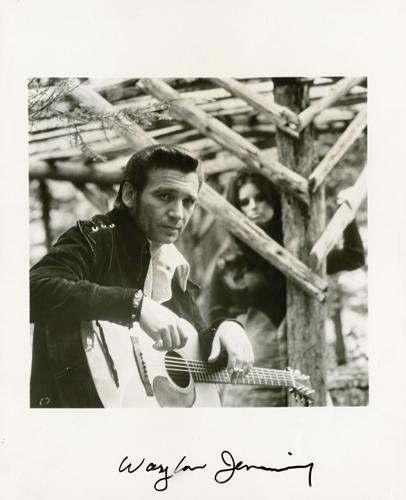
Waylon Jennings and Jessi Colter circa 1969
After “ten years on the road / making one-night stands / speeding my young life away,” as a song would later put it, his illness could have been brought on by any number of things. Jessi suspected botched dental surgery was to blame. It might have been the narcotics he’d been gobbling, or perhaps his touring regimen of three hundred shows per year for so little money; he often returned with less cash than he’d started with, and debts. Oh, the debts. The Waylors would have to be paid first, although he was doing them a favor at this point, using them as his touring band when Nashville wouldn’t even allow him to record with them. His choice would’ve been to flip the bird at Music City and use them in the studio, too, but RCA executives were emphatic. Like all Nashville label heads, they required seasoned studio pros to handle the delicate business of cranking out easily digestible singles, considering live bands too loose and untrained. It was another reason Waylon was thinking of getting out of the music business when his contract expired at the end of 1972. “How many years can I keep bangin’ around the honky-tonks?” Jennings asked rhetorically.
“Baby, you look real yellow,” said Jessi, touching his arm soothingly.
“Nah,” he said tersely. “It’s the reflection of this shirt.”
Jessi insisted he return to the hotel, and Waylon was on the verge of arguing—“Bullshit, I ain’t going”—when his six-foot frame toppled over. The nasty fall was cushioned by his wife, standing five foot four.
From the day the music died to that night near Gallup, New Mexico, Waylon Jennings had been living three or four lives at once. The hardest of these was the one that had taken over in the mid-sixties, when he was only twenty-six. Jennings moved to Nashville and into the $150-a-month Madison Apartments, a bug-ridden hotel ten miles from Music City already inhabited by methamphetamine addict Johnny Cash. Together, they turned the place into a full-time drug den.
Later, both men would marvel that they managed to last even a month in such conditions. There they were, blowing up balls of black gunpowder with sticks of dynamite for amusement, kicking down the door when one of them, home alone, latched it shut and passed out, and using amphetamine, an upper producing an effect equivalent to a half-dozen cups of coffee, all while trying to write songs and get some money in the bank. They alternately complained about their respective loves and claimed a reunion was just around the corner, with Cash later admitting: “The only woman who would talk to me is Betty Ford.” Their lovers—Barbara, Jennings’s third wife, and June Carter, Cash’s girlfriend—moved into separate apartments downstairs and tried to keep the men’s place tidy. They were essential. “Man, you’re the worst housekeeper I ever saw,” Jennings had told Cash on move-in day. “What have you been doing in the kitchen, fighting?”
“I cooked biscuits and gravy.”
“Do me a favor,” said Jennings, “and don’t ever cook me any.”
Carter would show up periodically to do the dusting and mopping the place needed practically at the top of every hour. Mysteriously, Cash’s amphetamines always managed to spill into the toilet. Once, while enjoying a visit from Bob Dylan, Cash hid in a closet when June came to the door. But Johnny would neither return to his estranged wife nor give up on June Carter, who repeatedly declined to marry him, even once breaking things off for five minutes, just long enough to discover he had stolen her clothes and hidden them in his hotel room to keep her from leaving. Within weeks, Waylon’s drug intake skyrocketed. “Twenty amphetamines a day was normal, and thirty wasn’t unusual. I’d hit the ground running; I never had a hangover because I never gave myself a chance.” At true low points, John, down from 200 to 140 pounds, would become “Cash,” a Mr. Hyde to Johnny’s Dr. Jekyll, as when the Man in Black cut all the legs off the furniture for no reason or tore apart his roommate’s car looking for his hidden stash, and then lied about it. One time, Cash hallucinated he “was an Indian flyin’ through the woods,” only snapping out of it when he discovered he was barefoot in a murky puddle.
“That Waylon,” said the Man in Black, deflecting. “He’ll take a doorknob down if he thought it would taste good.”
“Too much was never enough,” Jennings admitted of the Desoxyn, Alka-Seltzer, white cross, and coffee regimen that kept him upright. He wouldn’t ever eat, either, which made getting obliterated easy. Jennings’s drummer frequently arrived to find him comatose and would rush to check his pulse. On the other side of the living room, guitarist Luther Perkins might be pawing Cash for a heartbeat—“he’ll sleep twenty-four hours,” Perkins said. “If he awakes, he’s alive. If he doesn’t, he’s dead.”
But despite their seemingly parallel paths of self-destruction, the roommates didn’t discuss it. “While they knew that the other one was indulging,” recalled Waylon’s future wife, “they never shared their stash.” Later, they would regale fans with stories about those days, as if they had been just some goofy potheads.
“Hey, John, remember that time the cops pulled me over in Bucksnort, Tennessee, for writing a check for cocaine?”
“Yeah, and they didn’t even arrest you,” Cash said, “just took your stash and said, ‘Waylon, don’t write checks for that stuff,’ and sent you back to Nashville! Did you write ‘drugs’ on the memo line of the check?”
“Imagine being so strung out that they get me of all people to talk to John. Hell, I was doing as much speed or more than he was!”
“I had a few good hiding places in that old apartment that you never knew about,” said Cash, laughing, “but I always found your stash!”
As roommates, though, they were dead serious about their intake. Conversation consisted of debates regarding the effectiveness of the “overandunder,” slang for a combo of amphetamine pills and tranquilizer dose, which Jennings assured Cash would balance them out, whatever that meant. It never did. “With the pills, I was always chasing the high amphetamines gave me during the first six months. I lost it somewhere along the way, that feeling.”
Jennings blamed the mythic story of “Hank’s road to ruin,” which spurred his acolytes to burn out before they could live long enough to fade away, for leading him off the path set for him by Buddy Holly. “It was ironic,” said Jennings. “Rather than give me strength, the drugs made me vulnerable.”
As he began to cobble together cult fanbases in rural Maine and Ohio and on New Mexico reservations, Jennings blew through his increased earnings at an increased rate. He admitted to forking over cash to anyone who asked and picking up every check. “I would joke about being a junkie and crazy,” he said. “All I was doing was saying, I’m not really crazy. I’m wrong.”
After a tour in which Jennings opened for Cash, Waylon politely suggested Johnny find his own house “so your kids can visit.” He was crushed when June Carter, as a condition of her marrying Cash, insisted Johnny cut Waylon and other “bad influences” out of his life. Other than June, though, Nashville didn’t seem to know about Jennings’s dependency or tumultuous personal life. In the spring of 1966, Music City welcomed him to town with overblown press releases trumpeting the hot new singer of “Stop the World (and Let Me Off)” and “Anita, You’re Dreaming.” But he wasn’t thrilled to be there. “Buddy Holly loved music better than anybody I ever saw,” Waylon said. “In his last few months, he talked to me about never compromising and staying away from Nashville.” Instead, Jennings cultivated what he called “Waylon’s music,” which melded his teenage rockabilly sound and the forlorn style of Roy Acuff’s “Wreck on the Highway,” which his mother had played at full volume until she burst into tears. RCA kept pushing him as the leading artist of their invented “Folk-Country” movement, and Waylon, intimidated by his producer and personal god, Carter Family guitarist Chet Atkins, kept mum about his ambitions.*
Atkins “handled” Jennings with an iron fist, requiring Jennings to adhere to the Nashville Sound. That meant singing compositions with hooky pop choruses, on which Atkins overlaid strings, a “sugar sweet” style, as Waylon’s wife called it.** (Jennings and others “felt that there was too much clutter—strings, backing vocalists, and extra instruments—between their music and the public,” one Nashville historian wrote. Musicians stared at their charts while playing instead of watching Waylon’s hands for changes, infuriating the singer.) At the time of Jennings’s arrival in town a few years later, “countrypolitan” songs from Atkins and other Music Row overlords “were generally easy listening with a vocal twang and conservative lyrical bent,” critics lamented. Atkins and others indulged in Beatles spoofs and saccharine, string-drenched “weepers” in the sixties, which bordered on self-parody. TV networks approved content that met its definition of “LOP,” Least Offensive Programming, to please sponsors rather than audiences, and Music Row followed suit in country music. “You couldn’t even cut a song Chet didn’t like,” said one songwriter, “and it produced a war of cultures. In Nashville everybody acquiesced to the class. They’d think, ‘We may be poor, but we don’t want to be destitute, so we won’t make waves.’” Jennings, as “an introvert in an extroverted business,” rarely mustered the courage to push Atkins harder on broadening the material.

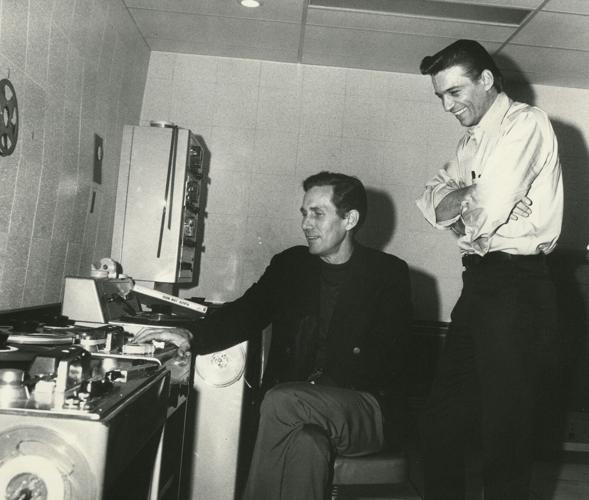
Chet Atkins (left) and Waylon Jennings during a 1965 recording session
“They don’t want to analyze lyrics,” Atkins explained. “Just hit ’em in the face with it.”
“But,” said Jennings, “what if we didn’t hit ’em there?”
“Program directors say, ‘Well, that song’s too deep for our audience.’”
“Bullshit!” said Jennings.
Chet and his studio team insisted on selecting the material for recording and instruments to be used, “often eliminating fiddles and steel [guitars] in favor of backup vocal groups” and coaching local musicians through a maximum of two takes. That meant the Waylors, earning $1,500 a week in Scottsdale, were barred. Left alone with unfamiliar musicians, including Charlie McCoy, the Blonde on Blonde guitarist, Jennings made an immediate faux pas, trying to play a twelve-string guitar, a folkie’s instrument, and, worse, sing at the same time, which was frowned upon on Music Row. At least, as he later learned, Buddy Holly had made the same mistake.
At the end of the sixties, Chet Atkins received a promotion to vice president and delegated his oversight of Waylon Jennings to producer Danny Davis, a Tijuana brass trumpeter. The contrast couldn’t have been more dramatic. Jennings, “Singer of Sad Songs,” faced off against a classically trained A&R staffer whose music industry cred was originally borne of homogenized Latin jazz performed for the white upper-class sect. Everyone, including Davis, followed the model of Billy Sherrill, a producer at Epic, who turned everything into Southern-accented, commercial-minded pop. With the much older Owen Bradley, Patsy Cline’s producer and coiner of the term Music Row, Sherrill established the Nashville Sound—an often “full-throated wail [with an] orchestrated crescendo, while all the time [the singer held] onto that deep well of sadness.” Sherrill, a racist and a sexist, was nauseated by curse words, eye contact avoidant, and stubborn—he refused to let George Jones use the melody from “Help Me Make It Through the Night,” not due to plagiarism concerns but because he insisted it was garbage. Even after Tammy Wynette had a pop smash with “Stand by Your Man,” a tune they wrote together, Sherrill still wouldn’t let her have much say in the material. He told the Baptist and fellow small-town-Alabama-raised divorcee he couldn’t permit her to release songs about infidelity because “that isn’t what the public expects [from] me.”
After the Sherrill-penned “Almost Persuaded” topped the charts for a record-breaking nine weeks in 1966, Music City began copying everything he did, right down to the studio, background singers, and even the engineer. In Nashville, wrote Andrew Grant Jackson, singers “stuck to moon-and-June lyrics and didn’t” get much say in which of those songs they got to record, then had to sit back as “producers laid orchestra strings and a choir” over your precious track; singers were contractually obligated to keep mum about it.*** Jennings, despite being billed as “The Rebel” in press kits, was not immune. Davis set upon Waylon’s material with a red pen and warned Jennings that his booming voice needed to be more measured. His work with Atkins and Davis “were good, smooth records,” Waylon said publicly, “and there I was rougher than a goddamned cob. All the damn sand I swallowed is in my singing.”
Truthfully, Jennings and his producer clashed from the get-go. After their initial session, Jennings returned to listen to mixes, only to discover someone had waylaid his tape—surely, this wasn’t what he recorded the other day. He claimed he didn’t recognize Danny Davis’s work, a criticism not without some validity. “He’d overdub arrangements without asking me, and turn songs down without even playing them for me.” Jennings had been approached to record Dick Holley’s “Abraham, Martin and John” and agreed to do it; Davis went behind his back and told Holley to take his tune elsewhere. The topical yet uncontroversial lament to assassinated American icons became a million-seller in the hands of Dion, a fellow Winter Dance Party “survivor.” Aggravating Waylon further, one executive asked: “When are you going to cut a country record?”
“You don’t know what that is,” the singer deadpanned.
Worse, Davis’s recording philosophy couldn’t have been more antiquated. He used a patented system devised as a big band member in the ’50s that began with asking artists to have each part written out for the musicians ahead of time. Jennings crafted melodies on the fly, with players expected to wing it for a looser, more lively sound. Davis would make wisecracks, roll his eyes in boredom, or even leave the studio if Jennings didn’t start the first take immediately. During an overdub session, with Jennings laying a second guitar line on the original track, Davis, thinking he was alone in the booth, muttered under his breath about Waylon’s professionalism just as Jessi entered.
“If I told him what you said,” she seethed, “he’d kill you.”
Jennings returned for the next session armed with a .22 handgun on loan from felonious country phenom Merle Haggard. When Davis tried to get the musicians to carefully follow their charts, Jennings warned them: “Anybody still looking at his chart after the third take, your ass is dead.” He whirled toward the control room and glared through the glass. “And, Danny,” he said, “I don’t want to hear any shit out of you.”
Atkins finally admitted he had made a mistake in pairing an anti-authoritarian “rebel” and a studio hardliner. When Atkins told Waylon he would be changing producers, Jennings was ready. Why, he asked, don’t you let me produce my records? He had, after all, landed a few Top 10 country hits. “MacArthur Park” won him a Grammy, but that was the recording Atkins had panicked over, leading him to bring in Davis to wrangle it into a proper, clean, Music Row-ready tune. Recalled Waylon: “I knew exactly what I wanted the strings to do; I had to hum the parts. He probably had his own ideas.” When asked why he opposed Waylon’s independence, Atkins claimed he feared RCA’s top guys would feel underused and defect to rival companies. “I feel sorry for the old men in Nashville,” Waylon told a reporter. “They can’t see things are changin’ and they won’t be able to change. They’re the same ones who ruined Hank Williams.”
By the end of the sixties, country songs made up the majority of RCA’s 45s. Music Row, raking in $100,000,000 annually, gave unprecedented power to producers, just as pop labels had ceded authority to them in the ’50s. Jennings, like the hippies, called it “the System,” but while Music Row vocally supported Richard Nixon, Atkins endorsed Democratic presidential candidate Hubert H. Humphrey in 1968 and may have been more liberal about record making than he let on. Later, Atkins would say that he admired Jennings because he never backed down on his musical principles.
On his way out, Davis took one last potshot at Waylon: “This guy could be the biggest star in the world,” he said, “but he’s his own worst enemy.”




Post a comment as anonymous
Report
Watch this discussion.
(0) comments
Welcome to the discussion.
Log In
Welcome to the discussion.
Keep it clean. Please avoid obscene, vulgar, lewd, racist or otherwise abusive language. Comments featuring hate speech or threatening or violent content will not be tolerated.
PLEASE TURN OFF YOUR CAPS LOCK.
Be truthful. Don't knowingly lie or mislead.
Be proactive. Use the “report” link on any comment that violates our comment policy.
Share with us. We'd love to hear your feedback.