
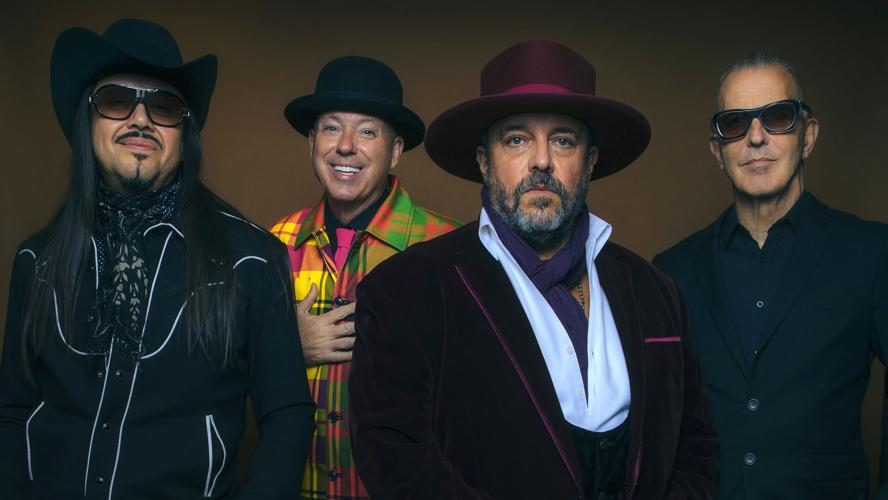
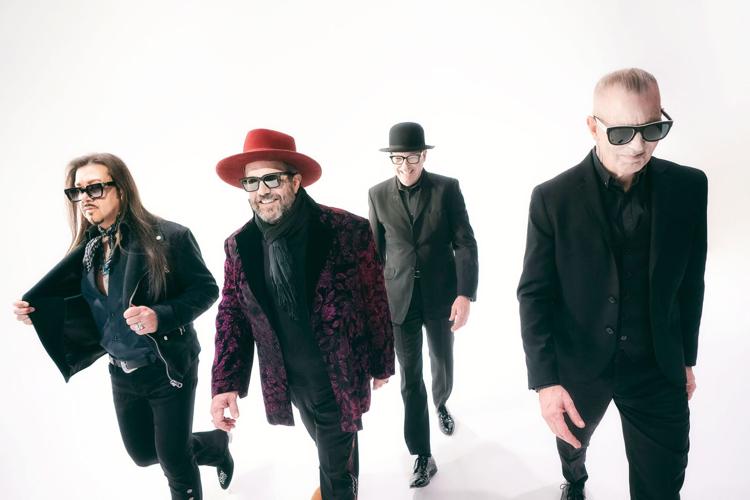


The Mavericks, from left to right: Eddie Perez, Jerry Dale McFadden, Raul Malo, Paul Deakin
When The Mavericks released their first Spanish-language album En Español in 2020, the project felt like a long time coming. Led by Cuban American singer-songwriter and guitarist Raul Malo, the delightfully unclassifiable band has Latin roots that run deep in their catalog, which also spans a heady mix of country, Tex-Mex, roots rock, blues and more. That album notched the band its first Billboard No. 1 — on the trade magazine’s Latin Pop Albums Chart — and put those roots front and center, to electric effect. The Mavericks are nominated for Duo/Group of the Year at next week’s Americana Music Honors and Awards, following a Lifetime Achievement Trailblazer Award win in 2021 that Malo says “validates all the things that [we’ve] had to go through” since forming in 1989.
The Scene caught up with Malo by Zoom while he was in Denmark, on the eve of kicking off the band’s European tour.
Last year’s AmericanaFest was especially big for the band, given your Lifetime Achievement Award win. As you head into this festival season, what has that award grown to mean to you?
It’s funny, because those things are not exactly bittersweet, but there’s a little part of you that’s like, “Oh God, we’re so old,” you know? [Laughs] We’ve been doing this forever. And that is a good thing, to be able to do this for your lifetime. So it’s this weird place that I think a lot of musicians and artists live, where you don’t really want to acknowledge all that kind of stuff because it puts this thing — this hobby, this calling that you’ve dedicated your life to — in a very real timeline. It’s interesting to look at it in that regard.
But undoubtedly, it means a lot to us to have won that award. … It validates all the things that you’ve had to go through: all the ups and downs, all those nights — every musician has those nights — where you’re like, “Man, I think I want to do something else,” or, “I don’t know if I can do this.” And I’m talking about early on, when you’re starting out and you have those doubts and you have those kind of thoughts. It makes you realize, “OK, I think I’ve done something right. I’ve dedicated my life to this and it’s getting acknowledged.” That’s a really nice place to be, as a musician, as an artist. It’s special.
I imagine it has to feel good to get such an honor when you’re still at the top of your game too. You all have so much going on right now, including your nomination for this year’s Honors and Awards. Sometimes those honors come far too late.
Thank you for that. That is a plus, for sure, to be recognized in this lifetime. But it’s not the kind of thing that we are obsessed with or anything. I love that we got that Lifetime Achievement Award, and then it feels like, “No, we’re not slowing down any time soon.” I’m in Denmark right now, you know? We’ve got a monthlong tour of Europe, and I love that we’re back at it — now that touring is going great and people want to come out to the shows and all that again. So you don’t really have time to think about awards. You can’t step back from yourself and look back, because you’re in it. But believe me, when I step back and look back, I’m going to have fun, and I’m going to look back on it with loving eyes and loving memories. And not feel like it’s been a life wasted on music or something. But that happens to musicians, and it happens to artists. I still enjoy making music and playing music and touring and singing. So they’ll [eventually have to] give us another lifetime achievement award.
I don’t think there’s a rule limiting you to just one! Americana is known as a community for artists whose music doesn’t fit neatly within genre confines. And The Mavericks have always been genre agnostic. What does it mean to be part of that community?
“Genre agnostic”? I love that. [Americana has] given us a home. I’m sure that there are some within the community that balked at us being invited, but I really do think we fit in and that our place is in the Americana world. And that’s what I’d like for Americana to be. The Mavericks are very much an American story, and not only with our Latin roots, but because it’s such a mixture of cultures and styles and genres. Admittedly, we’ve been super indulgent throughout the years, and that’s been part of the fun. I think that Americana has given us that platform where we can do whatever we want, in some ways.
When The Mavericks were firmly entrenched in country music, that wasn’t always the case. It was difficult then, and that’s really no fault of country music. It was our creative restlessness and our wanting to try different things and wanting to do this kind of record and write this kind of music and do this and that. So I think it has given us that creative liberty to really pursue those endeavors, like our En Español record. We knew that wasn’t going to climb up the Americana charts, but it gave us a number one record on the Billboard Latin charts. I love that our trajectory in our career is confusing.
It seems like you’ve really developed a sense of trust with your fans. They know you well enough that they can come to a show with no expectations other than that they’ll have a great time. I don’t think all artists can say that.
I think our fans enjoy — truly, at this point — whatever it is we play. And that doesn’t mean we can do whatever we want, but our fans like the fact that we mix it up. They like the fact that they come to a show and it’s not going to be the same show they heard two months ago or a year ago. It’s a fun place to be.
Speaking of En Español, it seems like it’s connected with a lot of people in a very cool way.
Well, I go by how the crowds react, and when we’re going to do a couple of songs from our En Español record there’s always a unanimous, beautiful round of applause. They’re hoping that we play some songs from En Español, and to me that’s the whole purpose of what we do, to make records and have them connect with people. I love the fact that a Spanish-language album has connected with a country-Americana audience.
It’s fulfilling in the creative way, but also in a very — I wouldn’t say necessarily political — social way. For a minute there [the country saw] so much immigrant-bashing and so much anti-immigrant rhetoric coming through the airwaves. To have The Mavericks release an all-Spanish record at the height of that — we didn’t do that on purpose, it’s funny how things work — was a nice little antidote. It proved my point that people aren’t really anti-immigrant; they’re just people. Politicians take advantage of people and their fears and drive that home for their own gains. And it’s nice to counter that with the live concert setting and have people that maybe wouldn’t listen to Cuban music or Spanish music really dig the record and go out and buy it, and take it home and listen to it. Those are little things, but you do that enough and in enough places and you never know — you might change people’s attitudes about stuff.

There have been a lot of conversations over the past several years about diversity in Americana music. How do you see Spanish-language and Latin music being part of that conversation in coming years?
I’m hoping that it gets even stronger. Obviously I’m American. I grew up in Miami, but I grew up listening to American music and loving American music. So, I know there’s tons of musicians like me, who speak Spanish and were born into a Spanish-language home, but love American rock ’n’ roll and country music.
I know that they’re there, because I see them all the time. I hear them in Texas, young Mexican kids that grew up in a Spanish home but sing country music beautifully and differently. And they incorporate their Latin backgrounds into the music and that’s exciting to me. Americana does not only mean bluegrass music or the banjo and the mandolin. We should broaden those horizons. And we’re trying. Los Lobos got their Lifetime Achievement Award [last year] as well. So that was great. I love that they got honored, as they should. They’re a great American band. And they certainly have shown their Latin credentials throughout the years. That was a beautiful nod on the part of Americana to honor them as well.
In an interview earlier this year, you expressed your interest in working with Jamaican artists. I’d love to hear more about what that would be like.
It’s a little bit of a bucket-list thing, but one of the things that we want to do as a band is go to Jamaica and record with some of our heroes that are still around — there’s not many left — before they go. There’s still some of the old ska guys still around: Byron Lee, The Skatalites, people like that. I just think it’d be so much fun and it’d be a beautiful project. And I know that we would have a hell of a lot of fun, just hanging out and doing nothing but smoking weed and playing guitar. I’d be happy with that. But hopefully we’ll come out with something useful, a record or songs. I love that as a band we’re fearless. We dive into whatever we need to do, and play with whoever we need to play with, and back up wherever we need to back up, and we have no problems doing any of it. It’s a loose concept as of right now, but one that’s definitely an itch that we’ve got to satisfy at some point.
You’ve also spent time performing solo shows over the past year or so. What do you get from those experiences that’s perhaps different from the band experience?
They’re a lot of fun in a different way because I get to really communicate with the audience. It’s different when you’re by yourself. I talk a lot more, share a lot more anecdotes, stories, whatever fits the bill. I normally don’t even have a set list; I just kind of wing it. And it really gives the show this “on your toes” sort of vibe, almost like sitting around in your living room with friends playing music. It’s purposeful in that regard, because I always learn something from them — either how to sing a song differently, or how a song connects to an audience if you play it differently. There’s always some little variation that you can then take and apply to a Mavericks show or to a recording session. So I use those shows as a sort of testing ground.

Ahead of AmericanaFest, we talk with The Mavericks’ Raul Malo, run down our favorite shows of the fest and more



Post a comment as anonymous
Report
Watch this discussion.
(0) comments
Welcome to the discussion.
Log In
Welcome to the discussion.
Keep it clean. Please avoid obscene, vulgar, lewd, racist or otherwise abusive language. Comments featuring hate speech or threatening or violent content will not be tolerated.
PLEASE TURN OFF YOUR CAPS LOCK.
Be truthful. Don't knowingly lie or mislead.
Be proactive. Use the “report” link on any comment that violates our comment policy.
Share with us. We'd love to hear your feedback.