


"I
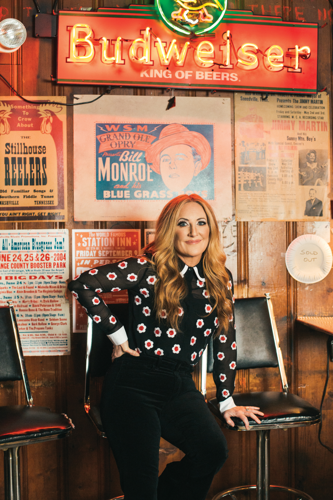
miss country music,” Lee Ann Womack says over the phone from her home in Nashville. “For the better part of my career, I was on a label that was trying to get airplay on country radio, and radio wasn’t playing country music. I’m not sure why that happened, but it was a frustrating, painful time for me. So I’ve had to create my own space where I can just make the music I want to make and let the chips fall where they may.”
In that self-made creative space, Womack recorded The Lonely, the Lonesome and the Gone, voted the third-best album of 2017 in the Scene’s Country Music Critics’ Poll. She’s also been voted the year’s Best Female Vocalist. She cut her album at Houston’s fabled SugarHill Recording Studios, where everyone from George Jones and Willie Nelson to Lightnin’ Hopkins and Beyoncé have made milestone recordings. In doing so, Womack has recaptured a time when country music contained distinctive regional sounds — and was richer for it.
“On commercial radio today, you don’t hear regional sounds anymore,” Womack says. “But when Rodney Crowell sings about Telegraph Road, he sounds like Houston. When Ronnie Bowman sings, he sounds like the mountains. Those sounds still exist below the surface, but they don’t get heard. It’s a shame, because regional sounds make the music more interesting. When you’re traveling, would you rather eat at McDonald’s every day, or would you want to taste the local cuisine?”
Womack’s husband and longtime producer Frank Liddell, who grew up in Houston, produced the record. He brought his band from Nashville and installed them in the room at SugarHill designed for Freddy Fender, with tiki decor and carpet on the floor. He wanted the Houston vibe of hillbillies transplanted to a big city where they had to balance the shock of the new with yearning for the old. Co-producer and bassist Glenn Worf declared, “I don’t want to make a period piece.”
“I don’t work with musicians who thought it was done the right way in a particular period,” Liddell says. “I want to work with musicians who are looking to do something that’s never been done before. On the other hand, I don’t want to work with people who want to wipe the slate clean and start from scratch. I’m looking for people who have those old records in their hearts and are ready to move forward. Those are the people we had. We all like melody and good drum sounds and good lyrics.”
“I don’t want to put a costume on and play the role of June Carter,” Womack adds. “I’m not trying to repeat what’s been done in the past. I want to make new music with the same spirit.”
Womack’s much-praised previous album, 2014’s The Way I’m Livin’, featured the songwriting of such Americana figures as Hayes Carll, Julie Miller, Bruce Robison and Neil Young, but this time she wanted to showcase her own writing. She co-wrote six of The Lonely’s 14 tracks. Three of those were written with her frequent co-writers Adam Wright and Waylon Payne, who each wrote or co-wrote several more of Lonely’s songs. As a result, there’s a unity to the album that magnifies its impact.
“I wanted ‘All the Trouble’ to sound like East Texas,” she says of the album’s first single, co-written with Wright and Payne. “I wanted it to sound like the church music I grew up on, mixed with George Jones, mixed with the songs I would make up in my head as a young girl. I wanted all of that on this record, and it all came together on ‘All the Trouble.’ ”
Womack sang that uptempo country-blues number in Music City Roots’ tent during the AmericanaFest in September. Pushed by Paul Franklin’s steel guitar, she belted out the key line, “I’ve got all the trouble I’m ever gonna need / And I just don’t want no more,” with the desperation of someone looking for a way back to solid ground.
“When I was a little girl and heard people singing about sin and redemption in church,” Womack recalls, “I hadn’t experienced those things, but I could feel what they were singing about. But I soon learned I’d rather hear George Jones or Willie Nelson sing gospel, because I want to hear a real sinner sing those songs. They don’t seem so ‘I’ve got all the answers,’ but more ‘I’m looking for answers.’ Really, we’re all looking for answers.”
Liddell also produces Miranda Lambert, who is at a significantly different point in her career. Lambert is still getting airplay on country radio — perhaps not as much as she deserves given her domination of the Country Music Critics’ Poll in recent years, but still enough to justify the many employees she needs for large-scale tours and radio promo. Lambert is still able to walk the tightrope between commercial radio and critical credibility. Womack, by contrast, has passed that phase of her career and has stripped down her operation, so she’s free to do the music she wants.
“Lee Ann has never said, ‘I don’t want to be on radio,’ ” says Liddell. “She has said, ‘I’ll take all the radio I can get, but I want to sing what I want to sing. I don’t need 10 people in my band anymore, and I don’t need to play for 10,000 people. I just want to have a great band and play for people who are really listening.’
“Like Rodney [Crowell], Lee Ann can play all those early hits with her current band and they still sound great,” Liddell continues. “People will go to hear ‘Never Say Never Again’ and ‘I Hope You Dance’ and will hopefully get turned onto the new songs. It’s not like she’s throwing out her past and starting over.”
But how does a record such as The Lonely, the Lonesome and the Gone get heard and make some money? That’s the challenge, Liddell admits. Public radio, satellite radio and social media are obvious options. Nonetheless, he says, true credibility still comes from what he calls “the music-listening press,” as opposed to the celebrity press.
“The music-listening press talks about her music,” he says. “How her record was written and recorded, not what she likes to eat and wear. I’ve said this a million times: No one ever suffered from having too much credibility. I’ve seen too many artists who keep chasing airplay without success and grind away all their credibility in the process. Take care of your art first, and then find out ways to get it out there.”



