
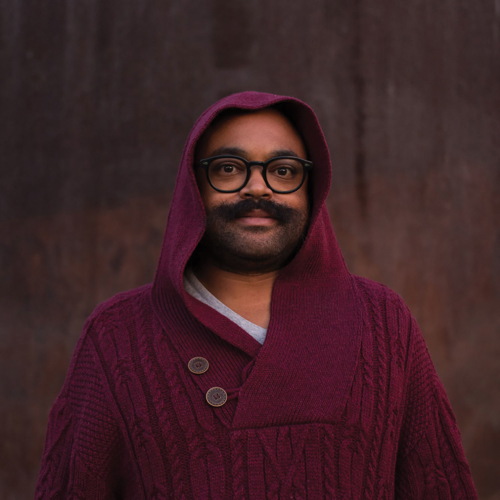


Early this year at Betty’s Bar & Grill, a venue on Nashville’s West Side that’s noted for its freewheeling approach to musical programming, I saw multi-instrumentalist and producer JayVe Montgomery execute a piece of conceptual art. Montgomery was in the middle of a furious tenor-saxophone solo when a group of music fans came into Betty’s and immediately expressed their displeasure at Montgomery’s playing. Montgomery, who is nothing if not an agile improviser, increased the intensity of his solo, overblowing notes in a sardonic, virtuoso display of chops. It was as if a devotee of free-jazz pioneer Albert Ayler had materialized among the beer mugs and cheeseburgers. “Go on back to Midtown,” Montgomery told the dissenters in the audience. “This is the West Side.”
Over the past few years, Montgomery has become one of Nashville’s most recognizable sonic innovators. In 2019 alone he’s played solo sets at Betty’s and Springwater, and he’s sat in on saxophone and flute with such notables as Godspeed You! Black Emperor and Nashville progressive soul band Altered Statesman. Montgomery released an excellent record under the sobriquet Abstract Black, In Circles With Self, and he produced a track on Philadelphia poet Moor Mother’s 2019 release Analog Fluids of Sonic Black Holes, which got kudos from Wire magazine in its year-end roundup of albums. He’s a world-class player who — like many of his fellow improvisers — is moving beyond jazz into a global music of infinite possibilities.
I last caught up with Montgomery in January for a Scene profile, just as he was releasing In Circles With Self. In March, he played Knoxville’s Big Ears Festival, and he appeared at this summer’s Pitchfork Music Festival in Chicago. In addition, Montgomery contributed to an upcoming project that reconstructs the work of bandleader and keyboardist Sun Ra. Montgomery, who was born Dec. 31, 1979, in Texas and worked in Chicago before moving to Nashville in late 2013, is a huge presence. He’s funny, sharp and opinionated. A couple of weeks ago, I sat down with Montgomery at Springwater to talk about jazz, his career, and being an improvising musician in Nashville.
You played Big Ears in March. How was that experience?
Roscoe Mitchell [saxophonist and leader of The Art Ensemble of Chicago] did a workshop on composition and improvisation. I’d been in a workshop with him before, probably a decade ago in Chicago, that was sponsored by the Jazz Institute of Chicago. So I’d always had this intimidating idea of Roscoe. He has his ideas and he sticks to them, you know, which can be intimidating for anybody. But yeah, it was a great moment, because there were some younger, lightly experienced improvisers there. One person asked Roscoe before they played their solo, “What song do you want me to play?” This workshop is about improvisation, so there was a lot of humbleness on the stage. After that moment, [I thought] it was time to raise my hand and just play this horn. It was good playing with the group being led by him for the workshop. As much as you play music for yourself, it’s nice to know somebody who’s been doing it for 50 years also is hearing you, listening.
You also played Pitchfork Music Festival in July.
I played with the Standing on the Corner ensemble. It’s a group of young musicians from New York who have done some instrumental work, live support work, for Solange. Solange was on the side stage watching me play EWI [Electronic Wind Instrument].
How did Solange like it?
Yeah, you can only wonder. She didn’t pull me aside and give me another job. But that was great — we had a couple days’ rehearsals this summer, and then we played Pitchfork right after a group from Chicago’s AACM [Association for the Advancement of Creative Musicians].
There’s a split these days between jazz traditionalists like Wynton Marsalis and musicians who incorporate elements of jazz without sticking to what was done in the past.
This year I debuted at Rudy’s [Jazz Room in Nashville] with Greg Bryant. He’s got a documented opinion about the music he plays being not jazz. Seemingly, these people who have come before us, who have made a career out of sort of institutionalizing jazz, or codifying it, they have to defend jazz as being a certain thing.
You know, the reason we don’t see William Parker in the Ken Burns jazz documentary is because the Marsalises are holding court on what jazz is, to be in the Lincoln Center or Kennedy Center or whatever centers those are. Hey, you can’t blame ’em, and I’ve heard people who’ve had conversations with the Marsalises who will say, they’re into the out stuff — which signals that they’re holding onto an industry they’ve helped establish. You can’t have a school if there’s nothing to learn. …
If you have a school of jazz, there has to be something you’re teaching. You have to be teaching the right way to do it. And if it’s just like, “We’re going to get together and we’re going to play freely,” well, why are kids getting scholarships or having to pay tuition? It would make no sense, seemingly, to have an industry of improvised music, because it’s really democratic. You know, all you need is your ears and an instrument. It’s almost like the mistake, the genetic mutation that happened when a Charlie Parker [performance on] “Bebop” became a whole style. It’s OK to have melody in improvised music, and it’s OK to not. I think what the Art Ensemble has been talking about is really moving to a place where musicians can be free — and not just free to be free, but free to show the populace that they can be free.
The aesthetic you’re talking about comes from free jazz, among other sources.
You even have a mimicry of the blues influencing European rock ’n’ roll, and free jazz being experienced by Europeans that then turn it into European art music. They realize that they’re close to the classical pantheon, so that they can then take those techniques and do what this movement of freedom is doing, like the Black Artist Movement or AACM, from their own cultural perspective.
How is Nashville for an improvising musician?
When I was here for a handful of years — three or four years — I only met one person out in Hendersonville who played so-called skronk music. He introduced me to that term, you know. And then I saw Tatsuya Nakatani was playing, and then met Chris [Davis, head of arts nonprofit FMRL]. Then maybe a year-and-a-half, two years later after that, I spoke up about Jack Wright coming, and [Chris] invited me to play. Chris has been the portal to this sort of explosion into playing improvised music in Nashville.
Tell me about the Sun Ra project you worked on this year.
In the first two weeks of May, I was in Chicago working with this organization called The Bridge. They’re a trans-Atlantic collaboration between French musicians and Midwest musicians — mostly Chicago, which is my musical home. In this edition of The Bridge, I was with Rob Frye of Bitchin Bajas, Dan Bitney who plays in Tortoise, and two French musicians, who were Simon Sieger and Olivia Scemama. Olivia played electric bass, mostly, and Simon played accordion, piano, trombone and [contributed] throat singing.
We got to have a few dates at Experimental Sound Studio in Chicago, where we got to touch reels that Sun Ra had written on, and we got to engage with some of his materials. We ended up taking a Moog solo [of Ra’s] and MIDI-translating that, and then sending that MIDI translation out to different synths that we then sent to two other people effecting. So we all had our hands on knobs that were essentially controlling and manipulating the ghost of Sun Ra. It’s like the whole solo is coming through our machines.



