
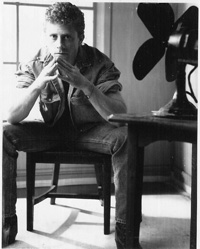
In Nathan Bell’s song “Manuel Jacket,” from his new album In Tune, On Time, Not Dead, the hard-nosed singer-songwriter recalls trying on an expensive jacket in the Nashville showroom of a famous designer and imagining how the spotlight would shine when it hit him. But Bell put the jacket back on the rack. He’d long fought any urge that smelled of compromise—no matter how heady the pull or how rich the possibilities. He didn’t trust his reasons for liking the way the jacket felt on his back.
Thirteen years later, the incident serves as a metaphor for Bell’s short Nashville stint. Coming out of the ’80s with critical acclaim for his folk-rock duo Bell & Shore, the Mid-westerner moved to Nashville as a highly touted songwriter turned solo performer.
Then as now, Bell’s work had a crisp literary quality, a tough blue-collar sensibility and a terse, muscular musicality. His songs sidled alongside Richard Thompson and Lou Reed as much as Steve Earle and Mark Germino—his two most common local comparisons. Nashville seemed like it could fit: It still had the glow of the ’80s, when big-time deals went to songwriters like Lyle Lovett, Mary Chapin Carpenter and the O’Kanes.
Bell’s arrival drew plenty of attention, too. He signed with prestigious independent publishing company Ten Ten Music and went into the studio with hot producer Richard Bennett, who’d worked on breakthrough albums by Earle, Kim Richey, Marty Stuart and others.
But Nashville took a different direction, and Bell found that trying to make it here felt like putting on that jacket. He could’ve tried what was necessary to cash in on the Nashville dream, but it didn’t quite fit. In 1994, he laid down his guitar, married his girlfriend and moved to Chattanooga, where he’s been working in corporate communications and raising a family.
Earlier this year, he picked up the guitar and started writing songs again—furiously. In Tune, On Time, Not Dead reveals he’s as observant and nervy as ever, and he’s rocking more fiercely than ever. His guitar work takes him into Crazy Horse territory—he even offers an ode to his instrument in “1966 Telecaster”—while “What Did You Do Today?” makes a political statement that invites both sides of the divide to sing along, thanks to a wickedly melodic guitar riff.
“Strike Up the Band” and “Big Bad Love”—the latter co-written with the late novelist Larry Brown—show he hasn’t lost any of his ability to cut to the quick. “There used to be a steel mill here / Now there’s nothing but moving along,” he sings in the former, which examines how Cleveland, like many Midwestern cities, has lost its industrial foundation. The latter is a leather-trimmed love letter to a woman who can bench press 203 pounds and likes her loving rough.But Bell’s decade of domesticity also works its way in—he’s too honest of a writer to act otherwise. Songs like “The Good Things” and “The Nest (Go Slow)” recognize how the comforts of family and big, good love can shield individuals from the world’s problems, but they also recognize that these qualities don’t make the world’s problems disappear. As before, Bell is indeed in tune, fully alive and capable of illuminating what good songwriters can help us see and feel. He may no longer be living on Nashville time—this appearance is his first time back onstage in Nashville in a decade—but his world has always had a wider view than that.



