
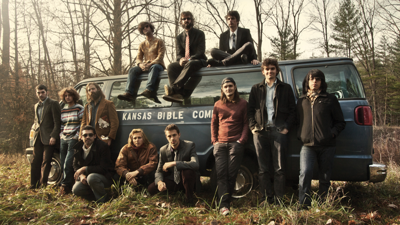
It recently came to my attention that I live within spitting distance of the ultimate band house. So I scheduled an interview with its residents, and ambled down the street on the appointed night to find a throng of band dudes lounging on the porch.
A neighborly bunch, they waved me in through the chain-link gate and were only too happy to give me the grand tour: of the jungle of a front yard where they're growing everything from basil to beets and amassing a recycling-bound mountain of beer cans; of common rooms full of motley, second-hand furniture; of a rehearsal space strewn with gear they'd schlepped in from the road; of four bathrooms and 10 or so bedrooms, one being a tiny, vinyl-sided structure set off from the house by a carport.
"I love my privacy," smiles the structure's trombone-playing occupant, Isaac Lederach, "and that's the only room in the house that gets any of it. I mean, the house is super cool, but no privacy as compared to the back, I'll tell you what."
A Frankensteined ex-halfway-house like this could theoretically sleep two or three normal-size bands. Kansas Bible Company, however, packs the place out, affectionately referring to it as "Hotel Chicamauga" — which also happens to be the title of the band's most recent album.
With a current head count of 12, KBC is one of the biggest young bands in town, but the size of the lineup isn't quite as outlandish as you'd think. For all the attention Nashville gets for being home to such perfectors of the rock 'n' roll power duo as Jack White, The Black Keys and JEFF the Brotherhood, that lean, mean band template isn't spawning all that many imitators at the moment. And anyway, White now tours with beefed-up lineups of each gender and both the Keys and JEFF have added extra live players.
Since KBC boasts a five-piece horn section — alto and tenor sax, a pair of trumpets and Lederach's trombone — the band has occasionally been mistaken for a ska or funk group. Really, they're an indefatigable, shape-shifting rock band, one that has the imagination and sense of theatrical play it'd take to carry a rock opera, if they so desired.
The guys met at Goshen College, a Mennonite school in Indiana, and moved to Nashville together two years ago, joining the swelling ranks of exciting local indie bands whose versions of rock, soul, country or some combination of the three call for lots of instrumental bells and whistles: horns, strings, backup singers, extra percussionists or — in the case of Kopecky Family Band — the occasional accordion part.
Diego Vazquez, a trombone player, is part of The Nashville Horns — sort of a contemporary counterpart to The Memphis Horns — whose members are in such demand right now that the bands they're in have to schedule gigs around their commitments. After catching Vazquez with the brassy, hooky soul-pop outfit Alanna Royale, I asked him who else he's been playing with. The list he emailed ranges from relative newcomers to reinvented long-timers, from smooth-grooving country stylists to hard-boogieing roots rockers, and soul-rockers, and funk-rockers. There's Magnolia Sons, Buffalo Clover, Derek Hoke, The Lonely H, Stoned Soul Revival, Shane Tutmarc, Stagolee, Cooper and the Jam, Jacob Jones, Los Colognes, Little Bandit and Jacob Thomas Jr. — and those are just the acts Vazquez could immediately recall.
This supersize band trend is a pretty significant plot twist for the storyline of rock 'n' roll. Jump-started by black jump blues, rock was propelled by blues-borrowing and R&B energy for a good while. But after Woodstock, it was very clear that soul and rock — and black and white pop musical innovation in general — were evolving in different directions. Strapping rock 'n' roll horn bands that thrived in the late '60s and early '70s — like Blood, Sweat & Tears and early Chicago — soon became anomalies. And later incarnations of rock — indie, alternative, commercial grunge — seemed to have little or no use for roll at all.
Popular music doesn't stand still, but it frequently circles back on itself. A horn-reliant ska revival was a blip on the 1990s screen. The Black Keys, The White Stripes and other acts steered the garage-rock revival of the Aughts toward blues fetishism and barebones lineups. Then, thanks to soul-reviving efforts like Daptone (and on a smaller scale, Nashville's own G.E.D. Soul Records), big, hot horn bands began connecting with new, younger, vinyl-greedy (and as is the case with many retro-tinged musical movements, disproportionately white) audiences. And all this happened within the listening lifetimes of today's 20- and 30-something music makers, no doubt stirring a craving in some of them for bigger, brighter-sounding bands.
"I personally started seeing a demand for horn players after doing a string of shows along with a handful of record releases with bands like Magnolia Sons and Buffalo Clover," Vazquez tells the Scene via email. "We would be approached by other bands or singer-songwriters that were looking to add either a horn section or a solo horn on their album or song. Both of the initial bands mentioned above scooped us up after having seen us play with some bands out of the G.E.D. Soul label: The Coolin' System and DeRobert and the Half-Truths."
In a separate email, Buffalo Clover frontwoman Margo Price retraced her steps from a folk-rock duo to her band's current, countrified, blues-greased, rock 'n' roll incarnation. "I began to rediscover a lot of rock 'n' roll/soul music from the '60s and '70s that I had brushed aside after my teen years (Led Zeppelin, Janis Joplin, Jefferson Airplane, The Supremes)," she writes. "I always think of Gillian Welch and Dave Rawlings' song 'I Want to Sing That Rock and Roll': 'Everybody's been makin' a shout so big and loud it's been drownin' me out / I want to sing that rock and roll.' That tune really hit me one day. I put down the acoustic, started to focus on really singing out and began to build the dream band."
Another approach to dream-band-building is the friend-chestral indie-rock collective, for which Arcade Fire's members are Grammy-winning poster children and Edward Sharpe and the Magnetic Zeros are hippified evangelists. The fact that they have larger — and in the case of the Magnetic Zeros, far looser — lineups doesn't mean they're not driven to succeed as bands; that drive just has a different look and feel for some of the more experientially inclined, group-hanging musicians of this generation.
Kopecky Family Band founders Kelsey Kopecky and Gabriel Simon could've gone the duo route, but instead chose to press ahead with as many as seven members at one time. "I mean, it has been challenging to figure out, 'OK, we have seven phone bills to pay, versus two,' " says Kopecky. "But it just made more sense to be like, 'No, let's all tough it together, make music that we're passionate about and then just let it all come out in the wash.' It's been so rewarding finally being in a place where we are paying our phone bills, thank God. It's so rewarding to look to my left and right and be like, 'We did this together.' "
Kansas Bible Company is still a long way from covering a dozen phone bills with band profits, but the fact that other acts are pulling it off is a source of encouragement. "You mentioned Arcade Fire," says singer-guitarist Jake Miller, aka Cazz, from the sunflower-flanked front walkway. "I mean, that was a huge turning point in my life when I got to see them in 2005. Just seeing what they were doing, I was like, 'Oh, you can have all your friends onstage with you playing all sorts of instruments that don't necessarily fit together, but you make a sound that is unique and cool?' "
The many, many members of KBC display a pretty damn remarkable commitment to collaborating on songs, along with cramming into tour vans — one of which a neighbor "fandalized" by painting "Hotel Chicamauga Courtesy Shuttle" down the side — and kicking in outside income and sweat equity to support their harmonious, party-hearty, communal lifestyle.
Says guitarist Mike Ruth, "It just always strikes me as weird when I see a band that I really like, in Nashville or wherever, but they don't necessarily get along. They just get onstage to play music. I mean, I understand that, and that's the way a lot of music is played. But when I get off stage, I'm just so ready to kick it with my homies. ... It ruins the whole experience for me when you aren't totally involved with it."
Email music@nashvillescene.com.



