
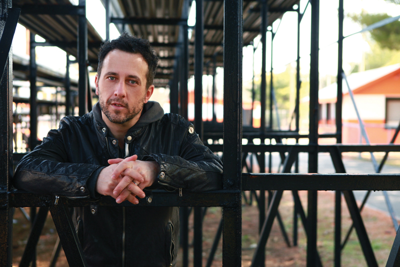
Television ads for the 2014 Chevy Silverado paired shots of truck-driving folk hauling, farming, rodeoing and parenting with singer-songwriter Will Hoge's "Strong." A bucolic ode to personal resilience, sung with a resolute rasp that was already familiar in these parts, the song became the new soundtrack of all-American, hardworking horsepower.
"[Chevy's] whole pitch," Hoge tells the Scene, "was, 'Bob Seger's 'Like a Rock' was a 12-year license and made that guy, like, barge loads of money.'
"There's not a better sales pitch than that. If I'm gonna sell out, I wanna sell all the way out."
The ad campaign lasted only a year, still plenty long enough to make "Strong" the biggest recording of Hoge's career to date. Fittingly, the Franklin native follows up that success with his deepest push into heartland rock territory yet, Small Town Dreams. The album splits the difference between studio gleam and everyman guts.
Heartland rock has always been one part of your musical identity, but you've really brought it to the forefront on this album. How did that happen? There was a point last year where I went back home to Franklin. I was sick with pneumonia and had to be out of my place in Inglewood for a few days, because we were trying to sell our house. So I went back to the house I grew up in, and slept in the bedroom I'd slept in my entire life, basically up until I moved out from home. Over the week that I spent there, as I got well I was able to get up and walk around the old neighborhood and see old friends' parents that I hadn't seen in 20 years, just seeing the way that things had changed and really spending the only appreciable time there that I had in two decades. That kind of fueled [the album] thematically.
These songs reflect on a sleepy, small-town upbringing. It sounds like you're depicting a different world than the rapidly developing city we're living in. Yeah. I spent my whole life here. My parents grew up here; my grandparents grew up here. ... I do think that I've reached a point, age-wise and experience-wise in this business and this town, of being able to have a bit of a reflection on it, I hope.
We've talked in the past about how country music has drifted closer to where you are stylistically. What thematic common ground do you think you share with what country's been known for, if not what it's known for right now? It's always been a storyteller's genre. ... I want to think, as a songwriter, that's something that I've always tried to [deliver], whether that's wrapped in R&B-style music or rock-style music or country-style music. I want to think at the end of the day the songs still evoke some kind of emotional response from people with the stories they tell. I think that's probably the biggest common ground.
What I'm getting at is that you've always reported from the vantage point of the underdog, but in these songs you're actually redefining what success and failure are. "Itty Bitty Dreams" says that trading high-flown aspirations for domestic stability isn't failure, which resonates with where country has come from. Plus it reminded me of the Alan Jackson song "Little Bitty." Am I the first to tell you that? The Alan Jackson thing, yeah. But I mean, I agree with that. ... The dreams that I had when I started doing this, I don't know exactly what those were. But I think when you start playing guitar when you're 15, you have these dreams of rock stardom, whatever that is — airplanes and limousines and all of those things. As you start a family and start to care about other things than just music, you start to realize that there are ways to do this, to be a working, functioning singer-songwriter that's also a decent human being and a father and a husband and all these things. That's not something you think about when you're 20 years old — or at least I didn't.
You've got a really interesting song on the album called "Guitar or a Gun." The teenage protagonist is choosing which of those to buy at a pawnshop, and you set that up as a choice that will determine the direction of his life. Why'd you lend it that kind of weight? Have you ever faced a similar moment in your life? Yeah, I did. That's very autobiographical. It's funny. My older son and I went to Franklin today. I was taking him around to some of the old Civil War battle sites and all that stuff. And we drove by the old pawnshop I used to ride my bike to. I would go and look at guitars or guns before I owned either of those two things. ... I just thought those two things were like magic when I was a kid.
There's something that's still incredibly romantic about that, especially when you think of a teenage kid in a small town, the idea of this sort of cowboy big-shooter thing or this rock 'n' roll guitar Keith Richards-y thing. There's an innocence to it.
Lately you've been self-producing albums, but you brought in Marshall Altman to produce this time. What did your recent round of royalties and licensing do for the making of the album? I feel like [for] the last two or three records in particular, there are more eyes and ears on what we're doing than we've probably ever had in the past, which is an interesting thing. I would be lying if I said, "Well, that doesn't factor in at all." It doesn't make me afraid. It doesn't make me not want to write certain types of songs or anything. But if I've got an opportunity to let people hear a record, I want it to be a record that I feel like is a real reflection of everything that I am as an artist.
The great thing about bringing Marshall in was we've known one another for years and been friends for a long time. We've wanted to work together for a long time. It's just never been the right situation. I heard a Frankie Ballard record that [Altman produced] on the radio, and it was followed by this Eric Paslay record [also produced by Altman] that I love, neither of which sound alike. ... [Altman's] a great guy to go, "What do you wanna do? Let me kind of mold that."
Working with a producer on this enabled me to just be an artist, which I haven't gotten to do. You know, when you're the producer you can still be the artist, but I have to be there every minute, and I have to make sure the paperwork is done. I have to make sure that the studio is locked up and the players are lined up. This one I got to just show up and focus on the songs and singing. That was huge.
You flew a self-congratulatory banner in your yard when you had a No. 1 with Eli Young Band's "Even If It Breaks Your Heart." It's come to my attention that you've since had another No. 1 — only in Texas. We've had two No. 1s in Texas.
What exactly does it mean to have a Texas No. 1? It means that a whole bunch of radio stations in Texas are playing your record. Any good Texan will tell you, they're their own country. ... They have a general disdain for all things from Nashville, but somehow we've been christened as OK down there. A lot of the guys and girls that are singer-songwriters down there have been really accepting of what I do artistically. It's changed a lot for us. All the sudden we're able to go down and play shows for a lot more people than we were before.
Your Texas hit "Another Song Nobody Will Hear" was a self-deprecating joke about obscurity that got played on radio down there, which is one of many instances when you've seemed to have it both ways. Do you think it's possible to retain an underdog spirit and enjoy broad success? Shit, I'm dumb enough to think so. Whether that's true or not, I don't know. But I feel like it's totally possible. ... I've worked for 20 years to build a fan base of people that'll let me go and make the records that I wanna make and all that. ... As long as I stay true to who I am and what I'm doing musically, I feel like people [will say], "Hell, yeah. Here's another one where we're sticking it to the man and the underdog wins again."
Email Music@nashvillescene.com



