
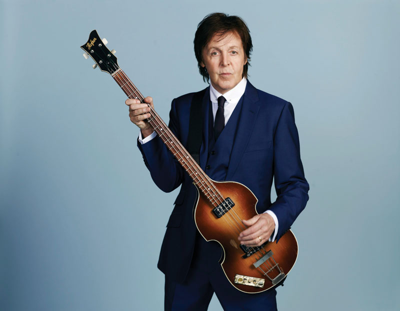

I am reluctant to even start to write about the English singer, songwriter, bassist and guitarist Paul McCartney, and that goes double for his former group, The Beatles, who came from Liverpool and whose recordings, songs and personalities are familiar to most students of rock 'n' roll music. Sir Paul — the musician was knighted by Queen Elizabeth II in 1997 — is a problematic figure for many pop music fans, and this has everything to do with the way McCartney's devotion to the concept of pop has weathered several musical revolutions that ended up both denigrating and exalting The Beatles themselves. What's at issue isn't McCartney's greatness as melodist, lyricist, arranger, singer and instrumentalist — Sir Paul is a master. Rather, it's the way that he uses his immense skill that pop fans have often called into question, and from this questioning arises my reluctance to attempt to untangle the links between pop and rock 'n' roll.
I could begin by describing the music scene of the early '60s, before The Beatles — John Lennon, Ringo Starr, George Harrison and McCartney — made their now-famous 1964 trip to North America, where their Liverpool accents and casual disregard for the kind of platitudes common to earlier pop stars beguiled fans and press. In a climate where there was still a distinction between adolescent, commercially minded rock 'n' roll and the supposedly more substantial offerings of jazz musicians and folk singers, The Beatles made a case for pop music that was neither intellectualized and abstruse, as much jazz had become, nor solemn and essentially conservative, as was circa-1962 folk music.
Fascinated by the '50s rock 'n' roll of Elvis Presley, The Everly Brothers and Buddy Holly, McCartney and his bandmates were also adepts of American pop and rhythm-and-blues — you may be familiar with McCartney's 1963 cover of Meredith Wilson's Broadway show tune, "Till There Was You," or perhaps you prefer his version of "Kansas City"/"Hey, Hey, Hey, Hey," an R&B performance in the manner of one of McCartney's vocal influences, Little Richard Penniman. The Beatles' early work brilliantly reassembled the elements of blues-based American pop music, with 1963's "I Want to Hold Your Hand" a subtly gospel-inflected rock 'n' roll tune that the super-eclectic Beatles enlivened with a bridge straight out of the songbook of Gerry Goffin and Carole King, an American songwriting team who influenced the group.
It was McCartney's musicality that helped guide The Beatles through such experimental recordings as 1964's "She's a Woman" and the same year's "What You're Doing." In contrast to the somewhat less harmonically sophisticated Lennon, McCartney proved himself a consummate pop tunesmith with Rubber Soul's "You Won't See Me" and Revolver's "For No One" and "Got to Get You Into My Life." McCartney's melodies were inspired, and the insouciantly chromatic harmonic language he perfected became lingua franca for the many Beatle-esque power-pop groups of later decades.
The Lennon-McCartney partnership produced what many listeners consider the best Beatles recording, 1967's "A Day in the Life," in which you can discern the differing approaches of two songwriters devoted to a carefree dismantling and reassessment of pop's basic materials. After The Beatles split in 1970, McCartney continued to create compelling pop in much the same manner as he had on the group's final full-length, Abbey Road. Whether or not such McCartney classics as "Junior's Farm" or "Jet" sported content — whether or not he had anything to say — remains a viable question. His skill is undeniable, but many fans may prefer Lennon's more personalized psychodramas, or Harry Nilsson's Beatles extrapolations, or the McCartney-Lennon epigones of power pop, to McCartney's version of musical utopia.
After the rise of such non-Beatles-influenced forms as disco and punk in the late '70s, the rock audience moved on. The English and American punk rockers looked backward to a time before The Beatles, and referenced the primitive aspects of '50s rock in a search for the sort of untutored super-amateurism that McCartney may have appreciated but never wished to emulate.
McCartney's recent music is often amazing — last year's full-length New demonstrates his continued genius as a pop songwriter and producer, and I hear disquieting hints of distress in such tunes as "Everybody Out There" and the gorgeous "Hosanna," which uses the slightly abstract harmonic language for which McCartney is justly famous. As with all true musical revolutionaries, McCartney never abandoned the conservative techniques that underpin nearly all his experiments. If you want to call that tendency into question, you may not understand pop music quite as well as you think you do.
Email Music@nashvillescene.com.



