
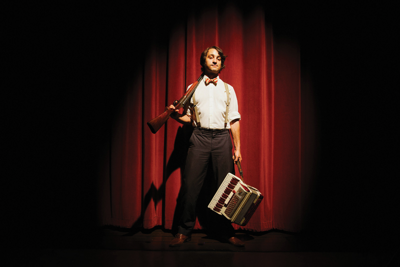

There aren't many performers like Jonny Gowow. At least not in Middle Tennessee. A sharp political thinker who nonetheless performs the most disarming, openhearted songs of love and loss — music he describes on his Facebook page as "gay music for straight people" — Gowow is the kind of figure who frustrates category fetishists and delights fans of piano-man chanteurs like Ben Folds at their most poignant, or full-throated anthems like Hedwig's "Midnight Radio" and the dizzying, catchy subversions of the long-missed local queer-country duo Good Lord to the Devil.
Made with his band, The Japanese Cowboys, Gowow's 2014 album Wide Stance remains one of the more singular Middle Tennessee albums in recent years, and Tuesday's show at Church Street gay bar Canvas Lounge promises a lot of new material written during last year's European tour as well as the beloved material he's been curating and serving to folks in Murfreesboro for nearly a decade via conceptual performances and gatherings of genre-bending artists. Gowow talks to the Scene over a leisurely lunch at West Nashville Vietnamese hash house Kien Giang.
Does your band's name come from Ween's 12 Golden Country Greats album? Yes. The song suggests something you don't see everyday, and I wanted our band to do the same thing.
You've been hewing out a fascinating career in the Murfreesboro music scene for quite some time now. How do you see the differences between Nashville and Murfreesboro audiences? I don't know that I see much of a difference between Murfreesboro and Nashville audiences. Both cities are saturated with live music and the musicians who perform it, which I think makes audiences in both cities a little jaded when it comes to seeing concerts. The biggest difference I guess is that Nashville has made a real tradition and institution out of live music, in the sense that there are long-established and well-respected venues [here], whereas Murfreesboro venues are still struggling to make the live music thing economically viable for their businesses. There's a lot of turnover in the 'Boro, which makes for a certain amount of instability in the scene, but also provides a lot of opportunity for artistic freedom when planning a show.
That freedom has allowed you to put on some amazing cabaret extravaganzas. Is that word a fair and accurate assessment of your shows? Cabaret as a genre is a lot like musical theater, or even early film, in that it incorporates a lot of different art forms into one show or performance — you're not just going to see a concert, you're going to see much more. You've got burlesque, you've got acrobatics, you've got storytelling and jugglers — and most importantly, you've got music and comedy. It's a musical variety show for adults, that really digs out and spotlights the most base and common of human desires, without taking itself too seriously.
I think that's my biggest problem with the contemporary approach to live music [is that] it takes itself way too seriously. You have musicians that put on a "show," but the show consists of a bunch of really sincere body language and facial contortions — it's really nothing more than the musicians "really getting into their music." And honestly, that makes me blush a lot more than a voluptuous vixen in stilettos and pasties.
How do you see your work in comparison with more traditional forms of musical theater? I don't feel at odds against contemporary musical theater, any more than I feel at odds with contemporary pop culture. Obviously there's the institution that's producing and touring big-spectacle shows like Wicked and Phantom of the Opera, just as you have the big labels producing and touring acts like Katy Perry and One Direction. But you also have these great shows like Avenue Q and Hamilton. So yeah, the musical theater industry is just as prone as any other to pumping out big, blockbuster entertainment spectacles — but just like other artistic mediums, there's a whole lot of interesting and thought-provoking material out there.
On your European tour last year, you got to live the gay dream and open for Bonnie Tyler. How on earth did that come about? My local watering hole, Liquid Smoke, was the bar of choice for Tony "Plum" Howells when he visited the states from Wales. He's a rock 'n' roll bat-out-of-hell legend around Swansea, and I gave him my album on one of his visits. He in turn passed the album on to Michael Kennedy, the host of a radio program in Wales called Welsh Connections. The album got airplay overseas, and then they were inviting me to open for a benefit show they were hosting, with Bonnie as the headliner. I couldn't say no.
How are you personally finding the shift away from physical media? It's a curse and a blessing. I can have direct access to my fans through YouTube and blogs; I can reach audiences in Australia, France and Russia with streaming services; and folks who aren't quite willing to shell out 10 bucks for a whole album can still purchase individual songs they like from iTunes or BandCamp. But the flip side is really scary. You've got Spotify and Apple Music, who pay the artists they stream a fraction of a cent for every play their songs get, and you've got an entire population of music fans who aren't willing to pay for music because they can get it for free. It really makes it difficult to make a living out of music these days.
But what's really unfortunate is the way music has become a kind of wallpaper for the vast majority of people. They are constantly hearing music, all the time, to the point that a piece that I've spent a lot of time and emotional energy wrenching from the bottom of my heart becomes nothing more than a way for them to pass the time while they walk from one class to the next. It's desensitized the population to the point that it's very difficult for them to actively listen and engage with music anymore.
What do you see as the ultimate goal of the Jonny Gowow experience? My long-term goals as a performer are pretty vague. I want to explore as many different means of artistic expression as possible, from writing to acting to filmmaking, which makes it difficult to pin down a specific career path. Wherever my performance career takes me, I'd like to be able to open my own venue at some point later in life, where serious artists can come and exhibit their particular perspectives on the world. I guess that's my idea of "settling down" in my old age.
Email Music@nashvillescene.com



