
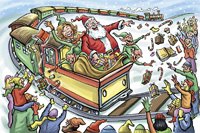
Santa Claus is standing on the back of a train stopped somewhere in southeastern Kentucky, throwing toys and candy to the screaming throng below. Perhaps 200 kids and adults crowd around in a flailing semicircle like frantic iron filings drawn to a magnet. They seem to consist primarily of upraised arms and straining vocal cords, with “Santa!” and “Over here!” the prime exclamations.
Four of us are helping Santa at this stop. Three are reporters, taking our turns at dispensing goodies with the Fat Man as we cover the Santa Train on its annual trip through the hills and hollows of Appalachia. The fourth is Patty Loveless, who is, according to an official press release, “Santa’s special elf.” She’s got a terrific backhand.
The putative recipients of our largesse are children, but they catch very little on the fly. They are Lilliputians in a world of NBA stars, and adults snatch the bulk of what’s tossed. Many pass the bounty on to kids; the rest, I hope, will do so once the train moves on, although a quick demographic assessment indicates there may be some adult freelancers.
One youngster has found a good spot on the periphery, and he snags several items, dropping to his knees to retrieve more from the gravel along the track. He’s clutching some candy bars, a yo-yo and a wiffle bat when a comic book hits the ground in front of him. He thinks for a second, then steps on it, anchoring it while his eyes stay resolutely on the train. Another kid, maybe 5 or so, sits on his father’s shoulders screaming Santa’s name, watching helplessly as dad, unable to maneuver, catches nothing but air. Near the front, a kid no more than 2 being held aloft like a pagan idol is busily melting down as candy and toys whiz by like bullets at Antietam. Finally, the arms holding him begin to lower, and the crowd swallows his wail.
We are at the edge of a depressed little town in the heart of coal country, and the stop will last no more than 10 minutes. Reporters and photographers work the crowd, looking for the picture or quote that will capture what’s happening here. Erudition is in short supply, but photographic opportunities abound.
The press corps has one of the train’s 11 cars, and we’ve spent most of the trip talking, taking in the scenery and wandering aimlessly. A Kingsport, Tenn., newspaper reporter who came aboard at 6:30 a.m. with a melancholy “Man, have I got a hangover,” has spent most of the morning face down on a table, silently attesting to its particularly bodacious nature. As I turn to grab another armful from a big plastic crate, I can see him shuffling toward the crowd, squinting against the strengthening sun like a hobo in a black-and-white film from the ’30s.
The Santa Train has traveled this gorgeous and desolate route from Shelby, Ky., through southwest Virginia to Kingsport since 1943. It was the brainchild of the Kingsport Merchants Bureau, which had Santa throw candy to people along this 110-mile stretch of Clinchfield Railroad track—now owned and operated by CSX Transportation—as a way of thanking those who shopped in Kingsport. Many couldn’t, as they were paid in coal company scrip redeemable only at company stores. It could be a brutal existence, and plenty of people relate how in the early days the Santa Train was all the Christmas some kids got. These days, they say, it is simply a fond tradition, a way, on the Saturday before Thanksgiving, to inaugurate the Christmas season for the grandchildren and great-grandchildren of those who first saw it roll by during World War II.
Naomi Judd, Rebecca Lynn Howard and Alison Krauss have all taken their turns as Santa’s helper, but there is perhaps no better choice for celebrity symbol of the Santa Train than Loveless, who grew up along the Clinchfield line in Elkhorn City, Ky. She was 7 when she first saw it.
“I was playing in our backyard at the house,” she says, “and I recall this train going down the track and seeing Santa waving on the back of the caboose. I thought to myself, ‘Did I really see that?’ and I wanted to run and tell everybody I saw Santa on a train, but I thought they’d think, ‘This kid is crazy.’ ”
Loveless’ coal miner father, John Ramey, epitomized the social and economic story of this hardscrabble region. “He worked at the Federal Mine, four miles into the earth,” she says, “sometimes mining coal on his knees.” That coal, which lay in thick seams below the wooded hills and hollows, made some people rich, but they were not the people who worked inside the mines and inhaled the coal dust that gave so many black lung disease, which killed Loveless’ father.
“Mama and Daddy had a hard time,” she says, “but they always tried to find a way to make Christmas for their kids. Even if they had to borrow from the company store or take a loan somewhere, Mama and Daddy would find a way to buy us a special toy, especially for me. A doll was always a big deal to me.”
The train rolls south through harsh, rocky land where life’s struggles and uncertainties gave rise to the stark music of the Carter Family, Ralph Stanley and, eventually, Loveless, whose voice channels the region’s tough realities. At one stop, a reporter runs across one of her cousins, who says simply, “Patty deserves everything she’s got. She had it as tough as anybody there growing up.”
At the moment, poverty’s daughter looks like a million bucks as she walks through the press car, meeting people and greeting old friends. Her day started at 3:45 a.m., when Melissa Schleicher, her hair and makeup person, began prepping her for a long day in the spotlight. She walks toward a car equally divided between gifts and the crew of the CBS Early Show.
Outside, water drips from rocks thrust upward at 45-degree angles, accented with holly and rhododendron amid great stands of hemlock and hardwoods. We pass through tunnels where the rock is held back with mesh wire, and now and then we can see the moon, a few days past full, setting a couple of hours after sunrise.
There is plenty of peril on this annual ride, even at stops, what with the jostling, the lunging and the flying objects, and one veteran reporter says—I hope apocryphally—that it used to be worse, swearing that at one point Spam was part of the mix of treats. It’s one thing, he says, to get struck by a candy bar. It is quite another to take a whack upside the head with gelled meat in a square metal can.
Donations for the Santa Train come in throughout the year from individuals and companies in 38 states. Knitting clubs, church groups and people in nursing homes send handmade mittens, scarves, hats and other items. CSX holds a systemwide toy drive. The Kingsport Chamber of Commerce provides support and volunteers. Barbie doll clothes, Beanie Babies, books, teddy bears, pencils, puzzles, sweaters, soccer balls and other items pile up, stored in a warehouse next to the Kingsport Food City. Food—chips, cookies, peanuts, cereal, cupcakes—comes from national and local sponsors alike. On the Wednesday before the trip, volunteers meet at the Food City to load 15 tons of stuff into big containers. Others ride the train, hand gifts to Santa and his helpers, give them out along the tracks and clean up afterward. At one stop, they pass out gifts to a group of physically challenged kids. There are even $5,000 scholarships given to students living along the train route.
“These are people who are still thinking of other people,” says Regina Smith, a CSX employee who oversees some of the Santa Train’s logistics, “and those who receive the presents are appreciative. They’re polite. The kids automatically say, ‘Thank you,’ and they like anything you give them. When I get off the train on Saturday, I’ve already had my Christmas.”
We slow and finally stop near another little coal town as sun glints off the windshields of cars in a dirt lot where the tracks cross a two-lane highway. Police tape strung by safety-conscious CSX employees runs along the tracks, and when we stop people scramble toward the rear platform. Santa, Loveless and this round’s helpers reach into a big box of stuff and start hurling it into a crowd dressed in Nikes and Barbie shirts, hip-hop jeans and ball caps, down vests and ragged flannel. There are loud obnoxious boys, chubby and screaming, little girls with their tiny hands up, and grim-faced teens and adults intent on snatching something, anything, from the air. Kids yell for Santa, then wince and duck when projectiles actually hurtle toward them. The crowds are overwhelmingly white and straight-haired.
Around the periphery, there are people who want no part of what some call “the chaos,” and it’s there that volunteers work the crowd, handing paint sets, toy trucks, dolls, puzzles, footballs and more to kids whose parents are not made for Santa’s mosh pit.
Loveless, meanwhile, is intent on her work, tossing items with a laugh or a wave, wearing the determined look of someone who has forgotten herself in an enjoyable act of giving. Finally, this stop’s boxes are empty, and Santa and his helpers wave and step back inside.
We straggle back on board, reaching for food, starting up conversations, thinking about story angles. As we are about to pull out, one of the TV guys gets on, shaking his head in obvious disgust. He looks perturbed enough that someone asks him what’s wrong.
“I just got called a nigger by a 4-year-old,” he says.
The car is silent for a moment, and we begin rolling again.
The tracks that move us through the mountains toward Kingsport were laid here a century ago to haul coal—north, to Cincinnati and the Great Lakes, and south, to power plants in the Carolinas. There was plenty of money for both the mining companies and the railroads. The miners and their families, on the other hand, got by as best they could in what amounted to indentured servitude. They lived in company towns, were paid in company scrip, lived in company homes, shopped in company stores and on Sunday listened to company preachers. Huge houses and little shacks still sit in close proximity.
By the 1980s, the coal boom had abated, Clinchfield had become part of CSX and the towns along this stretch of track faced new realities. Kids had classically gone directly from high school into the mines. Those days were over.
“We lost a whole generation of coal miners when the industry went through its prolonged downturn,” says Ted Pile of Alpha Natural Resources, the state’s largest coal company. “The jobs just weren’t there. A lot of people who had been employed moved away.”
In the last three or four years, the reality has changed again. Coal is booming, with prices up and domestic production setting records. Among the reasons are the global uncertainty that has kept oil and gas prices on a roller coaster ride, and environmental concerns that have kept U.S. nuclear energy in limbo for three decades. Coal is abundant and relatively inexpensive in the U.S., and there are more than 150 coal-fired power plants on the drawing boards right now. Most of the production is in Wyoming, but these are good times for Appalachian coal as well.
“It’s not near what it used to be in the ’70s,” says Mike Kennedy, a United Mine Workers spokesman who grew up in the region, “but anytime there’s a spike, people who’ve got a little money to invest jump into coal mining. It has increased to where they’re actually doing street hiring and companies are having a hard time getting coal miners.”
A new miner can make $50,000 to start, and few jobs in the region can compete with that. Still, says Pile, “We’re constantly out there recruiting, trying to bring people in.”
The region is also desperately in need of nurses, teachers and engineers, and the state, looking to reverse the exodus, has launched a program called Return to Your Roots.
The boom, of course, can’t last, and this remains, by most definitions, a depressed area. Coal is a finite resource, and people have been pulling it from the ground here for over a century. There are still substantial reserves, but Pile says, “The easy-to-recover reserves were taken a long time ago. The seams are getting thinner, and we’re having to go deeper underground.”
Between St. Paul and Dungannon, Va., the Clinch River widens a little. The guy from the Kingsport paper still has a serious droop going as we emerge into a broad valley. Cattle stand in the afternoon sun on hillsides amid pretty little farms. The deep greens and wet shadows of the mountains give way to light and space.
Frank Brogden, a retired PR executive who is this year’s Santa, is taking a rare break. He’s at the back of the train pretty much all of the time, even as it rolls between towns, wanting to make sure people stopped at crossings get to see him. He’s 73, and you can tell he loves the work.
“This is my last year,” he says. “I’ve done it for 16 years, and I was a helper before that. It’s one of the most satisfying things I’ve done in my life. It’s all I can do not to get emotional about it.”
We’ve got one more stop before we hit Kingsport around 3, in time for Santa to ride at the end of the city’s Christmas parade. I imagine that somewhere along the route he’ll finally get emotional.
“Hey, you want to do one more stop?” someone says to me.
“Glad to,” I say, and when we stop, I am again flinging gifts, feeling like a French nobleman or John D. Rockefeller or, more appropriately, since other people paid for everything, a member of Congress. Sometimes I use a sweeping motion, strewing candy and small items like they were grass seed. Sometimes I scoop a bunch of items into my cupped hands and let them fly like a kid splashing water from a washtub.
Finally, the box is empty. I put my palm to my lips and throw the crowd a big, dramatic Dinah Shore kiss before walking back inside. We roll toward Kingsport, the sun low in the west.
Last year’s helpers, I learn later, included Miss Virginia. Smith, the CSX coordinator who’s seen her share of celebrities come through—Travis Tritt, Joe Garagiola and Charles Kuralt have all been here—was not about to get starstruck. She is part of an American institution, small-scale though it is, and she is not easily impressed.
“She was talking about coming back again this year,” Smith says, “and I said, ‘If you win. Miss Virginia can come once. Miss America can come whenever she wants.’ ”
(The Santa Train will roll from Shelby, Ky., to Kingsport, Tenn., on Nov. 17, distributing presents at stops in coal towns along the way. As she did when Rob Simbeck rode the train last year, Patty Loveless will again be “Santa’s Special Elf” this year.)

