
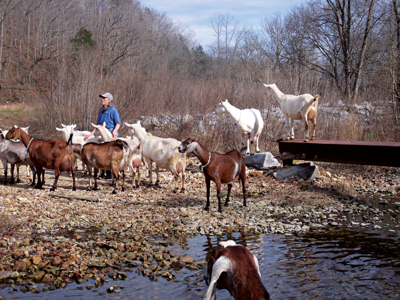
It's been a long time since I called a travel agent. These days, most excursions begin at Kayak, Expedia or another online trip planner. But our recent family spring break had a refreshingly analog origin: the cheese counter at Whole Foods in Green Hills. Many thanks to cheesemonger Sarah Jones, who recommended an overnight stay at Bonnie Blue Farm in Waynesboro, Tenn., and to Gayle and Jim Tanner and their herd of 70 goats, who welcomed us — almost like family — to their idyllic retreat two hours south of Nashville.
You might recognize Bonnie Blue Farm cheese from the menus of elegant eateries such as F. Scott's, Tayst, Flyte, Sunset Grill and Watermark, but the chèvre that arrives on the tables of Nashville's cosmopolitan dining rooms starts in a much more rustic environment. From the front porch of the Tanners' log cabin, which is available for overnight stays, you can take in the scenery, including the goat barn and milking parlor, chicken run, cheese cave, and 300 pristine acres where dozens of pedigreed Nubian and Saanen goats, along with a Jersey cow named Eileen, roam through pastures, woods and streams.
Our pilgrimage to Bonnie Blue started at Loveless Cafe, where we loaded up on a family-style breakfast of hams, jams and biscuits, before picking up the Natchez Trace and heading south. Of course, you can reach the Tanners via I-65, but that's a whole different kind of travel, and what's your hurry? You're on your way to a farm, where time is governed by the sun and measured by roosters. You may as well slow down to 50 miles an hour and enjoy a stretch of the historic parkway that meanders past Jackson Falls, a historic tobacco barn and the gravesite of the legendary explorer Meriwether Lewis.
When we finally drove under the arched sign of Bonnie Blue Farm and parked between the goat barn and the log cabin, Gayle and Jim emerged from the barn, and a fuzzy quartet of vociferous Great Pyrenees shepherds greeted us. Within minutes, our children fell in love with the Tanners' kids (that is, the baby goats playing in the barn), and we all tramped off to the creek (trip, trop, trippety trop) to hunt for crawdads.
For a group of city boys, standing knee-deep in a frigid creek while six-dozen goats splash by is an unforgettable experience. But for our boys, the memory of that watery stampede will be overshadowed by the sight of a single bearded Saanen stubbornly nudging their unwilling and lock-kneed father across a narrow beam that spanned the cold water. You can't get that kind of entertainment at Disney World.
By the time we changed into dry clothes and moved our stuff into the fully equipped cabin — which Jim built and where the Tanners lived until they completed their permanent living quarters above the barn — it was time for the 6 o'clock milking. Imagine, if you will, a cross between a police lineup and a Moulin Rouge-style cabaret. Six at a time, the goats parade across an elevated platform in the surgically clean milking parlor. The goats get a snack while a web of vacuum hoses drains their udders. About 15 minutes later, the empty goats exit stage left and another troop comes in. The whole process takes about an hour and a half. Twice a day. Every day.
The Tanners' 36 milking goats produce approximately 30 gallons of milk a day, which Gayle transforms into an array of soft pasteurized and hard raw-milk cheeses, including chèvre, feta, Camembert, Gouda, cheddar and tomme. Looking out the cabin window late at night, I saw Gayle, dressed in an immaculate chef's coat and cap, toiling away alone in her brightly lit cheese studio. My family had been asleep for hours, but the farm was still busy at work. The dogs were noisily patrolling against wild pigs and other nighttime marauders, the roosters were crowing at the full moon, and Gayle was heating milk, stirring curds and forming wheels of artisanal cheese to prepare for aging. (Furthermore, by the time we city slickers dragged ourselves out from under the covers the next morning, Gayle had already milked the goats again.)
Accented with a crisp, pretty pattern of blue and white tiles and equipped with gleaming modern appliances, Gayle's spacious cheese studio isn't exactly what you'd expect to find in the rural heart of sleepy Wayne County. "We didn't have to build it this nice," she explains, "but we're trying to raise the perception of goats. Goats always get a bad rap."
Indeed, the Tanners have introduced a playful element of Old World elegance to the West Tennessee countryside. Jim, who worked as a contractor in California, constructed a concrete-fortified cheese cave in the side of the hill by the cabin. Visitors to the medieval-looking grotto are greeted by a phalanx of half-size knights in shining armor, who stand guard over three climate-controlled chambers where wheels of award-winning raw-milk cheese age their way to moldy maturity.
Bonnie Blue's pasteurized chèvre and feta appear most frequently in Nashville's restaurants and shops — including Corrieri's Formaggeria, The Turnip Truck and The Produce Place — but the completion of the cave in 2010 allows the Tanners to expand their repertoire of raw-milk (unpasteurized) cheeses, which must age at least 60 days. On our visit to the cave, shelves were lined with marbleized wheels of award-winning Tanasi tomme (a semisoft earthy cheese named for the historic Cherokee capital that lent its name to the state of Tennessee); Parker Gouda (a nutty, supple cheese textured with tiny holes, named for an early resident on the Bonnie Blue property); and a sharp and salty bandaged cheddar that ages for a year.
While Gayle usually hangs back at the farm, Jim makes frequent trips to Nashville, Franklin, Chattanooga and Memphis, delivering cheeses to restaurants and shops and selling Bonnie Blue products — including fresh eggs — at farmers' markets. For $18 to $32 a pound, you can explore the unique hand-crafted flavors of Bonnie Blue cheeses, but for just a little more ($95 a night), you can get an unforgettable taste of life on a farm. Watching the Tanners and their beloved goats at work for just one day will forever change the way you look at cheese.
Email arts@nashvillescene.com.



