

In 2006, my wife and I traveled outside the country for the first time. It was our 10th anniversary, and we got tickets to a World Cup game in Nuremberg. Instead of staying in Germany, we set up camp across the border in Prague.
Now, Prague was chosen for several reasons, not the least of which is its beauty. But one of the Czech capital's glorious attributes, also, is that it is home to more than 100,000 English-speaking ex-pats, and in parts of the city, you could get by on English alone. Is that too American? Probably. I could spend the rest of this column describing the torture I put my college French teacher through, but I promised her that, after the mercy grade she gave me, we would never speak of it again.
(What does all of this have to do with reviewing an Indian restaurant on Nolensville Road? I'm getting there.)
Half-jet lagged from three legs of flying, we plopped down at an Italian restaurant just off the main square for our first meal to find ... a menu in Czech with Italian subtitles. Six months of planning and I was suddenly relying on two-decade-old Latin vocabulary words to order an entrée.
Now you know how I felt when I first picked up the takeout menu at Taj.
Lawazamaat? Samunderi? Garam shorbe? What did these words mean?
Co-workers and people close to me kept telling me that I had to check Taj out, because their meals were quite good. So I did what any sensible person would do — I called in a culinary Sherpa.
I'd like to think that if the roles were reversed and I were guiding someone through Southern cuisine, I could walk them through the food I grew up with the same grace, answering really dumb questions with the sense of amusement that greeted me. But with the help of my guide — a friend and Indian-American — I was able to find good and sometimes great things to eat.
Here's what I learned:
— Many Indian places, Taj included, try to cram the food of 1.2 billion people onto one menu, blitzing through the subtleties (and sometimes huge differences) of regional variations. It's the same phenomenon that happens with most of the Chinese restaurants in the U.S., too. Don't get hung up on this.
— What looks like eight pages of dishes is really smoke and mirrors. Within different sections, different proteins are treated the same way. So a chicken dish in one section is sauced the same as a similarly named goat dish, etc.
— Skip the buffet. Look, I know buffets are convenient and sometimes a good value, but everything I tasted on the buffet at Taj was inferior to anything I ordered on their menu. Indian cuisine, like any other, has no immunity against heat lamps and warming tables.
— I attempted to order dosas — a kind of crepe that's often street food — a couple of times but never got them, one time being told, "That's South Indian," despite the fact that it was on the menu under the label "South Indian specialties."
— When in doubt, choose something from the tandoor oven.
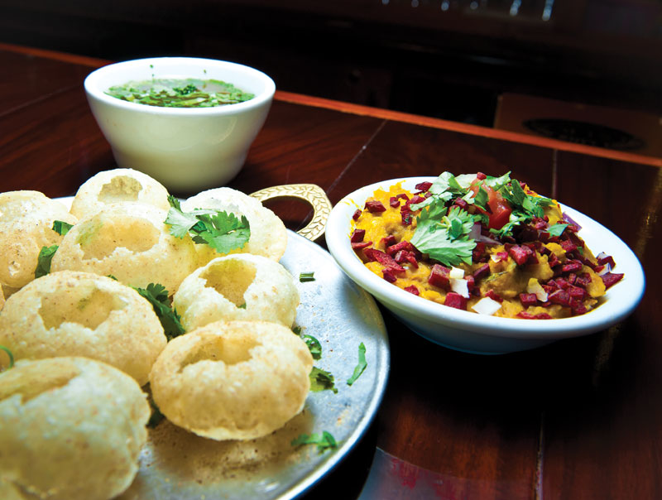
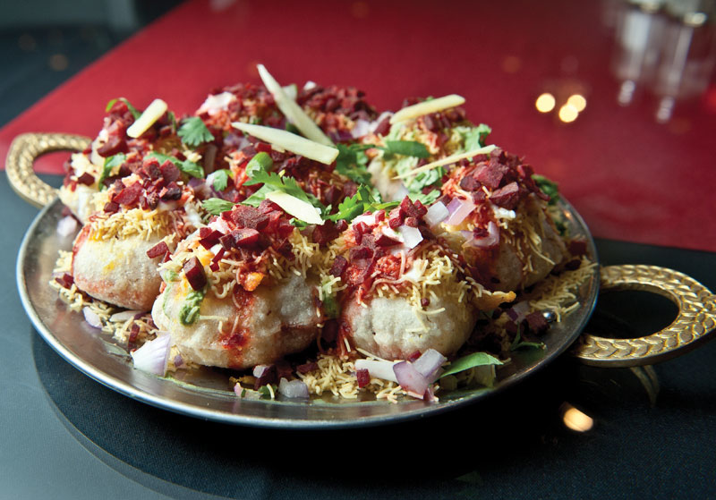
To start my first meal, the Sherpa ordered some pani puri — hollow, thin spheres — and a plate of bhel puri, small crispy pieces in a mound of potato, onions and chickpeas and topped with beets. Puri is an unleavened fry bread, and if you see it on the menu, it's generally as some form of an appetizer or snack. These particular puri had a bit of black salt in them.
Pani puri ($6.95) come with their tops cut off and are ready to be stuffed. These came with a delicious potato and chickpea filling that I spooned in and covered in chutneys, alternating between the tamarind and onion versions. It's hard to overestimate how addictive (and filling) those little guys are. The bhel puri ($5.95) are like a looser, crunchier version with the beets adding an earthiness and texture that's really outstanding.
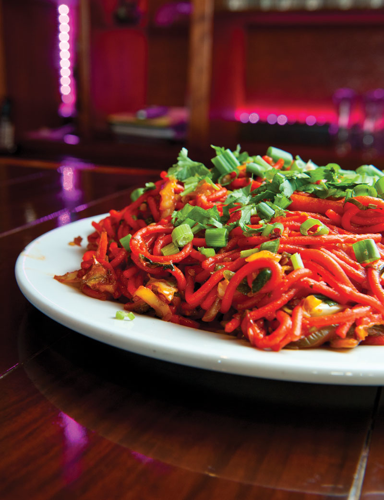
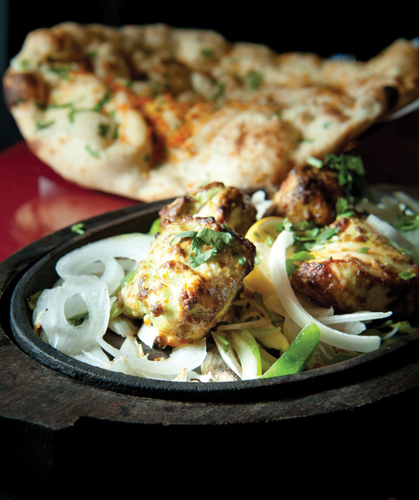
For mains, we tried the seekh kebabs ($15.95) and an Indo-Chinese favorite, hakka noodles ($7.95). The kebab, created by wrapping ground beef onto a long metal skewer and sticking it down into a tandoor oven, was a little charred on the outside, but the meat inside the crust was perfect. "You want it to be that way and not underdone on the inside," the Sherpa said, laughing. Served with green peppers and onions, the meat was spicy and bright with a little bit of garlic. Delicious.
But the hakka noodles were an altogether fun revelation. Garlicky, topped in cilantro and scallions and turned red from chili powder, these noodles are the kind of thing you wish for at the end of a night of drinking. They've got enough kick to be interesting, but not so much as to prevent you from eating plates of noodles at a time.
Emboldened by my first visit, I was ready to go back and order on my own.
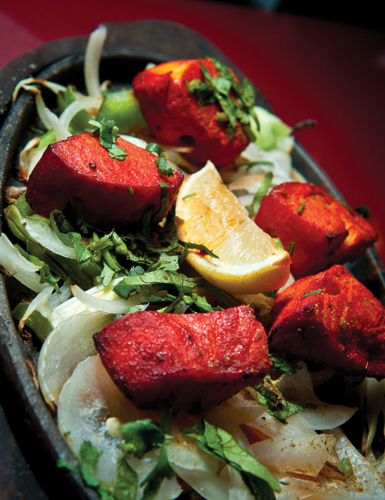
We stepped lightly at first. Chicken tikka masala ($12.95) is hardly adventurous — it's essentially a British creation — but man, it is good. Chunks of chicken are grilled in the tandoor oven and then served in a creamy tomato sauce. We added boti (lamb) kebabs ($15.95) and a tandoori fish tikka ($18.95) and couldn't stop eating either. At one point, the three diners at the table had commandeered different plates that were supposed to be "shared" and were eating right from them, not talking. The fish tikka, in particular, was perfectly cooked, something that doesn't always happen when mahi mahi gets introduced to a blast heat environment.
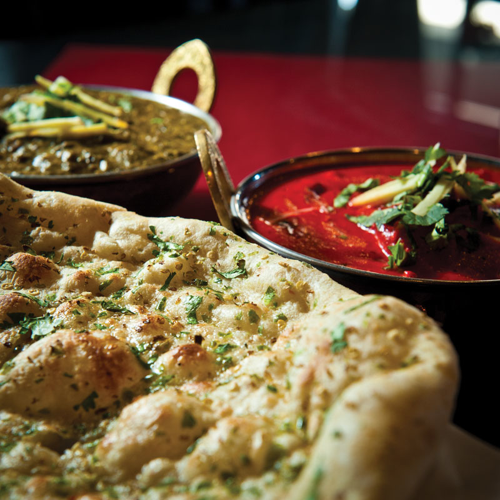
Either the fry bread (paratha) or oven-baked flatbread (naan) are essential additions, particularly if you don't like leaving sauce behind.
Other visits brought disappointment and satisfaction. The only mediocre experience at Taj was a lunch buffet, which devolved into what one friend called "a little bit of orange, a little bit of red and a little bit of green" on the plate. Every dish seemed to hit the same sort of note.
Just order from the menu (which has clear descriptions in English), because if you do, you end up with great things like bhindi masala ($9.95) — an utterly comforting okra dish — and goat curry ($12.95), slightly chewier than beef but with more flavor.
And if you're unsure of what to do, wander over to the tandoori section of the menu, close your eyes and put your finger down on something. Everything we had from that oven was excellent.
I think Taj is emblematic of a lot of what Nolensville Pike has to offer to Nashville. Walk in at lunch at many places up and down the road and you'll see the city's immigrant communities supporting their own. During a couple of visits, ours were among just a few non-Indian faces in there.
But Taj — like many other places — deserves a wider audience than that. The flavors strike many of the same comforting notes as much of the food Nashville grew up on, even if the ingredients are different or the names aren't English. With a little bit of effort, the payoff is very satisfying.
Taj's hours are 11 a.m. to 3 p.m. and 5 to 9:30 p.m. Tuesday and Wednesday; 11 a.m. to 3 p.m. and 5 to 10 p.m. Thursday and Friday; and 11 a.m. to 10 p.m. Saturday and Sunday. Closed Monday.
Email arts@nashvillescene.com.



