
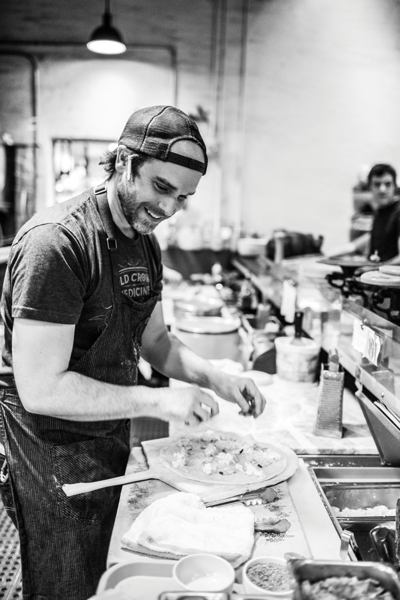

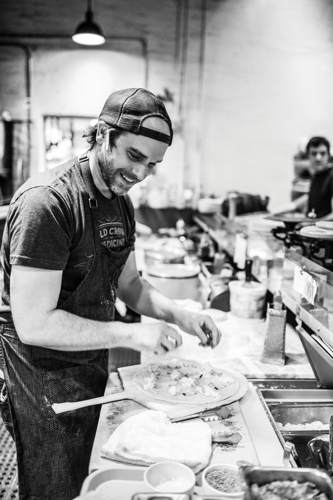
There are a lot of ways to measure a restaurant's success, but this is surely one of most telling: On a Saturday night when Nashville had been iced over for a week, and businesses, bars and dining establishments were all struggling to draw patrons, City House was packed.
That in itself isn't news: It's always packed. But with a huge number of cancellations, most of these were walk-ins, people who managed not to bust their butts on the ice that still covered sidewalks in Germantown. Every stool at both the main bar and the kitchen bar was taken, and every table but one was filled.
Tandy Wilson opened City House in 2007, and it's been one of the city's best restaurants ever since, an ode to Italian cooking with a California-style ethos and local ingredients. On Saturday night my companion and I had the octopus to start — tender fingers of the cephalopod over fregola and roasted cauliflower — and a spectacular carrot, cabbage and kohlrabi salad that used an Alabama-style white barbecue sauce for a dressing. My wife had the linguini, while I had the chuck steak, which was sliced thin and covered in giant flakes of Parmesan cheese and a few drops of Worcestershire sauce.
It was a quintessential City House meal: simple preparation, complex flavors. And the most interesting part of it — the true measure of the chef's influence — is that Tandy was nowhere to be found. The kitchen never missed a beat without him, a sign that he built the right staff to execute his vision.
Last weekend Wilson and a group of Nashvillians (including Pat Martin and Hattie B's John Lasater, joined by New York-to-Nashville restaurateur Jonathan Waxman) were cooking at the South Beach Food and Wine Festival, showcased at a $225-per-ticket event called the "Nashville on Fire Dinner." South Beach is one of the bigger festivals of the year, one that puts the invited chefs in front of food travelers who might end up back in Nashville at their restaurants one day — not to mention national media and a few James Beard Award voters. It also puts you on a beach in Miami instead of back home freezing your gnocchi off.
Wilson is on the so-called "long list" of Beard semifinalists for Best Chef Southeast again this year and a popular pick to be on the short list of finalists, a mark he's reached the past two years. What was most interesting about this year's list, though, was the Nashville representation — or more precisely, the lack of it. For a city that's supposed to be on fire, is that a snub?
In our region — Georgia, the Carolinas, Kentucky and West Virginia — Louisville had two restaurants on the list and Atlanta four. Charleston and Asheville both had three. Nashville? Just one. For all the promotion of Music City as a food destination, it's still the non-fine-dining side of the food scene that burnishes our reputation. It's Arnold's and Prince's. For every City House and Catbird Seat, there are a dozen more places that don't consistently stand out. (That's going to be read as an insult to a lot of very good places. It's not.)
While you shouldn't read too much into the Beard Awards from year to year, they still can be useful for measuring the perception of a city's dining culture. On at least some level, as far as we've come in the past 10 to 15 years, Nashville isn't even the best in our region, much less a national player. There are some fundamental issues we have to overcome before the city stacks up favorably.
If I were the city's restaurant czar, here are four changes I'd make:
First, I'd put a ban on opening new steakhouses. I count at least 15 mid-to-high-end steak places between downtown and the spot where West End meets I-440, and there are even more outside that narrow corridor. It's not that there is anything wrong with places like Union Common or Prima, both of which have excellent non-steak offerings, but Nashville needs more steakhouses like it needs more measles outbreaks. A great dining city has more variety.
Second, a greater emphasis needs to be placed on service. The best 15 or so restaurants in Nashville have, for the most part, a well-trained staff of servers who are attentive to customer needs. After that, though, service can be hit-or-miss. At one recently opened restaurant (name withheld until we can do a proper review), my wife and her party waited 20 minutes for someone to take the check, only to discover that the server had left for the evening. One reason that brothers Max and Ben Goldberg made the semifinal Beard list for Outstanding Restaurateur — a national award, not just a regional one — is for their commitment to customer experience. You just don't get mistimed entrees and rude staff in their Strategic Hospitality places.
Third, I'd double the number of good line cooks. Ask any chef in town and they'll tell you the city doesn't have enough top-notch people to work their lines, creating a domino effect every time a new place opens. When Pinewood Social opened at the end of 2013, for example, it pulled both servers and cooks from Rolf and Daughters, which then pulled from another restaurant, which then pulled from another. Before Sinema opened last year, Dale Levitski told me that more than finding a high-profile spot or moving from Chicago, the thing he worried about most was building a good line.
Finally, I'd spread the wealth a bit. Not every new opening needs to be in the Gulch or Midtown. A big reason for Sinema's success is that there is literally no fine-dining destination between its location in Melrose and the Williamson County line. There are diners with disposable incomes outside of East Nashville and Green Hills, and neighborhoods like Bellevue and Donelson are both ripe for at least one great fine-dining place.
It's a really good time to be a diner in Nashville. But don't believe the hype — we can eat a lot better.
Email arts@nashvillescene.com



