
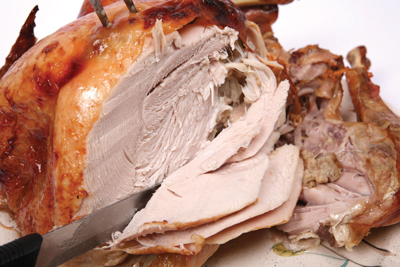
In many Louisiana households, after the Thanksgiving meal is eaten, along comes the moment when a crucial decision must be made: whether to make the gumbo. I can remember my brother, Chuck, some six or seven years ago, holding a bird carcass over a big boiling pot of water, and saying to no one in particular: "See you in three days." (This is the same brother who often says, "Some people's body is a temple; mine is a carnival.")
Properly executed, a gumbo takes time. First, it's very labor intensive. And second, the pieces just need hours and hours to come together. It's nothing short of a mystery, to be honest, how the disparate parts produce the final taste. Sure, any gumbo recipe can show you the "how," but it sure can't explain the "why."
When I see people take their carved-up Thanksgiving turkey and throw it in the trash, I want to shake them hard, convert them, explain the gumbo that awaits if they only take the time. And so, herewith, the map down Gumbo Road.
Phase I: Making the stock
Take the whole bird and any leftover turkey you have lying around and put it all in a large pot, bones and skin and meat and heart and innards all. If the bird doesn't fit, chop it in pieces and force it in. Cover the bird with water. Simmer for 4-5 hours. Or longer, overnight even. The house will start smelling great.
Then pull out the bird. Strain. The liquid is your gumbo stock. Take a whiff. Amazing. And a gorgeous yellow-golden color.
Pour the stock in a pot, and put the pot in the refrigerator. Remove all the turkey from the mass of bones and other stuff. Do not shirk this task — take out every last piece of meat. This takes a long, long time, and is a task for the wildly obsessive-compulsive. But you'll end up with a huge heap of turkey. Trash the bones and junk.
After the stock has cooled (eight hours or so), a glaze of fat will have formed on top. The stock underneath will have firmed up like Jell-O. Scrape off the fat and toss. Gaze at the stock with wonder. Place it on the stove, warm it back up, and proceed to ...
Phase II: Making the roux
Chop up one onion, one green pepper and three stalks celery. Place in one bowl.
Chop up a half cup of fresh parsley, a quarter cup green onion tops and five or six pods of garlic. Place in another bowl.
Put two-thirds of a cup of white all-purpose flour and two-thirds of a cup canola oil in a four-cup Pyrex measuring cup. (This is the monster Pyrex. You gotta have one.) Whisk the flour and oil completely. Scrape leftover flour from the sides of the glass Pyrex.
Danger lurks. You are now going to manufacture what Louisiana cooks call "Cajun Napalm." Put the Pyrex in a microwave and cook on high for six minutes. This stinks the crud out of your kitchen. Rancid, bitter, burning ... just god-awful.
After six minutes, pull the Pyrex out with a mitten or glove on one hand. In your other hand, stir with the whisker. BE CAREFUL!!! DO NOT SPILL!!! After stirring thoroughly, put the napalm back in the microwave. Cook in two-minute intervals: microwave two minutes, whisk, microwave two minutes, whisk, etc. The roux becomes thicker, darker. Continue until the roux is the color of chocolate. Once there, stir in the onion, bell pepper and celery. Microwave that for another minute, whisk, microwave another minute, whisk. Then add the parsley, green onion and garlic. Microwave that for one minute, then whisk. Then relax.
(SIDENOTE: Some fancy New Orleans cooks still use the old-fashioned method of cooking rouxs in saucepans on a stovetop, but technology trumped tradition in the South Louisiana Junior League cookbooks a long while back. Trust your microwave. Trust me too.)
Phase III: Sort of like Holy Communion, only different
Pour the roux and the stock in a large pot. Stir. Combine. Simmer. You should have had about 12 to 16 cups of turkey stock, maybe more. At first, the flavors will compete. Stink, actually. The damn mystery. The unraveling universe.
But have faith. Continue on. Add all the turkey meat, chopped up. Add a chopped-up link of grilled Polish kielbasa or some andouille sausage if you have it. Also add 15 to 20 pieces okra, chopped up in segments, and a 15-ounce can of chopped tomatoes, with the juice too.
Now add lots of black pepper, and also cayenne (red) pepper. Hot sauces (both Tabasco and Louisiana Hot Sauce) find their honorable places in the universe right about now. Salt? I'm careful here. The stock can already be salty, as is the sausage.
Take a taste: Yuck. I know. What you must now do is let the pot simmer for several hours. And then, you need to just let it sit. I don't know why, but it just needs down time. Go watch a game. Rake leaves. Hang the Christmas lights. Sooner or later — maybe it's Saturday or Sunday by now — the mystery will have been revealed, and the gumbo will have found itself. It will come together, and all will be well.
Thus do you now have a pot of your basic South Louisiana turkey-and-sausage gumbo. As an addendum, I usually add two pounds of raw, peeled shrimp 10 minutes before serving. The shrimp cook quickly. Don't get the tiny ones — splurge and get decent size Gulf Coast shrimp.
When you serve gumbo, put a little bit of white, long-grain, steamed rice in a bowl (don't overdo the rice) and then ladle the gumbo on top. Some people sprinkle more green onion tops on their gumbo before eating. I second that emotion.
Unlike Nashville, gumbo freezes just fine. Sock some away, over near the vodka bottle. The hard season awaits.
Email arts@nashvillescene.com.



