


During my early interest in all things preserving and pickling, I would coordinate the recipe with my friend Judy — then I’d pack up my Ball jars, long tongs and Sharpies and take it all over to her place. At the time, I lived in a “charming” house, meaning it had no kitchen counter space or a dishwasher for easy sanitizing.
When I first toured my current house, I measured the clearance of the stove hood to make sure a canning pot would fit underneath. Once moved in, I felt emboldened to can with abandon. One year my friend DG was given an heirloom crock, so we decided to make sauerkraut for everyone we knew, which involved buying 40 pounds of cabbage in the mountains of Georgia. You might not realize how much space 40 pounds of cabbage takes up until you try to shove it all into the back of a Honda Element.
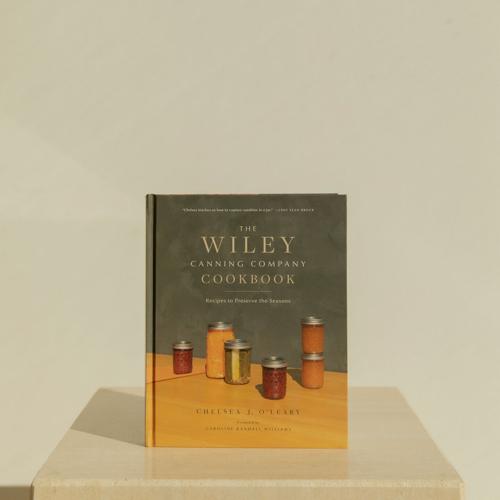
All that is to say, I was particularly interested when I heard about The Wiley Canning Company Cookbook by Nashville’s Chelsea J. O’Leary, which was released this week. Unlike the classic canning books I own and love, O’Leary’s new book takes apartment-dwellers, small families and non-homesteaders into consideration. Photos feature four lemons or a bowl of green beans, not enough produce to fill an SUV.
“The yields are less than in the Ball book because of how I shop,” O’Leary says. “I would usually bring home 2 pounds to 5 pounds of berries. I never go buy 10 red onions. So I made the yields much smaller.”
O’Leary launched The Wiley Canning Company in 2020, naming it after her grandmother, who was a next-level canner. O’Leary has happy memories of grabbing a jar from her grandma’s basement stash, and decided to teach people to preserve in a way that works for modern cooks in modern homes.
“Even if you are not living on a farm and just want to use what you bought at the farmers market, you can preserve things for later in the year,” she says.

O’Leary’s grandmother has since passed away, but she helped her granddaughter with the development of the book’s 45 seasonal canning, pickling, preserving and freezing recipes. In addition to yield consideration, O’Leary updates a lot of classics, such as using monk fruit as a sweetener. In addition to her grandmother, O’Leary’s got some other high-profile supporters. The book includes a foreword by Caroline Randall Williams as well as recipes in collaboration with Laura Lea Bryant and Sean Brock.
The Wiley Canning Company Cookbook includes tips on efficient workflow, especially if you don’t have a giant kitchen. And of course no book on canning would be complete without a section on safety of home food preservation, which O’Leary says is the part that intimidates many first-timers.
The book is available at area bookstores. O’Leary will appear at a number of signing events, including at Porter Flea later this year. She’s also available for private canning classes. Visit wileycanningcompany.com to sign up for those.



