
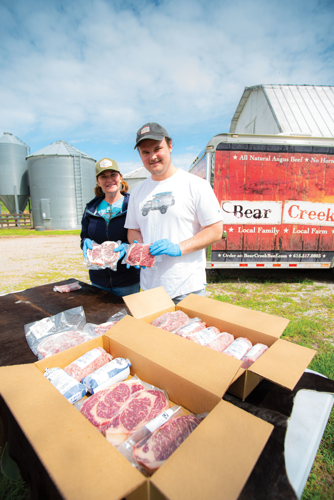

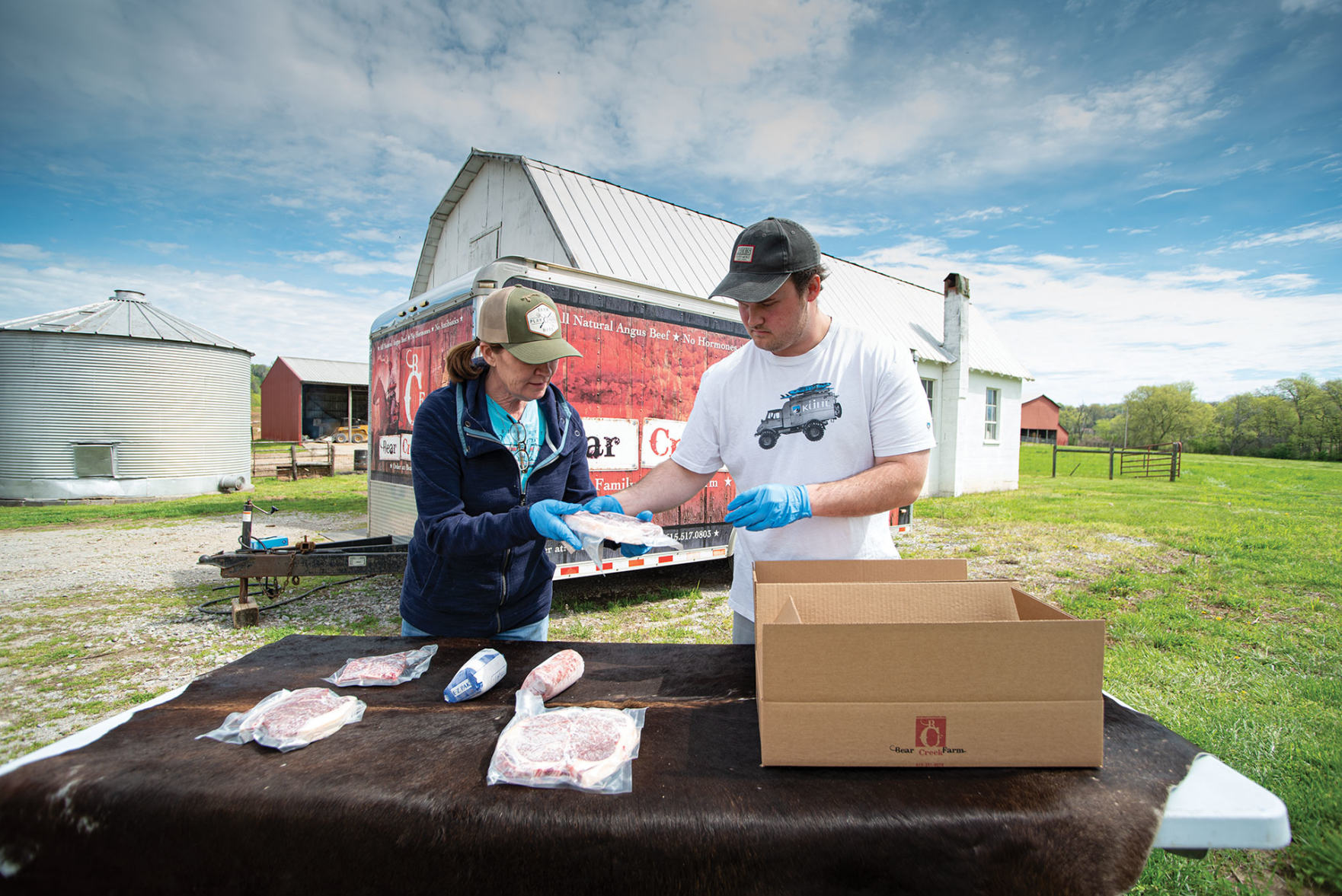
LeeAnn Cherry and her son Grant McKenzie sort meat orders at Bear Creek Farm
Julie Vaughn’s phone started to ping while she stood in the fields at her Rocky Glade Farm harvesting crops for restaurant clients. That’s when she knew something was up.
“ ‘Don’t harvest that order,’ ” she recalls reading in texts, “or, ‘Let’s cut that order.’ ”
The effects of the coronavirus had started to hit restaurants, with owners contemplating changing models or shutting doors. “We took one order to Nashville,” Vaughn says, “and on the way, my husband saw that [the restaurant] was closing.” (Vaughn tells the Scene that the restaurant bought the order anyway and dispersed it to employees.)
As with so many of us in Middle Tennessee, that was the second time last month that Vaughn and her husband Jim had been blindsided — a tornado followed by a crippling pandemic. On March 3, Jim came upon traffic while he was heading into Nashville to deliver produce. “We didn’t know the tornado had hit,” Julie says. “He left at 4 a.m. to deliver and couldn’t get downtown.”
LeeAnn Cherry of Bear Creek Farm, who grows beef for many restaurant clients in Nashville and throughout the Southeast, tells a similar story. She pulled into Atlanta on a delivery only to discover via Instagram that the restaurant client had closed. Both Cherry and Vaughn have dedicated a large portion of their business to restaurants, as does Dustin Noble of Noble Spring Dairy. “About half our business is restaurant customers,” Noble says. “That is nonexistent right now.”
Farmers — like their restaurant friends — have had to pivot and scramble for creative ways to get their food in the hands of consumers. Animals still need to be fed and grass still needs to be planted, which of course involves expenses and labor. Vegetables must be harvested, rerouted or preserved to keep them from going to waste. Meanwhile, other farmers with larger wholesale grocery clients scramble to keep up with increased demand.
“Anybody that’s in business — when you look at strengths and weaknesses, whether you’re a nail salon or dry cleaner — you could not prepare for this,” Cherry says.
And still, they figure out how to carry on in new ways. Rocky Glade has teamed up with Hatcher Family Dairy to sell at the dairy’s farm store. Cherry continues to sell at markets where safety precautions have been put in place, and she launched a farm store at her property. Customers can preorder or just show up there on Wednesdays between 3 and 6 p.m. for meat boxes or à la carte orders from Bear Creek as well as other farms. Additional online platforms are forthcoming. Noble, who sold to restaurants as well as large hotels and the Music City Center, will continue to make cheese — because “it has to be made” — and sell at markets as well as a farm stand on his property. He’s also looking at making cheeses that need to be aged longer or have a longer shelf life. Other farms — like Growing Together, a program of The Nashville Food Project — have expanded the number of CSA shares they are offering to help offset restaurant revenue.

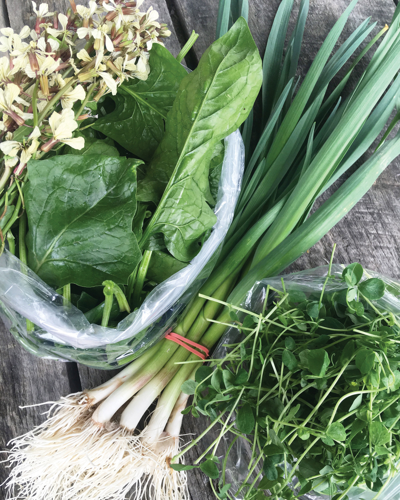
Bells Bend Farms produce box in collaboration with Nicky’s Coal Fired
In a smart farm-restaurant collaboration, Eric Wooldridge of Bells Bend Farms and chef Tony Galzin of Nicky’s Coal Fired teamed up for cooking classes that involve farm produce. Wooldridge tells Galzin on Sundays what he’ll be harvesting for the week. Galzin gives it some thought as the farm bags go up for sale to customers ($20 for two people), and then Galzin hosts his demo with recipes on Fridays. Guests can cook along with him at home if they’d like. “We’re just doing it for free and asking people to donate,” Galzin says. Anything — five, 10 bucks, or buy a gift card.”
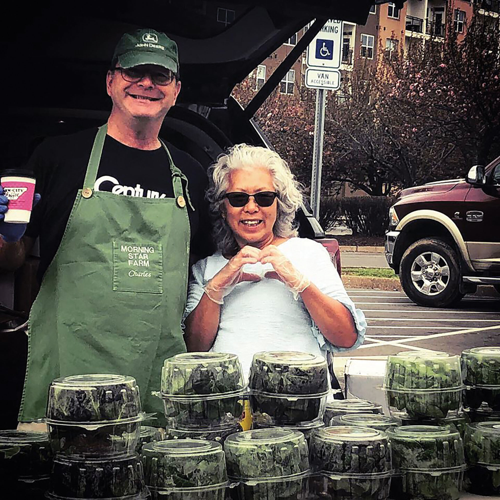
Even the Nashville Farmers’ Market launched a drive-thru service with farmers vending from the parking lot instead of beneath the farm sheds. Executive director Tasha Kennard found inspiration to create the new system by remembering visits to the old market — which had a drive-thru — with her grandmother. And while farmers markets are considered essential services under Metro’s “Safer at Home” COVID-19 response, and technically the sheds could stay open, Kennard says the downtown market also had to weigh all safety concerns — especially at a location that can draw 2,000 people a day.
Kennard says she sees farmers who are struggling with decreased foot traffic and missed restaurant sales, but she also sees farmers who are thriving through wholesale grocery accounts. Regardless of the market, she “hopes it results in more local product in our grocery stores.” And as the growing season picks up in May, Kennard hopes food won’t be wasted, with institutional buyers like hospitals and schools perhaps stepping into the equation.
“Farmers and small businesses need as much support as you can give them right now,” Kennard says. “We’ve all just got to have hope and faith that however this looks on the other side, we’ll be stronger and better.”
Indeed, farmers like Vaughn, Cherry and Noble — despite all the pivots — sound resolved and committed, even though change won’t come easily or quickly. In a true display of community, there’s a give-and-take at play, too — the farmers offer support for the restaurants, and the restaurant owners offer support for the farms. Catering service The Party Line and Gulch restaurant Biscuit Love sell pantry boxes through their websites, which include Bear Creek meats and other local products.
“They have fed my family for 15 years,” Cherry says of local restaurants. And she’s doing her best to support them too. She recently picked up a to-go pizza from East Nashville’s Folk and drove it back to Thompson Station. Her only complaint? Not being able to eat it in the car until she could wash her hands.

Morning Star Farms at the Nashville Farmers’ Market drive-thru
Likewise, Vaughn mentions the curbside service at Folk too, as well as its sister restaurant Rolf and Daughters in Germantown.
“We’ve been doing business with [Folk and Rolf chef-owner] Philip Krajeck for over seven years,” Vaughn says. “Through this virus thing they are very committed to their core farmers, and we appreciate that very much.”
Perhaps it should come as no surprise that farmers — long toughened by hard work and the whims of weather and other unforeseen circumstances — pass along the resilience and hope they find in the rhythms of nature. So even as they work to keep their businesses afloat, the farmers can often be heard giving their customers a pep talk too.
“To be a farmer, you have to have faith,” says Vaughn. “We have a lot of faith here. It’s all gonna be OK.”



Post a comment as anonymous
Report
Watch this discussion.
(0) comments
Welcome to the discussion.
Log In
Welcome to the discussion.
Keep it clean. Please avoid obscene, vulgar, lewd, racist or otherwise abusive language. Comments featuring hate speech or threatening or violent content will not be tolerated.
PLEASE TURN OFF YOUR CAPS LOCK.
Be truthful. Don't knowingly lie or mislead.
Be proactive. Use the “report” link on any comment that violates our comment policy.
Share with us. We'd love to hear your feedback.