

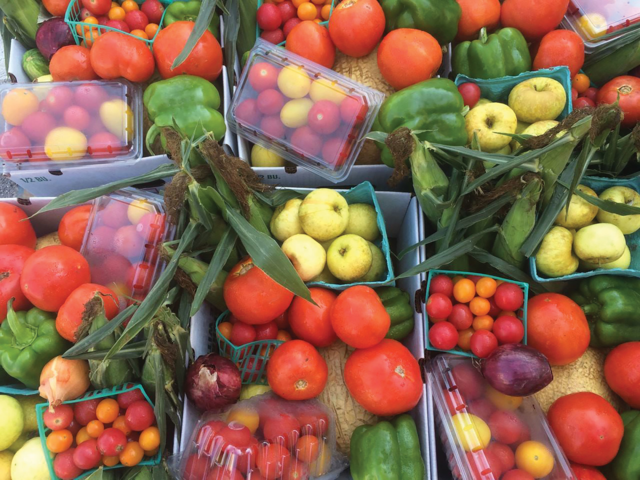
Delvin Farms
March is a fickle month. Who knows what’s in store weather-wise? We may see temperatures fluctuate wildly — or maybe they’ll gradually climb. But one thing’s for sure: Spring is coming, and with it an abundance of nutrient-packed vegetables to cure your blues.
A surefire way to reap the benefits of Middle Tennessee harvests is by investing in a local CSA, or community-supported agriculture program. CSAs are essentially subscription deals for fruit, vegetables, meat or some combination of the three. Customers pay farmers up front for an entire season — or two, or three — and pick up their farm shares at a designated spot on a regular basis. As a result, consumers know the exact path their veggies take from the dirt to their plate.
Cindy Delvin and her husband Hank started Delvin Farms in the 1970s in College Grove after Hank returned from Vietnam. “In knowing your farmer,” says Cindy, “you know what type of production they’re doing. You know what’s going into the soil, what’s going into the product itself. To know that particular farm and know the people personally who are growing your food is something that a lot of people enjoy. ... That evening they discuss that at the dinner table, and they can say, ‘Ms. Cindy grew this for you,’ or, ‘Mr. Hank grew that for you.’ They have that connection to the farm.”
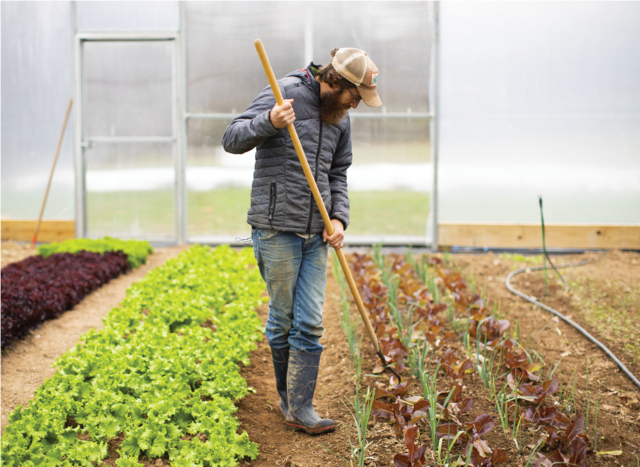
Sweeter Days Farm
But the benefits reach well beyond what customers see at their tables. CSAs support small, independent farms at a crucial time of year. Todd Bentley is the co-owner of Sweeter Days Farm in Ashland City. He says February and March are the financially leanest months of the year, but they’re also the months when a farm invests the most capital in things like seeds, organic fertilizer and compost.
“Changing the time frame of cash flow is the main way that [CSAs] help farmers,” says Bentley. “We need the capital to get the season started. It’s an investment, it’s a relationship, and it’s a guaranteed sale so that we know that the product we are growing isn’t going to waste.”
CSAs also help farmers plan some of the year’s production based on guaranteed sales, taking out some of the guesswork about how much produce to plant. Delvin notes that many family farms are going out of business because they can’t compete with large farms that offer discounts for bulk purchases.
“If people understand that and are willing to support a local grower, that saves the farm in the area and keeps it from turning into another subdivision,” says Delvin. “And we are getting a lot of those around here. If the farm stays as a farm, it helps the environment. It helps the community. It gives the community open land where they can come to pick up their food.”
Mikala Flint of Bloomsbury Farm says this year the farm is committed to being as close to plastic-free as possible. Bloomsbury is on 400 acres in Smyrna, and it offers 10 pickup spots around Middle Tennessee with a variety of share sizes. Like Delvin Farms, Bloomsbury is certified organic. Through CSAs, farmers are able to offer produce at a discount — definitely less than what a customer would pay at Whole Foods. It’s a good way for consumers who are unfamiliar with organic produce to taste the difference.
“Before I started working here, I did not know much about organic food,” says Flint. “There is a huge flavor difference. Our lettuces are crazy buttery. Arugula is spicier. It’s just a higher-quality and much better flavor. Once people try it, they don’t want to go back.”
USDA Organic certification is a good seal of approval, but Bentley explains that it can be difficult for small farms to secure the designation. There’s a lot of red tape, and the certification process is expensive. But there’s a way around that, says Bentley. Sweeter Days is Certified Naturally Grown. It’s a different designation that relies on peer-to-peer inspections to ensure farmers are employing organic processes.
“We use no synthetic fertilizer,” says Bentley. “We use no synthetic herbicide or pesticides, and we will never use genetically modified seeds. Those three things keep you safe as a consumer and keep the priorities on soil management and soil fertility through organic means.”
All of the CSA farmers the Scene talked to offer ways for consumers to pick and choose the product to different degrees. At three out of five of Delvin Farms’ pickup locations, customers who order a full share get a list of roughly 20 fruits and veggies, and they choose about 15. Sweeter Days will have a swap box, so if you love collards but aren’t hot for kale, you can swap it out.
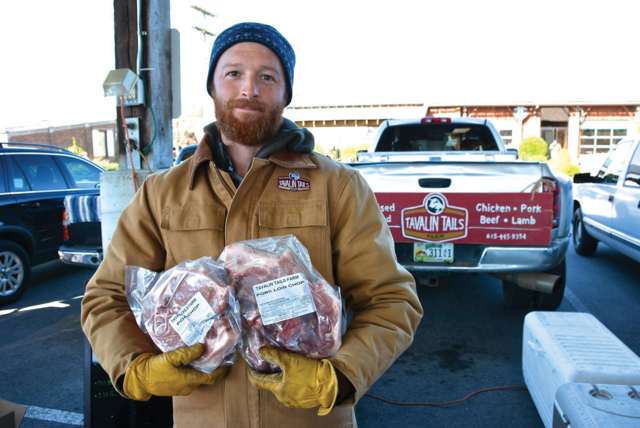
Brandon Tavalin of Tavalin Tails Farm
Meat lovers also have options. There’s a bevy of CSAs in Middle Tennessee that supply chicken, beef, pork and lamb. Tavalin Tails Farm is an offshoot of Delvin that’s owned by Cindy’s daughter and son-in-law, Amy and Brandon Tavalin. They specialize in raising Katahdin, a breed of hair sheep.
“Hair sheep shed wool naturally, so it doesn’t have as much lanolin, which gives lamb that mutton taste,” says Amy Tavalin. “People are switching over from beef to our lamb because it has a mild flavor.”
Like Tavalin Tails, Peaceful Pastures raises all its animals in pastures — not in stalls where they have limited mobility — and they’re all grass-fed. Darrin Drake says treating animals humanely ensures that he’ll create a quality product.
“You can’t short them on water,” says Drake. “You can’t short them on grass or hay … or it shows up in the quality of the meat. You can’t beat on them when you’re loading them to take them to the processor because you’ll end up with a piece of meat that’s called a dark cut. It’s not a high-quality product. If you don’t treat them well during that last few hours of life, they get excited. When they get excited, adrenaline gets into the blood system, gets into the meat.”
Drake says the processing methods affect how the meat should be cooked. Because Peaceful Pastures is certified organic, there are strict rules for processing. Processors that deal with factory farms usually inject the meat with water to plump it up. When cooked, all that water must evaporate. Organic, grass-fed meat cooks in a third of the time it usually takes, so it’s easy for consumers unfamiliar with it to overcook it. But once you get it right, Drake says you can taste the difference.
“The biggest thing is that it has more flavor,” says Drake. “Some people say that it’s a little chewier, but it’s not tougher. What they’re trying to say is that there’s just more substance there. ... It’s fork-tender, but it doesn’t dissolve in your mouth like a piece of meat you can get that’s grain-fed.”
What’s more, you can feel good about how the animals are raised — rotated through pastures so that there’s always fresh grass to eat. It’s similar to the transparency consumers get with local CSA produce.
“We get to know our customers, and they get to know us,” says Bentley. “Not just our growing practices but us as people. It goes beyond growing food. It’s friends supporting friends. ... We’ve had an impact on their health and their lives. That’s really meaningful. For the consumer, the biggest thing is they can feel good about the veggies they’re eating, and they can feel good about the local economy they’re supporting.”



