
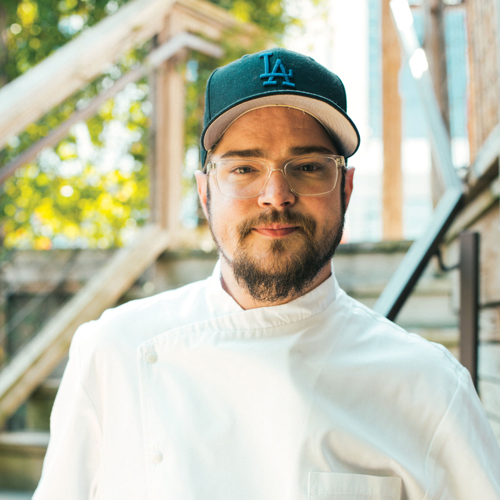


Chef Bryan Lee Weaver
Chef Bryan Lee Weaver makes it look easy.
The lanky Texan has a soft voice and an easy smile, so his kitchen at the popular Butcher & Bee in East Nashville hums along, quietly pumping out small plates and sandwiches with seemingly impossible alacrity during busy lunch services. Next year, he’ll open Red Headed Stranger, a new restaurant on the East Side focusing on the Southwestern fare he grew up with. But for now, his attention is on the Bee, a restaurant whose Israeli-inspired menu features ingredients and techniques that are probably unfamiliar to most Nashvillians. Even so, locals have taken to the flavors and the vibe of the restaurant, making it an immediate hit.
One might assume Weaver was deeply steeped in the cuisine of the Middle East when Butcher & Bee owner Michael Shemtov offered him a gig opening up a Nashville outpost of the Charleston restaurant. One would be wrong. “I had no base in Israeli food,” Weaver recalls. “I’m sort of a perfectionist, so it’s daunting for me to jump into something new. I like the challenge, though.”
At the time, Weaver was cooking at Superba Snack Bar in Venice Beach, Calif., so he had some experience working with small plates like the mezze at B&B. Still, he immediately dove into research.
“I bought 10 books on Israeli cooking, and Michael mailed me some more,” says Weaver. “I spent a lot of time looking at old Butcher & Bee menus, but for the first year I just went for it!”
Nashville diners responded positively right out of the gate, but Weaver and Shemtov knew they wanted to take it to the next level. Weaver explains: “I was comfortable with the small plates, so it was mainly learning new spices. Reading has given me a really good base in Israeli cuisine, but I needed a more personal connection.” So Shemtov planned a 10-day tour of Israel for Weaver and his Charleston Butcher & Bee chef counterpart Chelsey Conrad to visit Tel Aviv, Jerusalem, Akko and Haifa, and the two young chefs had different objectives on the trip.
“Chesley wanted to see exactly how they do it in Israel,” says Weaver, “whereas I wanted to use the trip as a jumping-off point to do my own thing.”
“Once I actually ate the food in Israel, I discovered I had been faking it pretty well for the first year,” he continues with a chuckle. The attitudes of the two chefs toward the trip speaks volumes about their culinary philosophies and the impressive willingness of Shemtov to support them both in sister restaurants.
“Michael really invested in us to grow our knowledge and the company,” explains Weaver. “It’s all about growth. Learning history and culture — you can get that from a book, but the real experience of walking through the markets and seeing the ingredients where they grow changes how you think about things.”
While Conrad seeks authenticity at the Charleston Bee, Weaver doesn’t obsess about it. “Authenticity is a very loaded word,” he says. “In Jerusalem, we discovered that the food was a melding of Jewish/Arab/Palestinian cuisine, and we often tasted the same dish done in different ways. So how can I be authentic about anything? Anything I do will be a mish-mash of who I am and where I’m from. It’s authentic to me!”
Weaver grew up in Texas and Colorado, but has worked in Portland, Ore., and California, and childhood visits to New Mexico also shaped his culinary gestalt. “I try to connect my past with how we do it in the South. I’m not from here, but the region has opened up opportunities for immigrants and is open to experimentation. I’m not claiming to make Israeli food or Southern food, but some people feel the need to label. Andy Ricker gets criticized for his Thai food because he’s a white guy from North Carolina, but he is doing it the right way at Pok Pok, because he studied in Thailand.
“I only want to make delicious things,” Weaver continues. “Knowing where they came from helps.”
But his next subject to master is slightly less exotic than B&B. Partnering again with Shemtov, Weaver plans to open a new restaurant at 815 Meridian St. near McFerrin Park in East Nashville, where Weaver will focus on the Southwestern flavors of his youth. “A lot of it is going off of memories of being a kid and walking into a tortilla factory or smelling a barbecue pit. Growing up in Fort Worth and outside of Boulder, we ate a lot of brisket, and there was always a Mexican element to the food. We also spent time in Albuquerque when I was a kid and made trips to El Paso and Juarez, so I want to explore that more.”
The restaurant will be called Red Headed Stranger, an homage to the outlaw country music popular in his home region. Investigating whether he could use the title of the famous Willie Nelson song for the restaurant’s name, Weaver clicked on the “contact us” button on the singer’s website and hoped. “Within two hours we got an email back from Willie’s granddaughter Raelyn Nelson, and she said not only could we use it, but that she’d be there every day as a customer!”
Music will be a big part of the vibe at Red Headed Stranger, with Willie and Waylon interspersed with Houston hip-hop. The decor won’t be over the top, but every element will have some personal meaning to Weaver. Even more important to him will be the tortillas. He explains his tortilla obsession: “I’ve been to Austin several times and really got into the breakfast taco trucks. It’s crazy that nobody is doing that here, putting a breakfast sandwich in a taco. That specific act for breakfast is easily repeatable, but the tortillas are the star of the show. They’re the big thing we still have to work out.” Weaver plans to start his process by grinding nixtamalized corn, which has been soaked and cooked in an alkaline solution to create the masa flour for the tortillas. Weaver has even visited noted heirloom grain expert Glenn Roberts of Anson Mills in South Carolina to discuss which corn to use.
“People want to call it Tex-Mex, but that’s not necessarily what we’re doing. Melty cheese and rice and fajitas — I love it, but that’s not what we’re doing. I want a place that serves great breakfast tacos and an awesome green chile burger. I thought about adding brisket, but that might end up being a whole other restaurant.”
Weaver has already made an investigative trip to El Paso, Texas, and Las Cruces, N.M., to explore the border cuisine and immerse himself in the culture of the home of the famous and delicious Hatch chile. Traveling with representatives of his suppliers at Zia Green Chile, Weaver met with chile farmers, visited the Chile Institute at New Mexico State University, ate in local cantinas and visited the legendary Hatch Chile Festival. He came back from the trip with a few solid new ideas.
“I really want a chile roaster now,” he says, “and we’ll definitely have a magnetic menu board like the one in this car wash I ate at twice — they serve the best breakfast tacos in El Paso!”
Weaver has future excursions planned to breakfast taco meccas of Austin and San Antonio to learn even more about the cuisine before his anticipated opening date sometime next summer.
“I count on these trips to trigger my memories and make it more authentic and grounded,” he says. “A lot of what I’m trying to do is based on aromas I remember, so I want to experience them again. Like at the Bee, I’m not trying to re-create what anybody else is doing. In the end what I want to do is be representative of myself." You’d think that would be easy, but sometimes in the restaurant world, you have to work really hard just to be yourself.
Email arts@nashvillescene.com



