
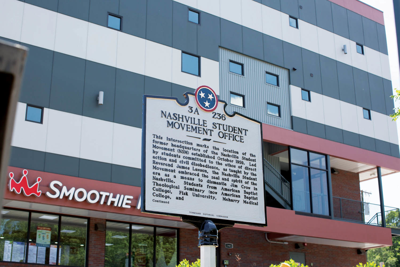


1812 Jefferson St.
Omari Booker was upset each time he drove past 1812 Jefferson St., where a new coffeehouse is slated to open in the coming weeks. Its name: The Sit-In.
“Sit-ins were brutal,” says Booker of the 1960s protests that eventually led to desegregation of lunch counters, with Nashville leading the country. While the sit-ins were nonviolent protests, African-American students who refused to leave were often the victims of violent opposition to their presence. “People were spat on. Cigarettes were put out on them.” Given that history, Booker says, it was very difficult for him to drive by that site every day.
Booker, a Nashville native and an artist working in the historically black North Nashville neighborhood, connected with Bob Bernstein, who plans to open the cafe in the neighborhood as part of his 25-year-old local Bongo Java chain. They talked on the phone, and they both agree that the call ... “didn’t go great,” in Bernstein’s words. By the end, Bernstein’s takeaway was that they would have another in-person meeting to discuss further, while Booker felt dismissed and misunderstood.
So Booker collaborated with neighborhood friends, jointly crafting a May 9 social media post using hashtags including #boycottbongo and #shutdownthesitin. In the post, which included a black-and-white image from the historic protests, they wrote: “This is the last straw in a long line of local establishments that profit from the pain and culture of African Americans.”
Booker’s boycott threats weren’t idle. He has patronized Bernstein’s establishments in the past, and he fondly recounts spending hours sketching at Bongo outpost Fido in Hillsboro Village. The campaign was a real, albeit small-scale, effort — the aim was to call attention to neighbors’ concerns, and it worked. The post led to community meetings and discussions. It led to online debates and overdue conversations about moving Nashville forward.
Words Matter
This isn’t really a story about a coffeehouse. It’s a story about semantics, and the different histories that blacks and whites have had in Nashville, and how that shapes their futures. Conversations with Booker and others have Bernstein reconsidering the shop’s name: “I’ve opened restaurants without a sign before … but I’ve never opened without a name.”
Restaurateur Tom Morales of TomKats Hospitality owns two hugely popular downtown spots, The Southern Steak & Oyster and Acme Feed & Seed; in February he opened Woolworth on 5th, a restaurant at the site of 1960s lunch-counter sit-ins that aims to pay homage to Nashville’s civil rights history. Both Morales and Bernstein say it will be years (between five and 10), before they’ll turn a profit in these businesses, noting the financial risks associated with such ventures. For the activists, “profiting” means benefiting.
The reasons why a proposed coffeehouse name became a lightning rod are complex. There’s not just one spokesperson or consensus in the local community about what went wrong and how — or if — it can be fixed. Some contend the issue is the name alone. While Bernstein says the name is intended to pay respect to the history that took place on Jefferson Street, and to encourage more sitting and talking, some see it as a play on words that trivializes the term’s history. Others bristle at what they see as a business making money on other people’s pain. For Joseph Bazelais, one of the organizers of the Jefferson Street Art Crawl and part of Booker’s group, The Sit-In was the tipping point. “Enough is enough,” says Bazelais. “It is one more experience that has been co-opted from the black community.”
The sit-ins took place decades ago, but the fight for equality is still far from over today, says Rhiana Anthony, one of the people with whom Booker initially met about the social media posts. “There’s no such thing as ‘post-racial,’ ” she says. To have a coffeehouse that honors such events implies that civil rights struggles are a thing of the past, which she stresses is not the case.
Others are concerned about the fact that it’s not a member of the local black community who has ownership of this restaurant. “It is interesting that two white guys opened these places,” Bernstein says of The Sit-In and Woolworth. “I get it. It is interesting to talk about who gets to tell history.” Both Morales and Bernstein emphasize that their businesses are not museums, and while they hope to spark interest in history, they are not attempting to supplant the roles of institutions like the black-owned Art History Class Lifestyle Lounge and Gallery, whose closing in 2016 is still deeply felt.
Others point out what they feel are historic inaccuracies: The sit-ins didn’t take place on Jefferson Street, which has long been the center of Nashville’s black community. Areas like downtown Nashville, where black people weren’t allowed to eat at the lunch counter, are where they fought and protested. Both Morales and Caroline Randall Williams — a Nashville-born African-American author and investor in Woolworth on 5th — tell story after story about people who have come to their restaurant since it opened in February, talking about how meaningful it is to be able to dine where they once could not. They both refer to Woolworth as an intentional “Welcome Table,” a reference to a traditional African-American spiritual.
Bazelais and others underscore that they believe Bernstein has good intentions. Bernstein came to the project more than three years ago on the invitation of D.J. Wootson, the African-American developer of 1812 Jefferson St. and several other buildings in the area, through his Titus Young Real Estate. (John Ingram is also an investor in the project.) The neighborhood is home to three historically black universities — Fisk, Tennessee State University and Meharry Medical College — but not one coffee shop, which locals told him they wanted.
Wootson asked Starbucks, Dunkin Donuts and a handful of local coffee purveyors, who all said the same thing: Jefferson Street wasn’t ready. But Wootson thought Jefferson street was ready. He was making his own investments converting some existing buildings on the north side of Jefferson Street into moderately priced renovated apartments, in addition to the higher-end 1812 building.
“I invited him here,” Wootson says of Bernstein. He says Dollar General wanted in the building, a move that would have allowed him to recoup his investment more quickly. But there are two Family Dollar stores on Jefferson Street, and Wootson wanted to bring in something else.
The two met at Citizens Bank on Jefferson Street and walked to the Fisk campus. Bernstein recalls Wootson saying, with tears in his eyes, “We need someone over here — no one will do it.”
Almost immediately, Bernstein gave Wootson a yes. “I was born in 1962 in a nice white suburb,” says Bernstein. “My mom introduced us to things, and from the beginning my view of the civil rights [movement] was that this was amazing. These people sat in to change the world. When later I realized how much Nashville was a part of this … this is a way to pay tribute.”
Bernstein had the architects reconfigure the room so it would be one large space with a stage for discussions, music and anything else the community wants. Tables were designed by a local artist, using newspaper headlines from the civil rights fights of the 1960s. Bernstein hopes they will spark conversation.
Even without the 1812 development, Jefferson Street is an active commercial strip, with businesses including a bike shop, dry cleaners, barber shops and more. But many say the struggle to get other businesses to serve the community is exhausting. Something that is simple in other neighborhoods, like getting a pizza delivered, is next to impossible in North Nashville.
Beyond Jefferson Street
There isn’t a #boycotttomkats hashtag, but there are people who have similar concerns about Woolworth on 5th. Morales restored the site of the lunch counter where sit-ins took place. The building had been shuttered for years after operating as a Dollar General — fortunately for architectural preservationists, Dollar General left the original terrazzo floors and other details alone. Morales, a Nashville native who remembers going to Woolworth as a child with his mother and nine siblings, witnessed desegregation of the city in a number of ways — he was a student at an early desegregated school. He wanted to preserve the building, its history and stories.
“The last thing we wanted to do is alienate anyone or act like we are appropriating history,” Morales says. “But this is Nashville history. It is American history. There needs to be a conversation.”
Elisheba Israel Mrozik, a tattoo artist in North Nashville and part of the core group with Booker, says she considers Woolworth on 5th appropriation of the black experience, like The Sit-In, but it just wasn’t on her radar. “I didn’t know it was open until April,” she says. “Otherwise I would have been just as loud and vehemently opposed to it as well.”
Booker elaborates: “It’s like when someone gets shot in your backyard — it is a different story than when someone gets shot in Kentucky.”
Moving Nashville Forward
“At one of the meetings, someone asked me how I would feel if someone opened a gas station called Auschwitz in my neighborhood,” Bernstein remembers. “At first I got defensive, but then I realized that if someone was going to say something like that, they must be really hurting and angry, and we need to talk about that. That helped me listen.”
And listening is making a difference. At other Bongo Java restaurants, hiring has consisted of putting a “help wanted” sign in the window. The conversations around The Sit-In led Bernstein to realize he could do more to make his workforce less white. Staff took postcards about hiring to the TSU and Fisk campuses, and with the exception of the manager, who has corporate experience at Fido, all the employees at the new shop are from the neighborhood.
Mrozik says she’d like to see Bernstein offer entrepreneurial advice and roundtables to aspiring neighborhood businesspeople. She knows how difficult owning a business in her neighborhood can be: Property values have recently increased, and she couldn’t buy a building when she wanted to expand her business One Drop Ink Tattoo Parlor.
Outreach is also part of the mission at Woolworth on 5th. Williams and her mother, noted African-American author Alice Randall, consulted on the space and the menu, contributing healthy soul-food recipes from their book Soul Food Love, and building the Tiny Cookbook Store inside the restaurant. Live music and educational debates and conversations take place downstairs, and an initiative with Fisk University may develop hospitality-education programs.
“Black people fought and sacrificed to eat at this table,” says Randall. “White people who have come to town later don’t realize how recent this history is.” A place like Woolworth helps change that, she believes.
According to Sharon Hurt — CEO of the Jefferson Street United Merchants Association — changing the name of The Sit-In is crucial to moving forward. Hurt would like the name of the business to be something simple, like Bongo Java Jefferson Street. But Bernstein says he doesn’t like to name all his restaurants (Box, Fido and Grins, for example) the same thing, because he’s concerned Nashville neighborhoods are losing their uniqueness. Incorporating elements of the neighborhood’s past was part of the effort to preserve it, not erase it, he says.
These kinds of conversations are not new in North Nashville. When I-40 was built in the 1960s, in a case that went to the U.S. Supreme Court, residents saw property values plummet as the interstate slashed across the neighborhood. Small businesses in the area were isolated from a larger customer base. Fear and resentment over such actions persist today, even among those who didn’t live in the area then. Now that investors are interested in North Nashville again, some worry that those who live and work there may forced out — a concern that has been echoed in neighborhoods across the city.
Bernstein says that while he’s listening, he still hasn’t made a decision about changing the name. He originally came up with the idea after reading civil rights icon Rep. John Lewis’ book March as part of the Nashville Reads program. He asked people in the community for their feedback, and what he heard was that the name was powerful; they encouraged him to use it. “Not one person said, ‘Don’t do it,’ ” Bernstein states. And certainly, some members of the community say they are appreciative of the efforts to honor civil right activists.
Bernstein knew it would foster discussion, which he wanted — but perhaps not on this scale or timeline. “Before I was a journalist [his career before launching Bongo Java], I was a political organizer,” he says. “I should have known better to have more neighborhood meetings and to cast a wider net.”
Williams adds that it is important to continue to explore the issues at the heart of this debate. This is about more than a name. “We have to figure out how to let people who want to be right-minded allies be part of community-building.”



Post a comment as anonymous
Report
Watch this discussion.
(0) comments
Welcome to the discussion.
Log In
Welcome to the discussion.
Keep it clean. Please avoid obscene, vulgar, lewd, racist or otherwise abusive language. Comments featuring hate speech or threatening or violent content will not be tolerated.
PLEASE TURN OFF YOUR CAPS LOCK.
Be truthful. Don't knowingly lie or mislead.
Be proactive. Use the “report” link on any comment that violates our comment policy.
Share with us. We'd love to hear your feedback.