


There are lots of upsides to becoming a good dining town, but ease when it comes to getting a table isn’t one of them.
As Nashville has slowly grown into a destination for diners over the past decade, one of the byproducts of that success has been the need to make a reservation. In Old Nashville, you probably needed a reservation only for a couple of places, like Arthur’s or Mario’s. But now? If it’s a weekend at one of our top restaurants, forget it. Those seats are gone.
“At Sinema, I would say on the weekends that it’s 100 percent reservations,” says Q-Juan Taylor, the restaurant’s managing partner, when describing their full dining room. “We have a little bit more wiggle room because of upstairs. We’ve changed our dining spectrum to accommodate a full menu upstairs. Even on the weekend, it can be tough, because it’s first come, first served, and if it’s full, it is what it is.”
Miel’s owner Seema Prasad says the influx of savvy diners has been good for her Sylvan Park spot, but the reservations culture has changed. If diners used to make reservations a week or more out, now it’s only a matter of days.
“A lot of regulars are like, ‘Can we just come in?’ ” Prasad says. And we’re like, ‘Um, on Saturday night? In our tiny restaurant?’ I want to help them. People are making reservations later, and I’ve gotta tell you that the amount of reservations that cancel at the last minute is greater than it’s ever been.”
Like most places in town, Miel and Sinema rely on OpenTable, the ubiquitous smartphone app and website that lets diners grab a table with just a few clicks. OpenTable is so dominant — with 163 establishments on the service in the Nashville area and more than 42,000 restaurant customers in the first quarter of 2017 alone — that many restaurateurs feel like they have to be on it. At Sinema, 60 percent of reservations come through the portal.
“I think without OpenTable, a lot of restaurants at that price point like Sinema would struggle,” Taylor says. “It’s a great tool for us to drive more consumers to the business. It would be really challenging to do something without it.”
But the service is not without its downsides. First, with ease of reservation comes ease of cancellation.
“OpenTable has a no-show rate of like 25 percent,” says Sarah Gavigan, who owns Otaku Ramen and Little Octopus, both in the Gulch. “So you lose 25 percent of those people. Imagine that you’re looking at your book on a Friday or a Saturday night, the two nights that are the lion’s share of your money for the week.”
And cancellations are not just lost money — they’re also a problem for predicting staffing.
“For the most part, by Wednesday, we’ve got an idea of how much staff we will need on Friday and Saturday and even Sunday for brunch,” Taylor says. “Reservations are preferable for a place like ours, because we’re not really casual. Because of the type of dining that it is, reservations help you plan for the night. From a service point of view, you want to provide that flawless service, and mapping out reservations and strategizing is necessary for a place like ours.”
Strategic Hospitality partner Max Goldberg says the cancellation rate is even higher — 32 percent — at their OpenTable properties: Merchants, Le Sel and Henrietta Red. Goldberg says his company uses the platform to keep notes on diners to create a better experience the next time they return. For Strategic’s ticketed tasting menu restaurants, Bastion and The Catbird Seat, Goldberg says they’ve been using Tock, a service developed by the owners of world-renowned restaurant Alinea in Chicago.
“It certainly helps us financially, because you are doing a reservation, but it allows us to dive a little deeper in terms of guest notes, which you can also do on OpenTable,” he says. “But [on OpenTable], they can’t talk to each other. So, if you came into Le Sel and had a martini, if I’m at Merchants, I can’t see that. OpenTable’s Guest Center [software] is apparently fixing that. But for as long as we’ve used OpenTable, that’s been something that we haven’t been able to do.”

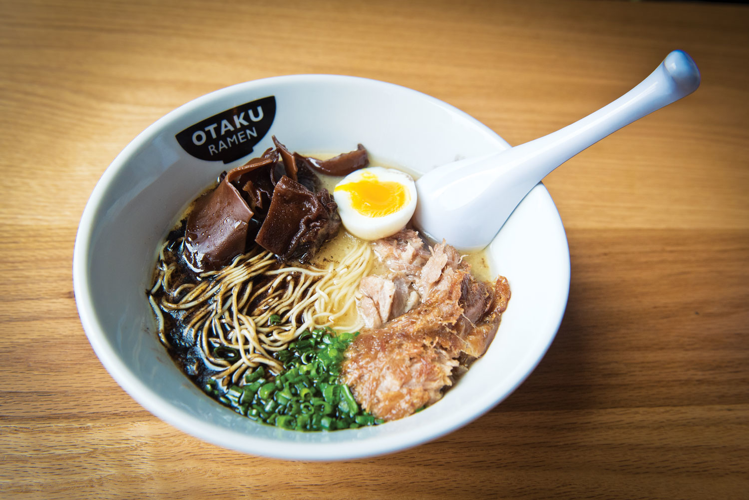
Ramen at Otaku South, which has chosen Resy as its reservations booking app.
Like others, Goldberg says he’d love to look at a competitor to OpenTable if it meant a better guest experience. Resy has recently come into the market — Gavigan’s Little Octopus uses it — and Tock has a nonticketed client in Franklin’s Saffire. Both of them are cheaper than OpenTable, which charges up to $1 per person. That can add up in a hurry.
“We’re a higher [average check] place, so it’s not as bad,” Prasad says about Miel. “But I can’t imagine it in a place where the ticket is $16 or so. There’s no way the numbers work for that.”
Cost is the biggest reason why Gavigan says she switched from OpenTable, and why she might just go back to a paper book. She says they were paying almost $4,000 per month with OpenTable versus $400 with Resy.
“Reservations are more of a guide than a rule for us,” Gavigan says. “We really want people to know that they can come here, and we’ll get them in. Start at the bar, enjoy your evening, and we’ll get you in. Reservations don’t really say that — they say, ‘We have it or we don’t.’ We chose Resy because of the price and because it really lets that message through.”
If Gavigan does ditch online reservations, she’ll have company in chef Margot McCormack, whose East Nashville restaurant Margot has had someone manning the reservation phone since it opened in 2001. McCormack says her place has had a long reputation as requiring reservations just to get in — the influx of new restaurants has relieved that a bit, but saving a slot is still a good idea for the weekends — and as a result, having a human touch creates relationships that bring people back.
“It just sort of flowed into that ideal of what coming to dinner should be for me,” McCormack says. “There’s this personal engagement and connection that happens.”



