
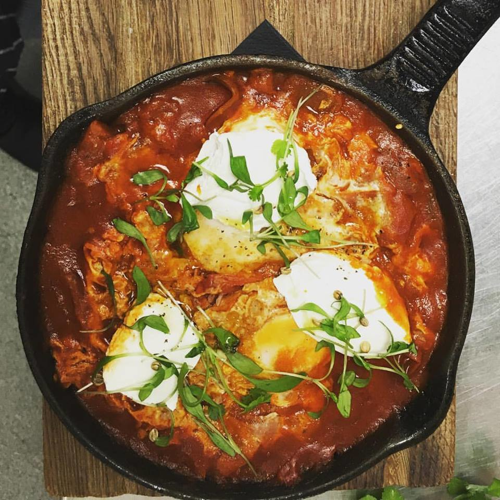
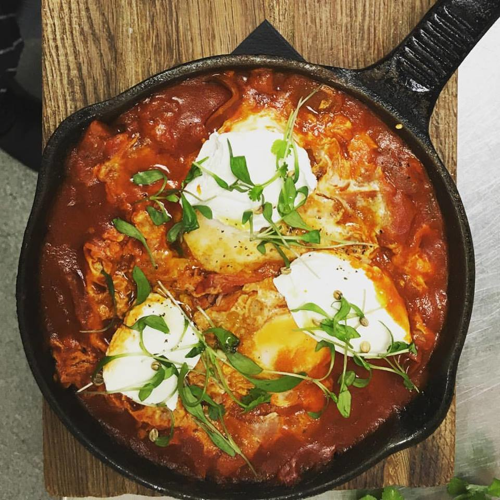


This photo of the shaksuka at Ottolenghi will haunt my breakfast dreams for a long time
We ask you to suspend your disbelief in case you happen to see the fabulous Molly Martin wandering around town before she's done feeding us her stories from her experiences working a stage at Ottolenghi in London. They kept her pretty busy working, and it takes time to craft a journal like this one, which she has been graciously willing to share. Just pretend she's still over there as you read the next installment, even if you spy her working in the kitchen at Salt & Vine. Here is Dispatch No. 3:
It’s been a long time since I had that “first day at a new school” feeling — a jumble of nerves, your identity and accomplishments completely overshadowed by the hopes that someone (anyone!) will like you and just FOR GOD’S SAKE DON’T EMBARRASS YOURSELF.
Well, I did embarrass myself those first few days at the Ottolenghi kitchen. Many times. I poured small amounts of liquid into giant containers. I burned things. I dropped a hotel pan with a calamitous clang that caused literally everyone to stop in their tracks to stare at me. Oh wait, I did that TWICE. I hung up my apron for the day with a deep exhalation of “WTF were you thinking? You know better!” I made the kind of mistakes and miscalculations that happen only to a total rookie, things I would never do on my home turf.
But, as I had to continue to remind myself, that kind of discomfort is what I went there for.
I hate to admit that I was actually, genuinely inspired by one of those inspirational quotes that people always post on Instagram, but it’s the honest truth: “In any given moment, we have two options: to step forward into growth or to step back into safety.” (Abraham Maslow) That quote hit me hard sometime in early 2016, because until I read those words, I hadn’t been able to name the restlessness I was feeling. I’m incredibly fortunate (and have worked incredibly hard) to be at a point in my career where I’ve been "running the show" in some way or another for the last six years or so. I have learned so much in that time, but ultimately, when you’re in a leadership position, it’s no one’s job to keep you inspired or growing creatively. No one will push you but you.
My saving grace, in those awkward early days of my stage at Ottolenghi, was Noor. She greeted me with kindness and only faint exasperation at my presence. You’d think people would be excited to have free labor around, but often it takes twice as long to show someone how to do something as it would to just do it yourself, and they’d rather just get the work done right the first time. Luckily, Noor was patient, funny, and shared my penchant for the F word and the occasional friendly ass grab. We hit it off immediately — my first friend in the new sandbox. Born in Bahrain, trained in the U.S. at the prestigious Culinary Institute of America, she was on a journey much like mine — to recapture what made her fall in love with cooking in the first place, and find her culinary identity. Her palate for the flavors of the Middle East, combined with her knowledge of modern techniques and styles, made her a great asset in my education. The food I’ve been discovering and immersing myself in for the last few years is hers by right of millennia of culture ingrained into her cooking.
Thanks to Noor’s constant reassurance that I was not, in fact, an utter embarrassment, I began to regain my footing and do my best to contribute rather than just absorb. I showed them I was willing to do any job, no matter how small; I helped in the dish pit, chopped buckets of herbs, and told them dirty jokes. Within a few days there was recognition, and increasing warmth. The executive chef, Shalom, was not the authoritarian dictator I braced for. A father of daughters, he put great thought into ensuring I learned all aspects of the operations, that I was treated with respect, and that I always had a hot lunch. Shalom was friendly and self-deprecating, and it took me a minute to realize that although he didn’t micromanage his team, he always knew exactly what was going on, watching and tasting everything going out the door. He cooked by instinct rather than timers and exact measurements, with the kind of muscle memory and intuition that only come from decades on the job. I liked and respected him enormously.
Thinking back to that first nervous day, what struck me immediately was how, well … ordinary the kitchen was. I have long revered the Ottolenghi brand, and I suppose I had pictured some sort of lemon-and-sumac-scented temple of gastronomy, with bay leaf garlands and garlic braids hung haphazardly from the ceiling. What I found instead was an iteration of every kitchen I’d ever been in (though it was, in fact, redolent of lemon and sumac): very cramped but efficient, packed with loud industrial equipment, linoleum floors, and lots of very busy people. I was sheepishly aware of the generosity in simply allowing an extra person to share their space, let alone their knowledge. There’s a shorthand that’s necessary to ensure you don’t collide with someone holding a 10-inch razor-sharp blade, or don't back into a blazing hot sheet pan; throughout the day there is a constant chorus of “Corner!” “On your right!” (or my personal favorite, sounding a little like a chicken clucking) “Backsbacksbacksbacks …”
The kitchen language was almost the only common language in the room. Moroccan dishwashers arguing in Arabic and Spanish; Shalom, a Brit (married to a Brazilian), occasionally interrupting their tiffs in Cockney-tinged Portuguese; two burly guys on the hot line yelling friendly insults at each other in Hungarian; German curses muttered just under breath at the pastry table. There’s a mutual respect engendered by the pressures of kitchen work, much like being in a foxhole; if you can trust the person next to you not to slow you down, any cultural differences become less significant. More often, they become fodder for good-natured and hilarious shit talking, comparable to discussion of college football teams. Your country is not your identity — you are a cook among cooks. You can find a home anywhere in the world.
—MOLLY MARTIN



