
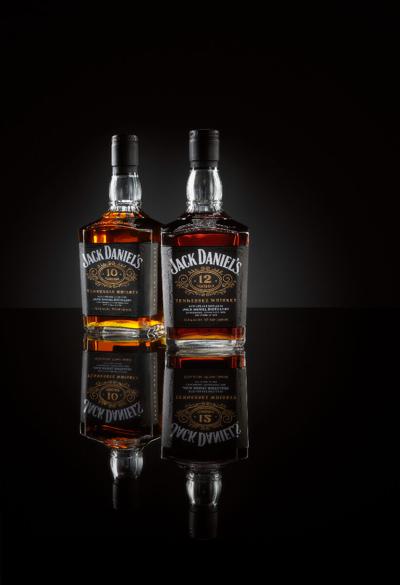


I usually do “Whiskey Wednesdays” around here, but this news is so exciting I couldn’t wait to share. When Jack Daniel’s Distillery released their 10-year-old Tennessee whiskey back in 2021, it was their first product with an age statement in many decades. While they had offered single barrels of older whiskeys through the years, Jack 10-year-old was unique in that it was made by blending a relatively small batch of older barrels that had been intentionally selected years ago and conditioned in special spots in a rickhouse with the specific eye toward creating a new product.
At least, it was unique until now, as they've announced Batch #2 of Jack Daniel’s 10-year-old Tennessee Whiskey along with another release of another product that is two years older. Both of these whiskeys have Jack Black as its DNA, the same mash bill of 80 percent corn, 12 percent malted barley and 8 percent rye distilled in the same way and aged in barrels made by the company’s own cooperage.
Where these two new old whiskeys differ is in how they were selected and handled. Identified early in the aging process, about 300 barrels of each batch were moved to the top floor of the barrelhouse, where the hot Lynchburg summers could drive the flavor from the oak into the whiskey for eight years. After their long, hot oak nap, the barrels were moved back down to the bottom floor for two reasons. First of all, since Jack Daniel’s does not condition their warehouses, the lower floors tend to be cooler, which helps to slow the extraction from the wood and prevent overoaking. Secondly, the cooler lower floors limit evaporation, which helps to preserve more of the precious spirit until it is ready for bottling.
Still, as Jack Daniel’s Master Distiller Chris Fletcher shared on a Zoom tasting session with a small group of spirits writers: “We didn’t get a great yield after all that time.” Both lots of whiskey started out in some of the “honey holes” of the rickhouses that are set aside for barrels that might become eligible for future single barrel selections. Those barrels also spend five to seven years on the top floor before being moved down to avoid developing astringency and becoming too tannic.
The barrels that would become Batch #2 of Jack Daniel’s 10-year-old and 12-year-old were identified early in their lifespan by Fletcher and his team. His grandfather was Frank Bobo, the fifth master distiller at Jack from 1966 until 1988, and he would have approved. Fletcher explains: “My grandfather always said that he didn’t want to have to teach his whiskey to be good! He never added anything to it and always drank it straight out of the bottle.”
When you find barrels that you know will stand out and stand up to extra aging, that’s liquid gold. Batch #2 comes from production during June of 2012, and the distillery was definitely on top of their game that month. “Our inspiration came from wanting to tell the story and the history of the distillery through the bottle,” shares Fletcher.
During the Zoom tasting, Fletcher shared his impressions of each product. He described the nose as having traditional Jack Daniel’s qualities: sweet-forward and fruit notes from their proprietary yeast. Banana is the descriptor most frequently used to describe the fruity character of Jack’s yeast strain, but Fletcher noted that Batch #2 exhibited more of a cooked banana aroma than the usual dried banana. Maybe it was a bit of group-think, but I definitely concurred with his assessment.
The front palate is very reminiscent of Old No. 7, Jack Daniel’s flagship black label, with more dried fruits like apples and bananas. On the midpalate, Fletcher notes that “the oak really jumps, even more than Batch #1.” Through a supreme effort of self-restraint, I still had a little bit of my Batch #1 bottle left over in my personal stash, long after the limited run has disappeared from store shelves. In my comparison, I actually felt like the first edition was a little oakier, but that might be because the fruit notes of Batch #2 were so fresh and bright that they drove my experience.
Bottled at 97 proof instead of Jack Black’s usual 80 proof, Batch #2 had a much longer finish than its younger brother. It featured just a bit of astringency and pleasant tannins before giving way to whiffs of spice, leather and wood.
It’s pretty remarkable how much difference can be imparted in the same recipe simply by where the barrels are stored and for how long. Not many whiskeys can handle more than seven or eight years in oak before the wood begins to overpower the grain, but these two new offerings certainly hold up quite well to the additional aging.
In fact, it was fascinating to taste what happened in the extra two years that Jack Daniel’s 12-year-old spent in barrel compared to Batch #2, which was made with the exact same mash bill and handled in pretty much the exact same way in the rickhouse.
While Batch #2 is all about the fruit, 12-year-old showcases the confectionary notes that are another hallmark of Jack Daniel’s products. Fletcher describes the nose as “molasses, sorghum and butterscotch, pretty outrageous.” I definitely get the Werther’s Originals candy notes in this whiskey, and I like them!
The extra time in oak contributed a lot to the amazing color in the glass, a deep bronze. The 12-year-old was bottled at a robust 107 proof — not quite barrel proof, but certainly high enough to intensify the oaky characteristics of the whiskey. The mouth feel is impressive, creamy and rich, and the butterscotch and molasses definitely drive the initial attack on the palate. The even longer finish gives way to baking spices and cinnamon, exhibiting a tad of tannins, but not enough to be unpleasant.
Another thing I appreciate about the two new releases is that during these inflationary times, Jack Daniel’s is charging the same price for Batch #2 as they did for Batch #1 — an MSRP of $70 per bottle. Even more remarkably, despite the proof premium of 107 vs. 97 and the additional two years of age, the 12-year-old Tennessee whiskey is priced at only $10 more per bottle. Considering how vigorously some collectors chase higher proof and older whiskeys, this represents basically zero upcharge when you consider the difference between ABV and age.
Fletcher explains this philosophy, saying, “I just believe in making great whiskey in a pretty good package offered at a decent price. This is not about creating a collectible. This is for people who enjoy drinking whiskey!”
I’d say he’s definitely succeeded at that with these two new products.



Post a comment as anonymous
Report
Watch this discussion.
(0) comments
Welcome to the discussion.
Log In
Welcome to the discussion.
Keep it clean. Please avoid obscene, vulgar, lewd, racist or otherwise abusive language. Comments featuring hate speech or threatening or violent content will not be tolerated.
PLEASE TURN OFF YOUR CAPS LOCK.
Be truthful. Don't knowingly lie or mislead.
Be proactive. Use the “report” link on any comment that violates our comment policy.
Share with us. We'd love to hear your feedback.