
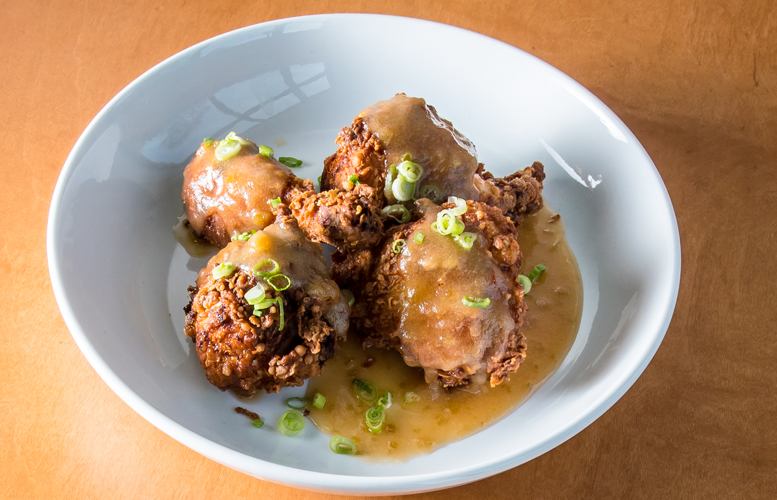

Fried half-chicken with apple and hot mustard sweet-and-sour sauce
As Nashville’s dining scene continues to evolve and improve, it throws into sharper relief the things we still lack. It doesn’t take a newcomer long to notice, for example, that Nashvillians are surprisingly underserved when it comes to Chinese food. Sure, we have quite a few restaurants labeled Chinese, and many people have their favorites in that roster — the sister restaurants Chinatown in Green Hills and Lucky Bamboo on Charlotte Pike are often cited; China Cottage in Madison is popular with folks on that side of town.
And when it comes to festive Chinese events, the Chinese Arts Alliance of Nashville works industriously to line up special dinners, like the popular multi-course Chinese New Year banquet that sells out year after year.
But Nashville continues to lack a single gold-standard Chinese restaurant around which opinion unites, a sort of archetype of sweet-and-sour, a model of moo shu, a beau ideal of bao buns.
Furthermore, it’s not just a lack of authentic Chinese restaurants that leaves us aggrieved. We don’t have much to boast about when it comes to beloved-but-less-authentic Chinese fare — the familiar Chinese-American food that almost every U.S. city came to embrace around the middle of the 20th century. It’s the Cantonese-inspired hybrid cuisine that filled the takeout cartons of millions of childhood memories. Sadly, much of present-day “Chinese” food in Nashville fails to measure up to even that quotidian standard.
Here’s the thing: At some point in Nashville’s history — certainly by the 1990s — the sprawling, super-cheap Chinese buffet became the city’s norm, each one outfitted with groaning boards loaded with everything from greasy orange beef in sticky sauce to dried-up sushi to slices of lukewarm pizza and steel basins of green Jell-O and Cool Whip for the kids. Pre-fab industrial sauces, never freshly made, served to douse the entrées while fulfilling the expedient cost ratio.
And then, the damage to our dining scene was done. About a decade ago, I was talking to an entrepreneur who was planning to open a Japanese restaurant in West Nashville. In the course of conversation he revealed that he was actually of Chinese descent. When I asked why he wasn’t using his expertise to give Nashville the Chinese restaurant we so desperately craved, his reply was simple: “The concept of Chinese food has become degraded in Nashville.” In a businessman’s eyes, our sensibilities had become so blunted (and fixated upon low price and massive quantity), that it didn’t make sense to take the risk to try offer us better-quality Chinese cuisine.
But as the current Nashville restaurant scene booms, our long Chinese-food drought has been noticed, and a few businesses are taking up the challenge. Celebrated chef Maneet Chauhan has two new restaurants opening in the next few months; one is a “modern diner,” The Mockingbird, and the other, we are told, is Tànsuŏ, “an exploration of contemporary Chinese cuisine reminiscent of China’s night markets and traditional street fare.” Meanwhile, another entrepreneur, Alex Wong, and his team have launched Angelhouse Family Dinners, pop-up events offering “Chinese comfort food” (most notably Peking duck) — and they are regularly selling out the house.

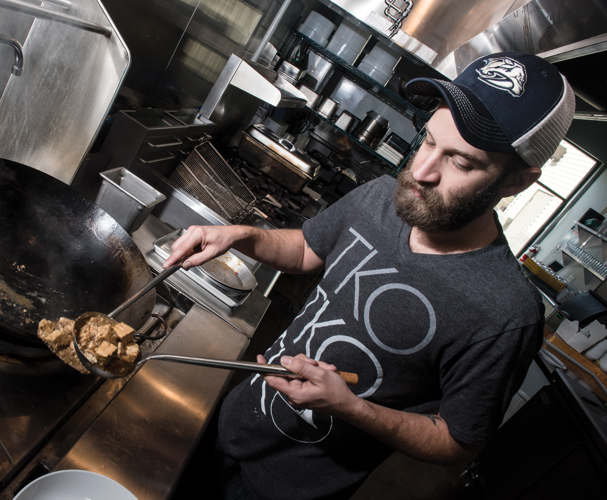
TKO chef-owner Ryan Bernhardt in 2016
But perhaps the most promising addition is a new little East Nashville spot, TKO, from a husband-and-wife team of well-credentialed restaurant veterans: Ryan Bernhardt, former chef de cuisine at Margot Café, and Anne Thessin Bernhardt, current general manager at City House. (She’s keeping her day job, a wise move in the risky world of new restaurants, where even a splashy success may not pay off financially for months.)
Talking with the Scene, Chef Ryan calls the food “Southern-inspired Chinese,” the notion of using Southern products along with Chinese preparation methods. The touchstones are from the aforementioned Cantonese-style Chinese-American cuisine. While creating the concept, the chef spent time back in his hometown of Evansville, Ind., talking with the owners of Shing Lee, a 45-year-old Chinese restaurant with a passionate following.
Based on their research and inspiration, the Bernhardts hope to deliver “the flavors of Chinese food from childhood, but better, grown-up.” Better how? They aim to make the food “a little cleaner, lighter, not so gummy with cornstarch.”
TKO opened in October at 4204 Gallatin Pike, on the northern side of Inglewood. It’s too early for a true review, but every aspect is intriguing.
The kitchen is wide open, with a line of bar seats viewing the action and the starring equipment, what Ryan calls “old-style Cantonese wok stoves, which create a specific flavor that only exists in this kind of food.” The apparatus has two wok chambers, each with a 22-inch wok skillet over a giant burner that is equivalent to three standard French burners. The heat is so intense that the stoves face a steel backsplash that is constantly bathed by rivulets of water.
“We’re clean cooks, so I want people to see what we’re doing,” Ryan says.

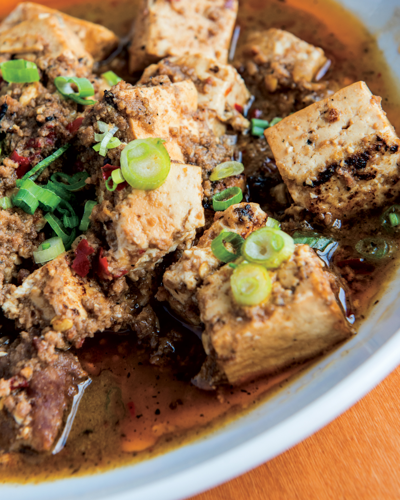
Lamb Mapo Tofu
As for the menu, the Bernhardts aim to encourage sharing of dishes, with a roster of around seven appetizers and six larger plates, modest-but-sharable in size, with nothing priced above $19. They also offer a “mystery dinner” for two for $50, with three appetizers, a meat or protein, and a rice or noodle dish; some items may be on the menu, or they may be something more experimental.
In an interesting twist, the Bernhardts have designated TKO as a gratuity-free restaurant. Instead of expecting tips, they say they pay the staff a reasonable regular wage that’s budgeted into the cost of the meal. That way if there’s a slow day with few tips, the servers don’t suffer. They also hope the system will help keep staff from departing in a very competitive restaurant climate.
One of the stars of the menu is the fried half-chicken with TKO’s version of sweet-and-sour sauce. Half of a local Springer Mountain Farm chicken is broken down into four pieces (leg, thigh and two chunks of breast) that are small enough to fry, having been dipped in buttermilk and coated with sesame flour. The sweet-and-sour sauce is cooked up with apples, vinegar and sugar, and the mixture is then pureed, generating the pectin that helps the sauce stick to the chicken. The sauce is finished with hot Chinese mustard powder, for an impressive balance of flavors. Other dishes include mapo tofu with lamb from Virginia’s Border Springs farm; silver carp, delicately steamed; and house-made lo-mein noodles with shiitake and oyster mushrooms.
As for the beverages, there’s beer (only high-gravity to start, but a full beer license is coming soon), a “small curated wine list, appropriate for food,” and fun cocktails, in a nod to old-school Cantonese joints.
TKO, the name, alludes to takeout, which the Bernhardts originally expected would be the core of their business, until they wound up securing a full 30-seat restaurant space. Anne says they still hope for tons of takeout customers, and never plan to offer delivery — they want to meet their customers, their neighbors, and chat and offer them a drink. (To that end, the menu includes half cocktails, just enough to sip while watching your dinner get prepared on the sizzling wok.)
Regarding the open kitchen, Ryan says with a laugh, “I love to do this, that chefs don’t have to be behind a wall screaming at each other.”
He adds, “Food is the center of family, that’s where it started, and that’s where it’s coming to.” That’s why restaurants are so important — especially the comforting kind, like the Chinese food spots we remember from childhood. It’s a chance not just to interact with your companions, but to meet the dedicated people who make your dinner for you. “That extended family you don’t have anymore,” he says, “you can build.”



