


We’ve written about Chattanooga Whiskey Co. several times here at Bites, usually in the context of their former flagship product, 1816. Like many other young spirits companies, Chattanooga Whiskey sourced aged product manufactured elsewhere to release under its name and used that to maintain cash flow and develop a reputation while they ramped up production on their own products. Chattanooga Whiskey Co. did a really good job of that by selecting some fine spirits and selling them at prices that didn’t charge too high of a premium for sourced juice.
More exciting were the experiments going on in the small distillery near the Chattanooga Choo Choo. Under the leadership of CEO and founder Tim Piersant and distiller Grant McCracken, the company released literally a hundred different small-batch recipes as part of a process of determining the company’s unique style. McCracken comes from a beer brewing background having worked at Boston Beer Co., so he already had a predilection for working with malted barley as a preferred ingredient. This led to some fantastic whiskeys that technically still qualify as bourbons thanks to the use of 50%-plus corn in their mash bill, but with a much higher malt content than most traditional bourbons.
All the while, Chattanooga Whiskey Co. was constructing a much larger production distillery in downtown Chattanooga where the team could produce enough whiskey to eventually end the need for purchased product. And the time has finally come to break free. Despite already earning market share with the 1816 product, Chattanooga Whiskey Co. has decided to go all-in with a new series of whiskeys it's releasing under the trademarked brand of “Tennessee High Malt.”
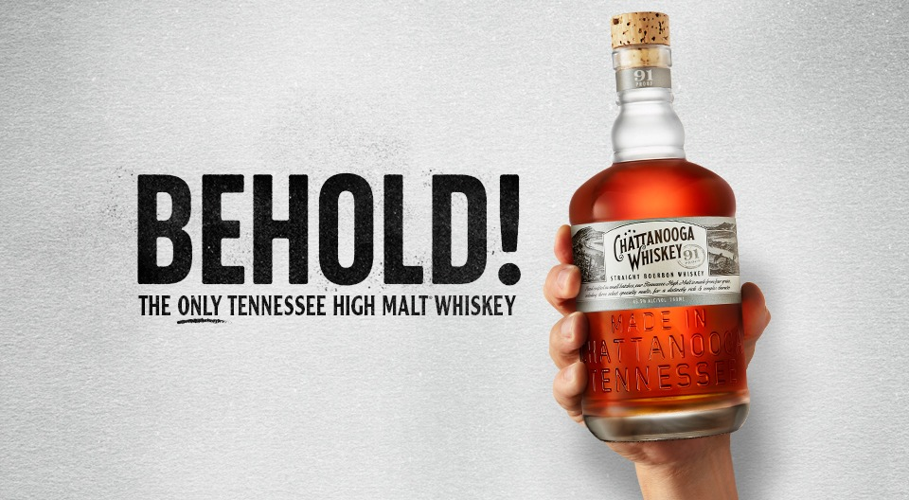
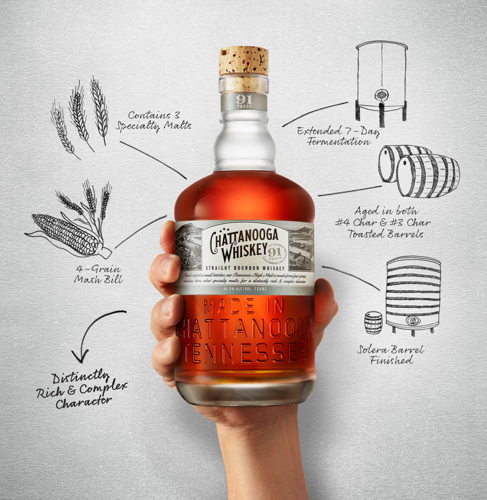
The new expressions are named Chattanooga Whiskey 91 and Chattanooga Whiskey CASK 111, created using a special using a four-grain mash bill, including three specialty malts; rye malt, caramel malt and honey malt. Although the new products still qualify as bourbon, the high barley content differentiates their products by drawing attention to the unique complexity of malt. If you’re thinking of Scotch, don’t. These malted barleys are not smoked with peat like their European cousins, so they don’t exhibit the same smoky character as Glenwhatever.
Instead, Chattanooga Whiskey 91 and 111 exhibit lovely fruity flavors like apricot and orange along with notes of sweet tea and buttered toast. Each batch is run through a solera system, a large tank where new make mingles with previous batches to blend their flavors and offer more character. That means there should still be at least a few molecules of the old 1816 in every bottle if that’s important to you.
Chattanooga Whiskey 91 gets its name from the fact that it was the 91st experimental batch that Piersant and McCracken distilled in their quest for perfection. They had many friends and experts sample the product, and it was almost universally picked as the favorite. In recognition of the batch number, the product is bottled at 91 proof, with the 111 logically at 55% alcohol. These higher-proof spirits are intelligent choices because the 91 is more assertive as a cocktail ingredient, and the 111 dips into the lower end of cask-strength whiskeys that are popular with collectors and bourbon fans who like to drink it straight.
Retailing in the $35 range for 91 proof and $45 for 111, the included proof premium puts Chattanooga Whiskey’s new releases in line with other favorites like Woodford Reserve and Knob Creek, and are certainly worth a try at that price. For a small batch whiskey that is carving out its own space in the crowded whiskey market, these guys are really putting out some interesting stuff! Try some out and let us know what you think in the comments below.



Post a comment as anonymous
Report
Watch this discussion.
(0) comments
Welcome to the discussion.
Log In
Welcome to the discussion.
Keep it clean. Please avoid obscene, vulgar, lewd, racist or otherwise abusive language. Comments featuring hate speech or threatening or violent content will not be tolerated.
PLEASE TURN OFF YOUR CAPS LOCK.
Be truthful. Don't knowingly lie or mislead.
Be proactive. Use the “report” link on any comment that violates our comment policy.
Share with us. We'd love to hear your feedback.