

The Belcourt is currently in the middle of its
“Classic Capra”film series, playing several films directed by late, revered filmmaker Frank Capra. For the past week, the theater has been playing a 35mm print of that holiday favorite It’s a Wonderful Life, and beginning this Friday, five Capra films — It Happened One Night, Lost Horizon, Mr. Deeds Goes to Town, Mr. Smith Goes to Washington and You Can’t Take It with You — will be digitally projected.
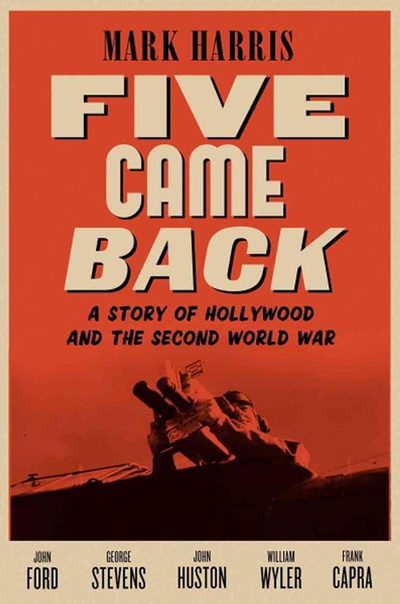
All five films will be screened in an all-day marathon on Friday. For some background on Capra before that binge-watching challenge, the Scene talked to entertainment reporter Mark Harris, who wrote the fascinating book Five Came Back: A Story of Hollywood and the Second World War, about Capra, his movies and how his filmmaking came in handy during World War II.
What do you think about The Belcourt getting its Capra on this holiday season?
I think it's a great idea. It's funny to me that people think of Capra now as a holiday-season filmmaker; that's really because of It's a Wonderful Life, but it only became a Christmas perennial decades after he made it. When the movie first came out, it was such a financial failure that it sank Liberty, the independent company that Capra started with William Wyler and George Stevens right after the end of the war.
Any personal Capra favorites people should flock to the theater to see? Are there any Capra films people should see that aren't being screened?
Of the films that are being screened, my favorite might be the earliest one, It Happened One Night, with Clark Gable and Claudette Colbert. It's Capra at his loosest and most relaxed, before he started to think that his movies needed to make statements in order to be important. And it's sexy, which is not a word a lot of people associate with Capra movies. For people who are interested in seeing more Capra movies, he made a lot of films before the ones in this series. It's interesting to see something like The Bitter Tea of General Yen, which he made before he was a household name.
You wrote about Capra and his involvement in World War II extensively in Five Came Back. How much of Capra did you know coming in, and what did you get the most from him after you finished the book?
I had seen Capra's most famous movies — the ones in this festival. And I knew that he had made the Why We Fight series, which I hadn't seen. I had only a vague sense of what his World War II service had been before I started to research it — and I knew that although he lived until 1991, he made almost nothing of note after It's a Wonderful Life in 1946. I wondered why that was, and whether it had to do with how the war changed him, and researching him was an attempt to answer those questions for myself.
I think what I got from researching him that I didn't expect to get was how surprisingly at home Capra was in the war. Before World War II, he had been politically confused in many ways: He was, as his mood dictated, a populist, a Mussolini admirer, and an anti-Roosevelt, anti-union conservative Republican. And the war, in some ways, temporarily cleared his head: It was suddenly very clear to him who the good guys and bad guys were, and he turned out to be very well-suited to make that case in the wartime documentaries he produced and supervised.
While reading the book I got the sense that Capra went into the war mainly because, being an Italian immigrant, he felt he wanted to prove his patriotism the most. Is that a good assessment of who he was during the war?
I think that was absolutely a big motivating factor for him. Capra's family had brought him to the U.S. when he was a very small boy, but culturally, he was in many ways still treated like a foreigner. Even after he became famous, one magazine profile compared him to an Italian fruit vendor. And the fact that his country of origin was allied with Hitler made it even more imperative for him to prove his patriotism. But he also felt a genuine sense of duty and mission, and believed deeply in the power of movies to evangelize for the cause.
What were the most intriguing (or even Capra-esque) things you found about the Why We Fight films?
One thing I didn't know about the Why We Fight films when I started researching Five Came Back is that they were made for almost no money; the War Department had the will to bring filmmakers to Washington for the war effort, but not the budget to give them free run. A lot of the most innovative ideas in the movies, like the use of foreign propaganda footage to explain to American soldiers who the enemy was, were Capra's resourceful respond to not having enough money to shoot anything. As for how they were Capra-esque, they were certainly idealistic. The movies made the men who watched them feel that the entire notion of a free world was in their hands. Capra wasn't embarrassed about trying to inflame them, which is probably why the movies were so effective.
Capra's career mostly waned after World War II and It's a Wonderful Life, with people citing his films for being too idealistic for postwar audiences. Do you think Capra's filmmaking was too rosy, or do you think he's gotten a bad rap?
I suppose I have mixed feelings about Capra's work overall, although there's not a movie in this festival that isn't worth seeing. There's no question that right after the war, Capra's filmmaking was too rosy for the tastes of the moment. Other filmmakers, including his colleague William Wyler, came back from the war determined to bring more realism to their movies, which was clearly what the public wanted; Capra, on the other hand, saw the war as an interruption and couldn't really take in the ways in which the world had changed. I don't know if he got a bad rap or not; he was in tune with public taste in the 1930s and out of step with it after the war, but the movies have survived.
He formed Liberty Films with George Stevens and William Wyler, the first independent company of filmmakers since United Artists. Do you think Capra doesn't get any props for his indie sensibility and wanting to work outside the studio system?
The very sad part of his story to me is that we'll never know what kind of indie sensibility he might have developed. Capra, Stevens, and Wyler were each to have made three films for Liberty; It's a Wonderful Life was the first; then the company fell apart and the others were never made. Capra was generous to and about other directors, and I wonder if, as time went on, he might have been emboldened by what other filmmakers were doing to challenge his own approach to material more than he did. But his sense of injury and rejection was so profound that he kind of dug in his heels and became even more sentimental after It's a Wonderful Life. He wanted to be independent after the war—but for him, independence was more about economic self-determination and freedom from studio input than it was about pursuing more challenging material.
What do you think is Frank Capra's legacy, and what should people know about Frank Capra after seeing these movies?
Okay, Craig, you've stumped me with this last one! I never know what to say to that except "He was a man. Take him for all in all," which Shakespeare already used. I think the movies he made are a really direct expression of his sensibility, for better and sometimes for worse. His legacy is, I guess, that we're still watching and arguing about them.