

Untitled, From the Series Erotic Topology, Zilia Sánchez.
.
Among the very best works in the Frist Art Museum’s extraordinary exhibit On the Horizon: Contemporary Cuban Art From the Pérez Art Museum Miami are two works from Zilia Sánchez, a Havana native who will turn 96 this summer.
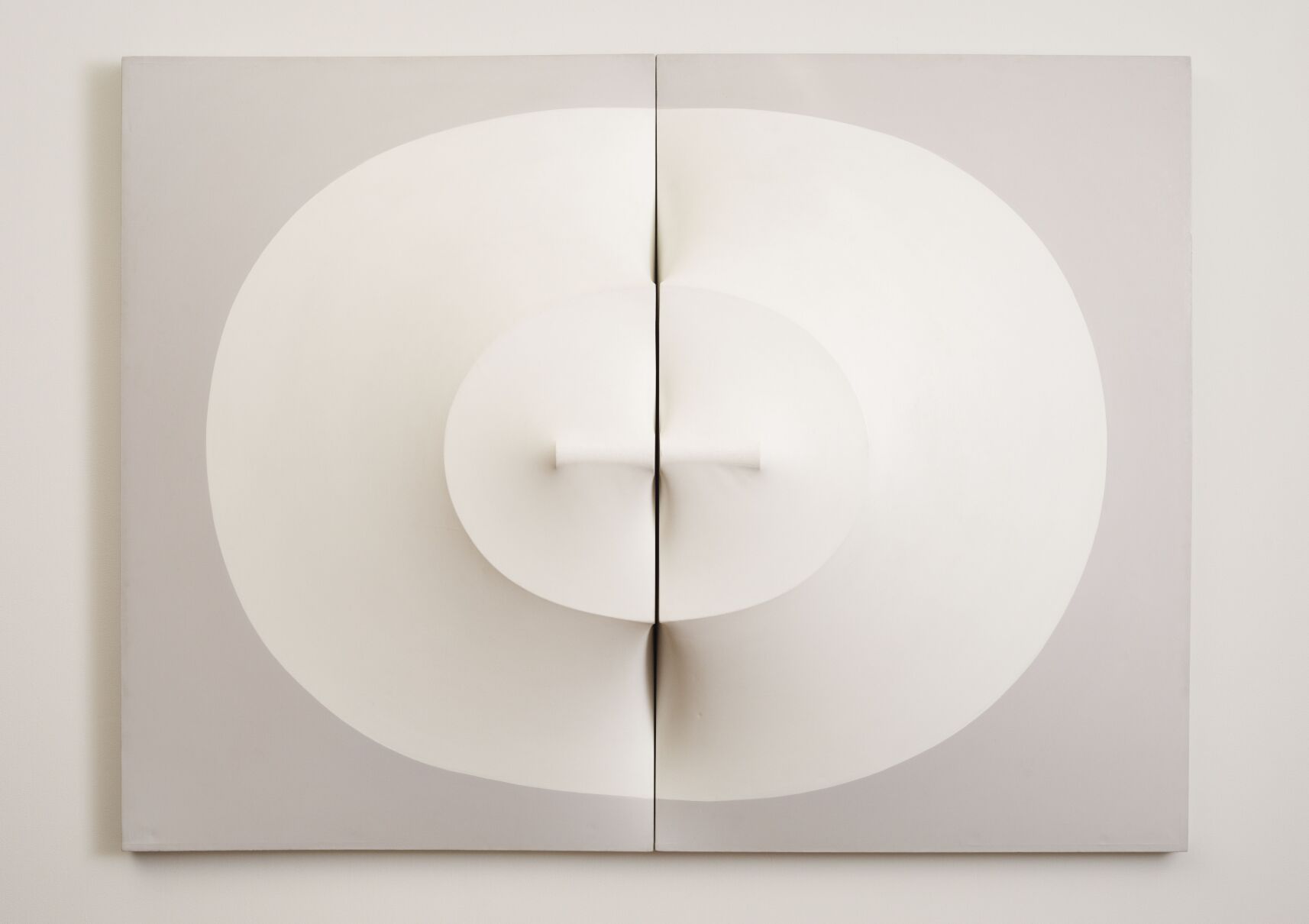
Both of the works are untitled — one is from 1970 and the other from 1971. The 1971 piece is from Sánchez’s Erotic Topologies series, and is installed to be the first piece you see as you enter the room. Because of its monochromatic palette, the artwork at first seems like an optical illusion — the shadows are subtle and gradient, and its minimal color pattern mimics a flat Agnes Martin canvas. But as you walk around the work, you become aware that the canvas is three-dimensional, and that instead of being confined to the wall, it stretches to occupy the space you share in the gallery. Its playful nature, along with the way it urges the viewer to observe the canvas from all sides, feels flirtatious — here’s where I notice you, here’s where I see the shape of your curve. Even the artwork’s placard is poetically suggestive: “A soft oval shape bulging out from the middle suggests both a woman’s erogenous zone and the topography of a volcano.”

Untitled, Zilia Sánchez.
.
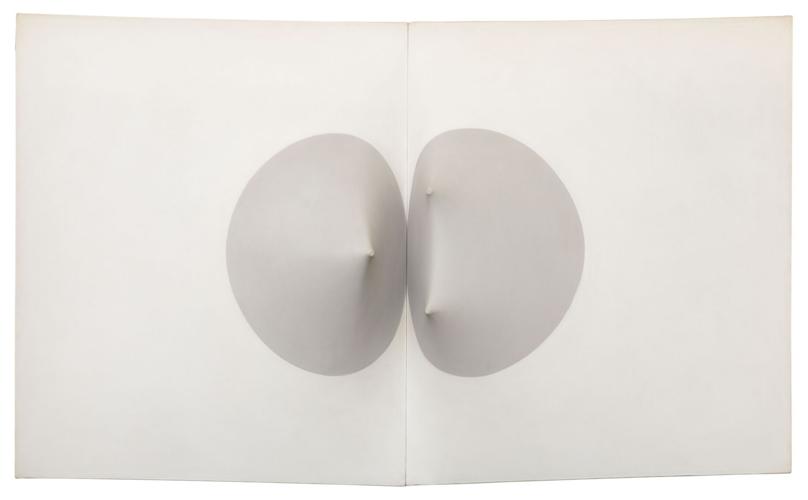
The earlier work from Sánchez isn’t listed as part of the Erotic Topologies series, but it seems just as evocative of a body’s curves. This one is somehow even more organic, almost unnervingly so — I’m reminded of the scene in A Nightmare on Elm Street when Freddy Krueger pushes his face through a rubbery wall. It’s also reminiscent of a pair of cartoon speech bubbles fighting for an audience. There’s an invisible struggle happening somewhere inside the stretched canvas, even as its graceful, ethereal composition conceals it. It’s a skin of paint that’s thickening in a can, and it’s the surface of water just before a body emerges.
Sánchez made the works by stretching her canvas over wooden armatures and painting them with a blend of water-based paints and varnish or powdered pigment. I would love to know what those forms actually are — at times the similarities to a vacuum-formed car dashboard made me consider whether the armatures could be something familiar, like a shovel’s handle or a wooden spoon.
A tension between what’s expected and what’s possible charges the entire exhibition, but Sánchez’s works are particularly forceful examples of that duality. She has said the origin of these sculptural works was an idea that came to her when her father died several years before — a sheet from her father’s bed had been hung out to dry, and she saw it flapping in the wind against a pipe or a tube, and was struck by the haunting quality of the fabric. So Sánchez’s untitled canvases, which came from grief and are informed by eroticism, are also shrouds for a beloved father — a marker for his absence. The array of personal, physical associations that such deceptively simple works create is rare, and rewards special attention.

Post a comment as anonymous
Report
Watch this discussion.
(0) comments
Welcome to the discussion.
Log In
Welcome to the discussion.
Keep it clean. Please avoid obscene, vulgar, lewd, racist or otherwise abusive language. Comments featuring hate speech or threatening or violent content will not be tolerated.
PLEASE TURN OFF YOUR CAPS LOCK.
Be truthful. Don't knowingly lie or mislead.
Be proactive. Use the “report” link on any comment that violates our comment policy.
Share with us. We'd love to hear your feedback.