
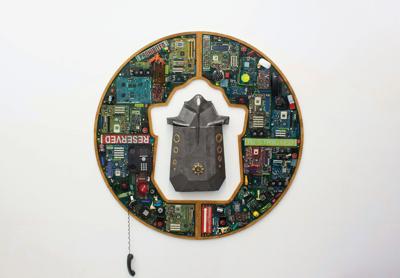


“Dehyie,“ Vincent Frimpong
Wedgewood-Houston
Nowadays, I’m constantly writing about how art is trending away from figures and representation and toward abstraction and formalism. Wit h these changes, narrative and content-heavy works are naturally receding while art about art is ascendant. That said, even at the height of American abstract expressionism in the mid-20th century, there were artists like those involved in the Bay Area Figurative Movement who never abandoned the human form. And some artists — like Shepard Fairey, for instance — spend their entire careers falling in and out of fashion as they dedicate their practice to social messaging or political narratives.
John Salvest’s latest show at David Lusk Gallery is a great example of how art can be formally compelling while also packing lots of punchy commentary about the world around us. Material Evidence is an exhibition of sculptures made from collections of found materials. Salvest uses paperback books, medicine tablets, coins, business cards and wooden walking canes to create painterly wall sculptures and freestanding works brimming with poignant insights and punning humor. There’s an inherent delight in seeing mundane detritus like colored yardsticks transformed into objects of real beauty, and sculptures like “Peace, Officer” — a peace-sign design formed on a wall by vintage wooden police batons — serve as sly reminders that when it comes to making art about social issues, a little irony can really help the medicine go down. Salvest is based in Arkansas, but he will be at Saturday’s opening, and will give a gallery talk at 5 p.m. Opening reception 4-7 p.m. Saturday at David Lusk Gallery, 516 Hagan St.
In March, Coop takes a break from its Volunteer State-focused Ten in Tenn series to host Logged In, an exhibition of work from Alabama-based Ghanaian artist Vincent Frimpong. Frimpong was born in Accra, the capital city of Ghana in West Africa, but he earned an MFA at the University of Arkansas, and his ceramics practice is currently based in Talladega, Ala., where the artist is an assistant professor at Talladega College. I don’t usually include a whole lot of biographical information in this column, but when it comes to Frimpong and his colorful, ambitious works, the theme of being a person traveling between two different realities is ever-present. Frimpong’s works are exquisitely technical, vibrant and unique. He covers a wide range — from wall sculptures featuring abstract designs to installations featuring small figures. Some of my favorites read more like tapestries or blankets — unexpected forms that surprise and delight in a show of ceramic works. The exhibition features lots of surfaces covered in intricate designs that speak to computer networks and digital circuits, as well as African textile designs. These works are satisfying for their striking colors and unique use of materials alone. And the narratives they carry — about being one person split between two worlds and transformed by them both — provide plenty of conceptual depth for deep-diving gallerygoers. Opening reception 1-9 p.m. Saturday at Coop, 507 Hagan St.
Get ready for a painterly close to the winter art season at Julia Martin Gallery, featuring a solo exhibition by Nashville’s own Emily Holt. Originally from Memphis, Holt has been a staple in the local art scene since 2003. When she’s not inspiring young minds as a high school art teacher at University School of Nashville, Holt is busy creating multimedia works that speak to Nashville’s ever-changing — and endlessly expanding — skyline. Recently, Holt has turned her attention to creating intricate architectural assemblages using materials salvaged from Nashville’s demolition sites. Holt collaborated with painter Peggy Snow for the What Happened Here? exhibition at Julia Martin Gallery, earning one of my Best of Nashville notices in 2022. This time around, the artist is shifting gears and showcasing large-scale multimedia paintings in a new solo show, Lossless Found. Holt’s latest body of work consists of expansive, unstretched bits of found paper, wire, fabric, paint and canvas that hang like tapestries in layered designs. All the colorful shapes and forms are glued and sewn on top of one another. The chromatic, abstract surfaces feature cutaways, revealing successive layers and creating a striking illusion of depth. These almost-sculptural works transform the act of contemplating a flat, square canvas into a dynamic and immersive experience. Holt’s cutaway sections and layers breathe new life into the traditional picture plane, challenging the conventions of midcentury abstraction that her exhibition calls to mind. Opening reception 6-9 p.m. Saturday at Julia Martin Gallery, 444 Humphreys St.
Terra Magia is a collaborative exhibition between artists J. Alex Schechter and Sean M. Starowitz that’s occupying the Neue Welt gallery at The Packing Plant this March. Schechter is a sculptor who also has a degree in religious studies. Starowitz is also a sculptor, and his CV is brimming with community-based social-practice projects informed by the artist’s passion for archival research. When you put them together, you get the notion of the “Magic Land” where this curious pair questions how the relentless pursuit of technological advancement has warped humanity’s natural worldview. With the loss of magic, ritual, meaning-making myths and society-sustaining stories, how far can electric motors, magnetic levitation and Falcon Heavys really take us? Schechter and Starowitz have me expecting gods and monsters — mystic warriors and horned beasts ensconced in endless mazes. Opening reception 5-9 p.m. Saturday at Neue Welt, 507 Hagan St.


Post a comment as anonymous
Report
Watch this discussion.
(0) comments
Welcome to the discussion.
Log In
Welcome to the discussion.
Keep it clean. Please avoid obscene, vulgar, lewd, racist or otherwise abusive language. Comments featuring hate speech or threatening or violent content will not be tolerated.
PLEASE TURN OFF YOUR CAPS LOCK.
Be truthful. Don't knowingly lie or mislead.
Be proactive. Use the “report” link on any comment that violates our comment policy.
Share with us. We'd love to hear your feedback.